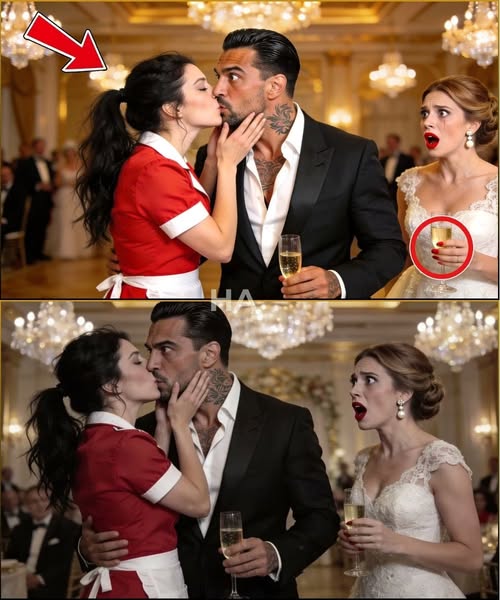
It didn’t work.
The tremor ran up her forearms, as if her body was trying to purge what her mind hadn’t caught up to yet.
Then the door opened again.
Griffin Hales walked in alone.
He closed the door behind him. Turned the lock. The click echoed like a muted gunshot.
He did not sit right away. He stood there and looked at her, and for the first time Fay saw his face without crowds and champagne and performance.
He looked… real.
Quiet. Controlled.
Dangerously attentive.
“Why?” he asked.
One word that held everything: why she did it, why she risked death, why a waitress no one knew chose the most reckless way possible to warn a man she owed nothing.
Fay swallowed. Her throat was dry.
“I didn’t do it for you,” she said.
Griffin didn’t react. He waited.
“I did it for me,” she continued, voice tightening. “I couldn’t live with knowing and doing nothing. I’ve tried living like that. It eats you from the inside.”
He pulled out a chair and sat across from her, every movement deliberate, as if he didn’t waste even a gesture.
“You were afraid before you walked toward me,” he said. “That wasn’t fear of me.”
Fay didn’t answer.
“You’ve lived with fear a long time,” he continued, voice quieter but precise. “That kind of fear doesn’t come from one night.”
His eyes did not blink.
“Who?”
The gentleness in that word cracked her.
Fay looked down at her hands, fingers laced so tightly her knuckles were bone-white.
She drew a slow breath like someone preparing to dive into deep water without knowing when she’d surface.
“Travis Buckley,” she said.
The name left her mouth like a shard of glass.
Her ex-boyfriend.
The first man who ever made her feel like she mattered after her mother died. The first man who gave her attention like sunlight.
And then turned that sunlight into a cage.
She told Griffin in layers. Not clean chronology, but the order pain demanded: the thinnest layers first, then deeper.
Travis checked her phone jokingly at first. Then seriously. Then as a rule.
He cut her off from friends one by one, not by forbidding it outright, but by making her feel guilty until she stopped trying.
He decided what she wore. Where she went. Who she smiled at.
And by the time the violence began, the trap was already built. Walls made of isolation and dependence.
“The first time he hit me,” Fay said, voice flattening like frozen water, “he cried harder than I did. Swore it would never happen again.”
“How many times?” Griffin asked quietly, something hardening in his eyes like steel pulled from heat.
“Enough that I stopped counting.”
She told him she ran.
The first time Travis found her in two weeks.
The second time in ten days.
The third time, he was already waiting where she planned to go, smiling like it was normal to know her thoughts before she did.
She went to police. They told her to change her number, move, file paperwork, as if fear could be packed into a suitcase and left behind.
So she disappeared.
Cleveland. Indianapolis. Milwaukee. Chicago.
Different names where real paperwork wasn’t required. Cash jobs. Event work. A life made of escape routes and shallow sleep.
“And the thing I’m most afraid of,” Fay whispered, voice thinning, “isn’t him finding me. It’s him finding my sister.”
“Piper,” she added. “She’s twenty-one. In college. She doesn’t know any of this. I hid it so she could be normal.”
Griffin was silent for a long time.
Then he said, calm as a verdict, “You saved my life.”
Fay shook her head reflexively. “I didn’t ask for—”
“You don’t have to ask,” Griffin cut in, voice quiet but absolute. “From now on, you’re under my protection.”
Protection.
Fay had heard that word from Travis once, too.
But Travis’s protection had been a leash.
Griffin’s protection felt like a wall built outward, not inward.
He stood. Opened the door. Looked at her like a choice, not an order.
Fay’s legs still shook, but they moved.
Griffin’s estate was not a home. It was a fortress pretending to be minimalism.
High walls. Cameras. Gates that opened before the car slowed, as if the property itself breathed on command. Guards everywhere, eyes sweeping constantly.
Inside, everything was clean and cold and precise, like a show home no one truly lived in.
Yet Griffin handed Fay a glass of water himself.
A small detail.
She drank like someone resurfacing from drowning.
He gestured toward a sofa.
“Sit.”
Not the metal chair under interrogation light. Not the cold table.
A soft place, with windows, with warm light, with room to breathe.
Fay sat, clutching the empty glass, while Griffin sat across from her, watching in silence.
“Keep going,” he said.
So she did.
She told him about the years of existing instead of living, about sleeping with shoes by the bed in case she had to run, about learning to become invisible.
Then Griffin’s phone vibrated.
He read a message. His face barely changed, but Fay saw a brief tightening of his jaw.
He turned the screen toward her.
“I know who that girl is. Are you sure you want to play this game?”
Celeste.
The air in the room cooled, like a door had opened to winter.
“She’s panicking,” Griffin said evenly.
Fay didn’t believe that. She had heard Celeste discuss murder like dinner plans. She had seen her silent at the venue gate, calm enough to calculate.
Celeste didn’t panic.
She planned.
Griffin looked at Fay. “Your sister. Where is she?”
“Michigan,” Fay answered carefully. “Ann Arbor.”
“I’ll have someone keep an eye on her.”
“You don’t have to—”
“I do.”
Two words heavier than any promise he’d made so far.
He stood. “Guest room at the end of the hall. Clothes will be brought. You need rest.”
At the door, he paused.
“From now on, you don’t leave this house without someone with you.”
Then he left, and Fay sat alone holding an empty crystal glass, realizing safety could feel unfamiliar, like wearing a shirt that didn’t fit.
At dawn, Griffin knocked softly and stepped into her room without the suit.
Black shirt. Sleeves rolled. Tattoos along his forearms, not decorative, but like history written in ink.
He looked tired. Human.
“There’s new information,” he said. “Celeste wasn’t acting alone.”
Fay didn’t pretend surprise.
“Malcolm Voss,” Griffin continued. “South side. My rival for ten years. He waits. He strikes only when he’s certain.”
Celeste had promised Malcolm her new widowhood like it was a business merger: Griffin dead, territory split, money in her name, Malcolm taking what he wanted without firing a shot.
“Now they know they’ve been exposed,” Griffin said. “They’ll need leverage.”
His gaze found Fay.
She understood.
She was leverage. Not because she was important in their world, but because she was vulnerable in any world.
Griffin spoke again, slower, softer, as if choosing words carefully.
“I can get you out tonight. New papers. New name. Somewhere safe.”
Fay felt the offer hit her chest like a wave. Real escape. Not hiding, but vanishing.
Then she remembered every time she ran and still got found.
“No,” she said.
Griffin’s eyes narrowed slightly. “You don’t understand what being near me means.”
“It means danger,” Fay answered. “But at least it’s honest danger. You don’t pretend.”
Griffin studied her a long moment, then nodded, a heavy acknowledgement.
He left.
Fay stared at the photo in her wallet of Piper smiling at graduation and whispered, “I’ll keep you safe.”
The next day, the estate changed. Cars. Footsteps. Low urgent voices behind closed doors.
When Griffin finally sat across from Fay again, he said, “Worse than I thought. Celeste promised my territory to others. Now it’s not one enemy. It’s many.”
Leverage.
Then he hesitated.
A rare thing on his face.
“There is a way to protect you completely,” he said. “Not guards. Not papers. A way no one dares touch you.”
Fay felt the answer before he spoke it.
“Marriage,” she whispered.
Griffin didn’t deny it.
“I’m not asking for love,” he said. “I’m offering safety. In my world, Griffin Hales’s wife is untouchable.”
Fay laughed once, short and exhausted. “That’s worse.”
Griffin tilted his head. “Why?”
“Because if you asked for love, I could refuse easily. You’re offering safety. Safety is something I’ve never been brave enough to refuse.”
She paced, unable to sit still.
“This morning you offered to help me disappear,” she said. “Now you want me to bind my life to you.”
“Not an entire life,” Griffin replied. “A contract. With an end date. When the threat ends, the contract ends.”
“And then what?”
“You walk away,” Griffin said. “Clean papers. Enough money. Your life becomes yours again.”
“And you?” Fay asked before she could stop herself.
“Not relevant,” Griffin answered.
The words stung in a place she didn’t want to examine.
Fay forced herself to breathe and spoke like she was writing her own survival.
“My conditions.”
Griffin listened.
“You don’t touch me unless I allow it. Never. No exceptions.”
“Agreed.”
“No control. No reading my messages. No tracking me without my knowledge.”
“Agreed.”
“And when the contract ends, you let me go.”
“Agreed.”
No hesitation. No bargaining.
Fay stared at him, searching for the slippery charm Travis used to hide hooks.
Griffin offered none.
“Give me the contract,” she said.
He retrieved a thin stack of papers, already prepared, clauses concise, her terms written in black ink like someone who had anticipated her boundaries and respected them before hearing them aloud.
Fay read every line.
Then she signed.
Griffin signed beneath, handwriting sharp as decision.
He placed a small box in her palm.
Inside, a simple ring with one bright stone. Not a trophy. Not loud. Almost humble, which somehow made it heavier.
“This isn’t a promise,” Griffin said quietly. “It’s a shield.”
Fay closed her fingers around the ring.
“I’ve never had a shield,” she whispered.
“Now you do.”
Three days later, Griffin told her to dress well.
He didn’t say where they were going.
At a private restaurant with no sign and a guarded door, eight men waited in a room built for power.
Their eyes went to Fay first. Scanned her shoes, her posture, the ring.
They were deciding what she was: asset or liability, shield or weakness.
Griffin leaned close. “Breathe. They are looking at me, not you.”
“Not true,” Fay whispered. “I can feel every stare.”
Griffin placed a hand lightly against her back.
Warm. Steady. Not claiming, not controlling. Anchoring.
And the room shifted.
Fear moved like a silent current through the men. Not fear of Fay, but fear of what Griffin’s touch implied.
Then one scarred man chuckled.
“New wife,” he said, tone laced with judgment.
Griffin’s posture tightened a fraction. His voice was soft.
“Careful.”
The room went still.
Before Griffin could speak again, Fay did.
“I’m sure you didn’t,” she said calmly to the scarred man. “Because if you truly meant offense, I imagine you wouldn’t have said it in front of my husband.”
Silence snapped into place.
Griffin turned toward Fay, surprise flashing across his face for the first time since the kiss.
Then he looked back at the table.
“She is not unexpected,” Griffin said. “She was chosen.”
Four words that ended the question of Fay’s worth.
On the drive home, Fay exhaled like she’d been holding her breath for years.
“I don’t know how you do this every day,” she said.
“You learn not to feel,” Griffin replied.
“That sounds lonely.”
After a long pause, Griffin said softly, “Yes.”
That night, Fay found him in his office at 2 a.m. holding a scratched old watch and a photograph facedown.
“My brother,” he said. “Reed. This watch was his.”
He told her about Reed’s death, about building an empire from grief, about looking in the mirror and realizing Reed would hate what he became.
Fay didn’t offer empty comfort.
She asked, “Say his name again. Like he lived.”
And Griffin did.
“Reed.”
Different this time.
Softer.
A crack in the ice.
Nine days of calm followed.
Not safety without danger, but safety without immediate impact.
Then Fay’s phone vibrated.
A message from an unknown source cut across the screen:
You think hiding behind him makes you untouchable? You still belong to me.
Travis.
Fear returned to Fay’s hands like a loyal curse.
She showed Griffin.
His face didn’t change, but his eyes darkened into cold intention.
“He’s testing boundaries,” Griffin said.
That afternoon, one of Griffin’s men was found beaten, a symbol carved into his collar.
“Malcolm’s style,” Griffin said. “He doesn’t kill. He warns.”
Then flowers arrived at a diner Fay had worked months earlier. White blooms with a card in Travis’s handwriting bearing the name she’d used in Chicago.
A reminder.
I know where you’ve been.
I can reach anywhere you’ve stood.
That night Fay stood in the kitchen staring at water trembling in her glass, hating that Travis still controlled her body from miles away.
Griffin stepped in. One step away. The careful distance he always kept.
“You are not alone anymore,” he said.
“Say it,” he told her.
Fay repeated it once. Twice. The third time, her voice broke and tears spilled.
And Griffin crossed the line.
He pulled her into his chest, careful not to trap, arms firm enough to say he was here and loose enough to let her leave.
Fay froze for half a second, reflex screaming that closeness meant pain.
Griffin loosened his hold slightly, giving her space.
Choice.