My Parents Ordered: “You Have 48 Hours To Get Your Stuff Out. Your Sister Owns That House Now.” So…
Discover a gripping family drama that unfolds in the heart of Burlington, Vermont, where loyalty and unfairness collide in unforgettable revenge stories. Monica, a determined young woman, faces a shocking family betrayal when her parents attempt to hand their cherished home to her sister, Tara, sidelining Monica’s sacrifices.
Fueled by a hidden truth, Monica takes bold steps to reclaim her rightful place, navigating intense family drama sisters rarely face. With the support of her loyal friend Kristen, she uncovers secrets that shift the balance of power, turning the tables in a tale of family revenge. As tensions rise, Monica’s journey becomes a powerful lesson in standing up for her worth, setting boundaries, and breaking free from toxic ties.
This family story exposes the raw emotions of trust broken and justice sought, as Monica rebuilds her life while her family faces the consequences of their choices. Will Monica’s fight for fairness redefine her future, or will the scars of family drama linger? Perfect for fans of revenge stories and family stories, this emotional saga captures the strength it takes to forge your own path. Watch now to witness a story of resilience, where one woman’s courage reshapes her destiny against all odds.
I’m Monica, thirty years old, a software engineer. Our family home in Burlington, Vermont, where I lived with my parents, had always been everything to me. I had poured my heart into this place, believing it would forever be my one safe haven. Every wall, every door carried the weight of my efforts and the dreams I nurtured for years.
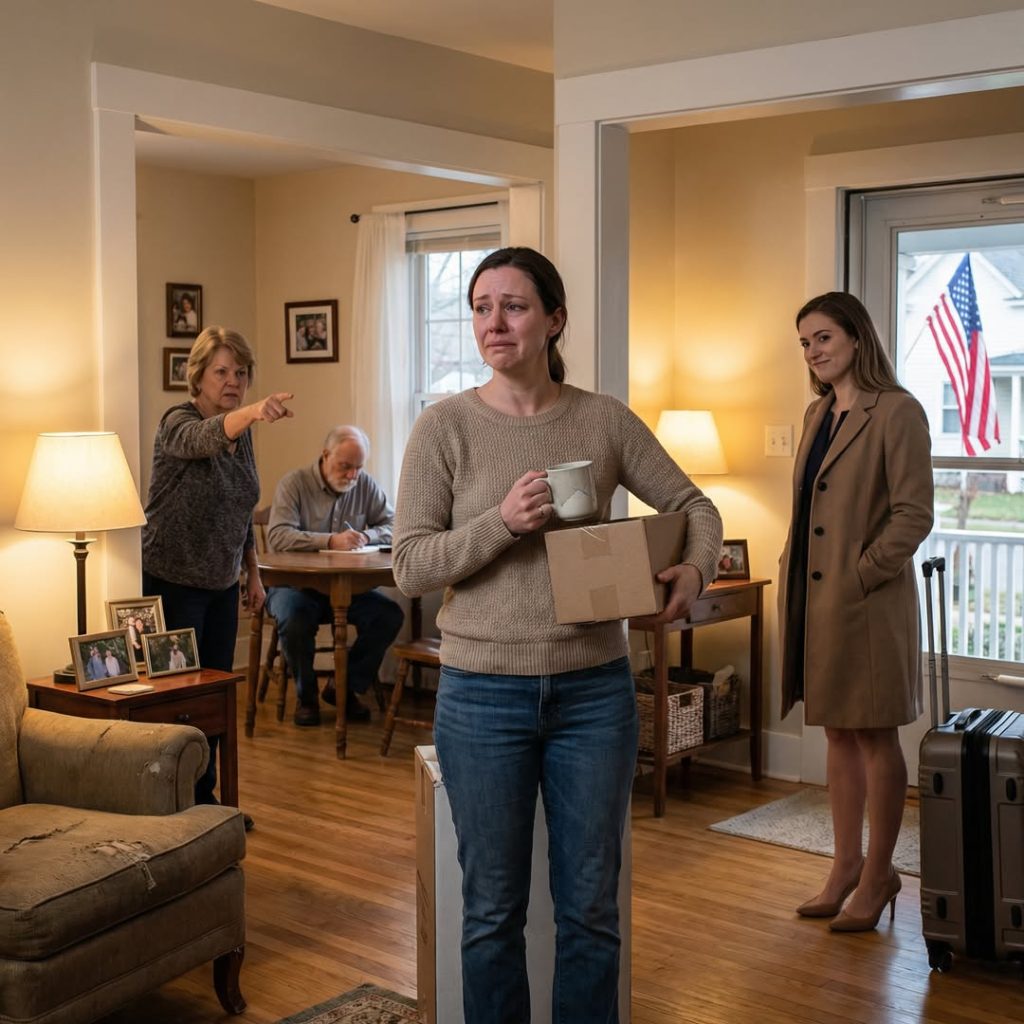
Then at dinner, my mother slammed her fork against the table. The sound cut through the room like a sentence being passed.
“You have forty-eight hours to get your stuff out,” she yelled. “That house is your sister’s now.”
My father only nodded, his eyes fixed on his plate. And my sister, who had been living far away in California, barely caring about this home, was suddenly handed everything.
I looked around the house, remembering how I had carried its weight, cared for every corner, and kept it standing as a real home. All those sacrifices, all that effort wiped away in a single cruel sentence. The one who gave nothing was rewarded with everything, while I was cast aside as if I had never belonged.
I froze. My heart pounded wildly, the air thick and suffocating.
Their words cut like knives, but arguing was pointless. I rose quietly, went to my room, gripped my phone tightly, and began to plan something they would never see coming. They thought I would just walk away.
Wrong.
In forty-eight hours, when my sister stepped inside that house, she would wish she never had.
Before we continue, I want to know: what time is it right now and which city are you watching from? Leave a comment so I can see just how far my story has traveled.
The next morning, I woke up in our Burlington home, the weight of my mother’s words still heavy. I’d spent years making this house ours, believing it was a shared promise. Living with my parents, I’d taken on their burdens, pouring my heart and savings into every corner.
After their financial crash five years ago, I stepped up. My software engineering job paid well, so I covered the mortgage—eighty thousand dollars over three years—when they couldn’t. I didn’t hesitate. This was our home, where I’d grown up, where every memory felt sacred.
I still remember the day the bank called, threatening foreclosure. My father sat at the kitchen table, head in his hands, papers scattered. My mother paced, her voice tight with worry.
“We’re going to lose everything,” she said.
I couldn’t let that happen. I drained my savings, worked overtime, and paid off the loan. The relief on their faces made it worth it.
Or so I thought.
I painted the living room a warm beige, replaced the warped floorboards, and fixed the creaky stairs. Every nail I hammered felt like a promise to keep us together.
My sister, though, was a ghost. Living in California, she called maybe twice a year, always too busy with her marketing job. When I mentioned the mortgage, she laughed it off.
“That’s your thing, Monica,” she said once, her voice dripping with dismissal.
I sent her photos of the new living room, new curtains, a plush sofa I’d saved for. She didn’t reply.
I told myself it didn’t matter. I was doing this for us—for the family.
I’d walk through the house at night, touching the walls I’d painted, feeling like they were mine. But there were cracks beneath the surface.
My parents leaned on me more each year. My mother would ask for “just a little help” with bills, and I’d cover them. My father stopped working after a layoff, and I paid for his car repairs.
I didn’t mind.
At least not then.
I thought we were a team.
I’d sit in the living room—the one I’d made cozy with throw pillows and a rug—and imagine growing old here, maybe raising my own kids someday.
The house wasn’t just a building. It was my proof that I could hold things together.
Looking back, I missed the signs.
My mother’s calls to my sister grew longer, her tone softer than with me. My father would mention her life in California, her success, with a pride I never heard for me. I brushed it off, told myself it was normal. They were my parents. They’d never push me out.
But last night’s dinner proved me wrong.
Their decision to hand the house to my sister wasn’t just unfair. It was a slap in the face. Every dollar I’d spent, every hour I’d worked, felt stolen.
I walked to the living room, staring at the sofa I’d bought. It wasn’t just furniture. It was mine, paid for with my overtime checks. The TV, the washer, the curtains—all mine. If they wanted me out, I’d make sure they felt what I’d given.
My sister hadn’t lifted a finger, but she’d walk into a home I’d built.
Not if I could help it.
I pulled out my laptop, my hands steady now. I wasn’t going to beg or cry. I’d show them exactly what they were throwing away.
By early afternoon, I needed answers. So I dialed Kristen, my best friend since our college days at the University of Vermont. She’s a lawyer now, with a sharp mind and a no-nonsense attitude—always my go-to when life gets complicated.
Sitting on my bed, surrounded by the familiar walls of our Burlington family home, I poured out the chaos from last night. I told her how my mother had slammed her fork down, her voice cutting through the air with that forty-eight-hour ultimatum, and how my father just sat there, silent, letting her hand the house to my sister.
Kristen didn’t interrupt, just listened, her calm focus grounding me.
“Do you have any legal papers for the house?” she asked, her tone all business. “Anything from your parents or before them?”
I mentioned my grandfather, who’d owned this place before he passed two years ago. I’d always thought it went to my parents after his death.
Kristen went quiet for a moment.
“Give me an hour,” she said. “I’ll check something.”
I spent that hour restless, pacing the hallway, my mind racing. My grandfather’s face kept flashing in my head—his weathered hands, his gravelly voice telling me stories on the front porch about building this house brick by brick. He’d look at me, his eyes crinkling, and say, “Monica, this place will always be yours.”
I’d smiled, thinking it was just his way of making me feel special.
Now, I wasn’t so sure.
I dug through an old box in my closet, pulling out photos of him standing by the oak tree in the yard, his arm around me. The memory stung sharp and raw, knowing my parents had dismissed it all.
Kristen called back, her voice tight with urgency.
“Monica, you’re not going to believe this.”
She’d reached out to a colleague in estate law and tracked down my grandfather’s will at the Chittenden County Clerk’s office. My parents had never mentioned it, not once.
Kristen read the document over the phone, each word hitting like a hammer.
My grandfather had left the house to me.
Me alone.
Not my parents.
Not my sister.
The will was signed, notarized, and filed three years before he died, naming me as the sole heir to the Burlington property.
I sank onto the bed, my hands trembling.
“How did I not know?” I whispered.
Kristen’s voice turned cold.
“Your parents had access to the will. They chose to keep it from you.”
The truth was a punch to the gut. My father and mother—the people I’d trusted my whole life—had hidden my grandfather’s final wish to give my sister the house.
I saw it all clearly now: their long phone calls with her, their pride in her California life, their silence about my sacrifices. They’d watched me pour eighty thousand dollars into this place, fix every broken piece, and still planned to hand it to someone who hadn’t set foot here in years.
My chest tightened, a mix of anger and hurt.
This wasn’t just unfairness. It was a deliberate stab in the back, a betrayal of everything I’d believed about family.
I stood up, my jaw clenched, and walked to the kitchen. My grandfather’s old coffee mug sat on the counter, a chipped relic I’d kept. Holding it, I remembered his promise, his belief in me.
They’d tried to erase that—to rewrite his legacy for their own reasons.
Why?
Because my sister had a family? Because they thought I’d just accept it?
I wasn’t sure. But it didn’t matter.
They’d crossed a line, and I wasn’t going to let them win.
Kristen broke through my thoughts.
“This will is ironclad, Monica,” she said. “You have legal rights to the house. We can challenge this.”
Her words were like a lifeline, pulling me out of the fog.
I didn’t know exactly what to do yet, but I knew I wasn’t walking away.
I grabbed a notebook from the drawer, my hands steadier now, and started listing everything I could use: bank statements, receipts, proof of my contributions.
Kristen promised to meet me the next morning to map out our options. She mentioned a few legal steps we could take, like filing a claim to enforce the will, but we needed to act fast.
My parents thought they had blindsided me, that I’d pack up and leave.
They had no idea what I was capable of.
I sat at the table, pen in hand, ready to fight for what was mine.
The next morning, I woke early, my notebook still open from last night’s planning. My parents were gone, visiting friends in Montpelier, leaving the house quiet.
I stood in the living room, staring at the sofa I’d bought with my first big paycheck—a plush gray piece that took months to save for. If I was being forced out, I wasn’t leaving my things behind for my sister to claim.
I grabbed a pen and started listing every item I’d paid for: the flat-screen TV mounted on the wall, the stainless steel washing machine in the basement, the curtains I’d picked out to match the beige paint I’d rolled on myself. Each item felt like a piece of me, proof of my years keeping this house alive.
I called Kristen to finalize our legal strategy. She was already at her office, her voice crisp over the phone.
“We’ll file a claim to enforce your grandfather’s will,” she said. “It’s straightforward, but we need proof of your contributions.”
I pulled out a folder stuffed with receipts: every purchase, every repair, every dollar I’d spent.
Kristen suggested getting a notarized affidavit to document my financial role, and we agreed to meet later to sign it. I felt a surge of control, like I was finally taking back what was mine.
But first, I needed to secure my belongings.
I searched online for moving companies in Burlington and found Green Mountain Movers, a local outfit with good reviews. I called and spoke to a guy named Tom, explaining I needed a rush job.
“Can you do it today?” I asked, my voice firm.
He hesitated, then agreed to send a truck by noon. I gave him the list: the TV, the sofa, the washer, a few smaller items like the microwave and my bedroom dresser.
“This is personal property,” I told him. “I’m taking what’s mine.”
Tom didn’t ask questions, just confirmed the address and quoted me a price.
I hung up, my pulse steady, knowing this was the right move.
While waiting, I walked through the house, double-checking my list. The kitchen table, a hand-me-down from my grandfather, wasn’t mine to take, but the chairs were bought last year after my mother complained about the old ones. I tagged them with sticky notes, marking what stayed and what went.
The process was methodical, almost calming, like I was reclaiming pieces of my life.
I avoided thinking about my parents or my sister, focusing instead on the task. Every item I marked was a reminder: this was my work, my money, my home.
Around ten, the doorbell rang.
It was Mrs. Linda, our neighbor from across the street, a kind woman in her sixties who always brought us cookies at Christmas. She’d seen me through the window pacing and came to check in.
“You okay, Monica?” she asked, her eyes soft with concern.
I didn’t tell her about the will or my parents’ decision—that felt too raw—but I admitted I was moving things out.
“It’s complicated,” I said, forcing a smile.
She squeezed my arm.
“You’ve always been good to this house. Whatever’s going on, you don’t deserve it.”
Her words hit hard, and I blinked back tears, grateful for her support.
Mr. William, another neighbor, stopped by soon after, his work boots still dusty from his morning shift. He’d known my grandfather well, always swapping stories about fishing trips.
“This place meant a lot to him,” he said, glancing around. “And to you.”
I nodded, unable to speak.
Their kindness gave me strength, a reminder that I wasn’t alone, even if my family had turned their backs.
I thanked them, promising to explain later, and they left with quiet nods, leaving me to my work.
The movers arrived at noon, a three-man crew with a white van. I walked them through the house, pointing out the tagged items. They worked fast, hauling the sofa and TV to the truck, wrapping the washer in blankets to avoid scratches.
Watching them carry my things out felt strange, like I was dismantling my life—but also right. I wasn’t giving my sister a free ride.
Kristen called again, confirming our meeting time and reminding me to keep receipts for the moving costs.
“This strengthens your case,” she said.
I agreed, my resolve hardening.
By late morning, the house felt emptier, but I felt stronger. My parents and sister thought they could erase my place here. They were about to learn otherwise.
By midafternoon, the house felt hollow, my belongings gone with the movers. I stood in the living room, its bare walls echoing the absence of the sofa and TV I’d taken. The silence was broken by a sharp knock at the door.
I opened it to find my sister Tara standing there, her suitcase at her feet, eyes narrowed like she already owned the place. She’d flown in from California, probably thinking she’d walk into a fully furnished home.
I braced myself, knowing this wouldn’t be civil.
Tara pushed past me, her heels clicking on the hardwood.
“Where’s everything?” she snapped, scanning the empty living room. Her voice was sharp, laced with entitlement.
I crossed my arms, staying by the door.
“I took what’s mine,” I said, keeping my tone even.
She spun around, her face flushing.
“Yours? Mom and Dad said this house is mine now. You don’t get to strip it bare.”
I stepped forward, my voice steady but cold.
“I paid for that sofa, the TV, the washer—everything I took. You didn’t contribute a dime.”
Her eyes widened, but she didn’t back down.
“You think you’re entitled because you threw some money around?” she shot back. “This is my home now, Monica. You’re out.”
The air crackled with tension.
I clenched my fists, fighting the urge to shout.
“You haven’t been here in years,” I said. “I kept this place standing while you were off in California, ignoring us.”
Tara laughed, a harsh, bitter sound.
“Oh, please. You stayed here out of pity, playing the good daughter. Mom and Dad chose me for a reason.”
Her words cut deep, but I didn’t flinch.
“They chose wrong,” I said, stepping closer. “You don’t know half of what I’ve done for this family.”
She stormed through the house, checking the kitchen, the basement, her face growing redder with each empty corner.
“The chairs? The curtains?” she yelled, spinning back to me. “You took everything.”
I held her gaze.
“Only what I paid for. You want a house? Furnish it yourself.”
Tara’s hands shook as she pulled out her phone, her voice trembling with rage.
“You’re unbelievable. I’m calling Mom and Dad. They’ll deal with you.”
I shrugged, leaning against the wall.
“Go ahead. They’re not here.”
She froze, confused.
“What do you mean?”
I didn’t elaborate, just watched as she dialed, her fingers fumbling.
Tara paced the kitchen, phone to her ear, her voice rising as she spoke to my mother.
“She gutted the place, Mom. It’s empty.”
I stayed silent, letting her rant. She hung up, glaring at me.
“They’re coming back from Montpelier tonight,” she said, her tone venomous. “You’re done, Monica.”
I didn’t respond, just pointed to the door.
“You know where the exit is.”
She grabbed her suitcase, muttering under her breath, and stormed out, slamming the door so hard the frame rattled.
I stood there, my heart pounding but my resolve firm. Tara thought she could waltz in and claim everything.
She had no idea what was coming.
I locked the door, ready for the next move.
That evening, I was at Kristen’s apartment in downtown Burlington, my belongings safely stored in a nearby unit. My phone buzzed relentlessly, my mother’s name flashing on the screen. I let it go to voicemail, knowing what was coming.
Tara had called them back from Montpelier, and now they were facing the consequences of their choices.
I wasn’t ready to hear their voices.
Not yet.
Instead, I sipped coffee at Kristen’s kitchen counter, the weight of the past two days settling into my bones.
When I finally played the voicemail, my mother’s voice was shrill, almost unrecognizable.
“Monica, what have you done? There’s a stranger in our house!”
My father’s voice cut in, heavy with disbelief.
“Some man claims he owns it now. Explain yourself.”
I didn’t call back.
The truth was, they’d walked into a reality they’d created.
Kristen had worked fast, leveraging my grandfather’s will to push a legal claim that exposed their deception. The house had been sold quietly, legally, to a new owner—a local investor who jumped at the chance to buy a Burlington property.
I hadn’t orchestrated the sale, but I’d set the wheels in motion by enforcing my rights.
My phone rang again, this time my father.
I answered, keeping my voice steady.
“Dad, I’m not coming back,” I said before he could speak. “You hid my grandfather’s will. You tried to give my home to Tara.”
He sputtered, his words a mix of anger and shock.
“We were protecting the family. You can’t just—”
I cut him off.
“You protected Tara, not me. The will was clear. This is on you.”
I hung up, my hands trembling but my resolve firm.
My mother called next, her tone sharp with accusation.
“Monica, you’re tearing us apart. Come fix this.”
I took a deep breath, my voice cold.
“I’m done fixing your mistakes. Talk to Kristen about the will.”
I ended the call, silencing my phone.
Kristen sat across from me, her laptop open, papers spread out.
“They’re panicking,” she said, her eyes sharp. “The new owner has the deed. They can’t undo this.”
I nodded, staring at my coffee mug.
The house I’d fought for, the one I’d poured my life into, was gone—not because I wanted it sold, but because my parents’ actions had forced my hand.
I felt a pang of loss, but also a strange relief.
They’d underestimated me, thought I’d fold under pressure.
They were wrong.
My parents kept calling, leaving voicemails that grew more desperate.
“Monica, we’re your family,” my mother pleaded in one. “You can’t do this to us.”
I didn’t respond. Each message felt like a weight, but I refused to carry it.
My grandfather’s will was my shield, proof that this house was meant for me. I wasn’t the one who’d broken trust.
They were.
As the night wore on, I sat with Kristen, planning my next steps, knowing I’d never go back to that house or the lies it held.
Months later, I stood in my new apartment in Burlington, sunlight streaming through the window. I’d built a life of my own, free from the weight of my family’s expectations.
I’d landed a job at a local marketing firm, a small but vibrant company where my ideas were valued. My days were filled with meetings, coffee runs to the café down the street, and quiet evenings arranging my furniture—my sofa, my TV, the pieces I’d fought to keep.
I hadn’t spoken to my parents or Tara since that night at Kristen’s, and I’d blocked their numbers. The silence was heavy at first, but it gave me space to breathe, to rediscover who I was without their shadow.
I heard through a mutual friend that Tara had scrambled to buy a new house in California. She’d expected to inherit our family home for free, but with it sold, she had to dip into her savings. The news didn’t bring me joy, but it felt just. She’d assumed she could take what wasn’t hers, and now she was learning the cost of that arrogance.
I pictured her in her polished California life, signing mortgage papers, maybe regretting her words to me.
I didn’t dwell on it.
My focus was forward, not on her struggles.
My parents faced their own fallout. Without the house, they’d moved into a small rental on the edge of Burlington, a far cry from the home they’d tried to control. Word spread quickly, and our tight-knit community—neighbors like Mrs. Linda and Mr. William, who’d supported me—didn’t hold back their disappointment.
My parents’ reputation, once solid, crumbled as people learned they’d hidden my grandfather’s wishes. They were struggling financially, too, with no property to leverage and legal fees piling up from their failed attempts to contest the sale.
I didn’t know the details, and I didn’t want to. Their choices had led them here, and I was done carrying their burden.
Kristen became my anchor, checking in regularly, her lawyer instincts still sharp. She’d finalized the legal proceedings, ensuring the sale stood and my rights were protected.
Over coffee one day, she grinned and said, “You’re stronger than they ever gave you credit for.”
I smiled back, feeling the truth of it.
I’d spent years undervaluing myself, pouring everything into a house I thought defined me. But this ordeal taught me something deeper.
My worth wasn’t tied to that place or their approval. It was in my ability to stand up, to draw a line, to choose myself.
Setting boundaries was the hardest lesson. Cutting contact wasn’t about anger. It was about protecting my peace.
I’d given too much, too long, trying to please a family that didn’t see me.
Now I knew better.
I walked through Burlington streets, past the lakefront, feeling lighter. The life I was building wasn’t perfect, but it was mine—built on my terms.
I walked through Burlington streets, past the lakefront, feeling lighter. The life I was building wasn’t perfect, but it was mine—built on my terms.
For the first time in years, when I turned the key in my own front door, I wasn’t bracing for anyone else’s mood on the other side. Just the soft whoosh of the latch, the smell of my coffee grounds, the sight of my thrifted rug and the couch I’d watched the movers carry out of my parents’ house.
No one could tell me I had forty-eight hours to leave anymore.
But even with my new routines—the morning walks to the corner café, the late-night coding sessions on my laptop at the kitchen table, the midweek drinks with co-workers—there was one thing I couldn’t quite shake.
The feeling that some chapter hadn’t fully closed yet.
It showed up again one gray Thursday in November, the kind of Burlington day where the clouds sit low over Lake Champlain like a lid.
I was halfway through debugging a campaign analytics script at work when my phone buzzed with an email notification.
Subject line: Estate of Samuel Drake – Final Disbursement.
My grandfather.
I clicked it open.
Dear Ms. Griffin,
This email is to confirm that the remaining proceeds from the sale of the Burlington property have cleared. As per your grandfather’s will, these funds are held in your name alone. A cashier’s check will be available for pickup at our office by Friday at 4:00 p.m.
Best,
Laura Hastings
Hastings & Cole, Attorneys at Law
I stared at the screen.
I’d seen numbers already—estimates, preliminary statements—but something about the word “final” hit different. This wasn’t just a house anymore. It was a closed file in a law office, a line item in a ledger.
It was also half a lifetime of my grandfather’s work, turned into a sum of money with my name on it.
At five o’clock, I sat on my couch with the envelope in my lap. Thick paper. Heavy ink.
When I unfolded the check, my breath caught.
It was more than I’d expected. Even after legal fees, even after paying off the lingering balance of the mortgage my parents had secretly refinanced without telling me.
For a second, the old voice rang in my head.
You should give some of it to them.
I pictured my parents’ faces at the kitchen table the night they told me I had forty-eight hours. The way my father kept his eyes on his plate. The way my mother’s jaw had tightened around every word, like she was biting down on something bitter.
I folded the check back into the envelope.
“No,” I said out loud, to the empty room.
This wasn’t charity.
This was restitution.
Kristen insisted on meeting me at the bank.
“You’re not walking into this alone,” she said. “And you’re definitely not letting some random teller talk you into buying a savings bond from 1998.”
We sat in the sleek, glass-walled office of a financial advisor named Mark who looked barely older than us. He pushed his glasses up his nose as he scanned the documents.
“This is a significant amount,” he said. “Congratulations, Ms. Griffin.”
I didn’t feel like celebrating.
“It’s not a lottery ticket,” I replied. “It’s a house I lost.”
Kristen shot me a look—gentle, warning.
Mark cleared his throat.
“Right,” he said. “Of course. I just mean… this can give you options. Stability. Security.”
Options.
The word settled somewhere deep in my chest.
We talked through practical things: an emergency fund, paying off my student loans, putting a chunk into low-risk investments. When he started to pitch something riskier, Kristen raised an eyebrow.
“Ease up, Tiger,” she said. “We’re rebuilding a life, not buying a yacht.”
I signed the papers. A wire here. A deposit there.
When it was done, I walked out onto the sidewalk and drew in a long breath of cold lake air.
For the first time, the house didn’t feel like a ghost sitting on my shoulder.
It felt like a foundation under my feet.
Of course, my parents didn’t see it that way.
The next time they tried to claw back control, they used the thing they’d always relied on.
Shame.
It started with a letter.