At 7:12 the next morning, there were ten police cars outside my duplex.
For a second I honestly thought my life had split open.
I thought Patrick Callahan had gone home, looked up the value of his mother’s ring, and decided a broke single dad returning it was somehow more suspicious than decent.
I thought maybe I had filled my kids’ heads with one story about honesty while the real world was about to teach them another.

Then the sheriff standing on my porch took off his hat and said the sentence that changed the whole morning.
Lorraine Callahan asked us to come thank you properly.
I just stared at him.
The red and blue lights were still bouncing across the walls behind me.
Luke had one hand wrapped around the hem of my T-shirt.
Ben was pressed against my leg in dinosaur pajamas.
Emma stood a little farther back, trying hard to look brave and failing only in her eyes.
I looked past the sheriff and saw something I had missed in the panic.
Behind the last patrol car, turning slowly into the street, was an appliance delivery truck.
I thought I had misread it.
Then the driver climbed out.
Then Patrick Callahan stepped out of his pickup.
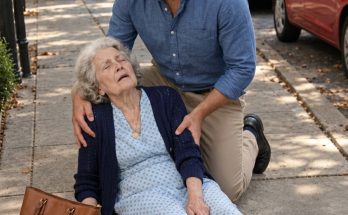
Then, from the passenger side of an older silver sedan parked behind the patrol cars, Lorraine emerged in that same blue cardigan, clutching her purse against her chest like she was holding herself together on purpose.
The sheriff gave me a small smile.
No accusation. No paperwork. No hand on his belt.
Just a smile.
Mrs. Callahan told us what you did, he said.
And because her late husband was Sheriff Charles Callahan, apparently every retired officer and half my department decided seven in the morning was a good time to make a point.
I must have looked stupid standing there, because he added, in a gentler voice, You’re not in trouble, Daniel.
Not even close.
That was when my knees almost gave out.
I laughed once, the kind of laugh that comes out when your body has been bracing for impact and suddenly doesn’t know where to put the fear.
Emma was the first one to understand.
Are they here because of the ring, she asked.
Lorraine heard her and answered before I could.
Yes, honey, she said softly.
They’re here because your dad did something beautiful.
I wish I could tell you I handled that moment with grace.
I didn’t.
I stood there in a faded T-shirt and socks that didn’t match, staring at ten police cars, my suspicious neighbors, a delivery truck, and an old woman whose wedding ring had somehow brought half the county to my front steps.
Then I stepped aside and said the only thing I could think of.
You all better come in before the kids think we’re on television.
That morning didn’t begin with the police, though.
It began the way most hard seasons do.
Quietly. In pieces.
I had not planned to become a single father at twenty-eight.
Nobody plans the version of adulthood where you start measuring sleep by fragments and grocery totals by what can be left behind without anyone noticing.
When Marissa left, she didn’t throw plates or scream or do anything dramatic enough to let me hate her cleanly.
She just packed a bag, kissed each of the kids on the forehead, and said she couldn’t do this anymore.
Then she was gone.
At first I kept waiting for a grand explanation.
Some hidden crisis. Some truth large enough to balance what she had broken.
It never came.
The kids were six, four, and two then.
Too young to understand abandonment in adult language, but old enough to feel its weather.
Emma became careful. Luke became louder.
Ben stopped sleeping through the night for almost four months.
And me, I became practical.
Practical is not noble, by the way.
It’s just what grief looks like when the bus still comes at seven-thirty and children still need lunches packed.
I switched shifts at the warehouse so I could be home when they woke up.
I learned which canned soup Luke would eat without complaining, which stuffed animal Ben needed if he woke shaking from a dream, which brand of cheap peanut butter Emma said tasted almost like the good kind.
I also learned how expensive everything becomes when there is nobody to absorb the hit with you.
A flat tire is not just a flat tire.
It’s the week that school field-trip permission slips come home.
A cavity is not just a cavity.
It’s the difference between catching up on electric or pretending the shutoff notice got lost in the mail.
And a broken washing machine is never just a broken washing machine when you have three children, one small kitchen, two jobs, and no grandmother living nearby to take the burden for an afternoon.
Our washer had been old when we moved into the duplex.
It shook so hard during spin cycles that Ben used to call it the dancing box.
I had fixed the hose twice, replaced the lid switch once, and kicked the lower right corner more often than any respectable appliance repair guide would recommend.
But that Monday night it gave up.
One smell of hot wiring.
One groan. Then silence.
I stood there in the laundry nook with a wet towel in my hand and knew immediately I couldn’t afford what needed to happen next.
So I stretched the problem.
I washed the absolute minimum in the sink.
I told the boys they could wear sweatpants one more day if they were careful at recess.
I spent one whole evening in a laundromat listening to industrial dryers thud while Ben fell asleep across three plastic chairs and Emma tried to fold socks like a grown woman because she could see me slipping.
The laundromat smelled like bleach, overheated metal, and old spilled detergent.
A teenage couple argued by the vending machine.
Somebody’s dryer buzzed every few minutes in a rhythm that got into my skull.
By the time I hauled the last bag back to the truck, my forearms were burning.
That’s when I knew I had to find something.
Anything.
The thrift warehouse sat near the edge of town in a long cinder-block building that looked like it had been tired since the seventies.
They sold donated furniture, appliances, mismatched lamps, and chairs with stories you could practically see pressed into the fabric.
The washer I bought wasn’t pretty.
White once, maybe. Dented on one side.
A yellowed sticker half-peeled from the control panel.
But the tag said sixty dollars.
The manager said it ran the last time they tested it.
He also said sold as-is in the tone of a man who had said it many times to people with no better options.
I paid cash.
The money had been my backup grocery envelope.
I told myself I would figure the rest out later.
That evening, after getting it home and sweating through the hookup, I ran the empty test cycle and found the ring.
I can still feel the exact weight of it dropping into my palm.
The diamond wasn’t huge, but it was unmistakably real.
Clear in the cheap overhead light.
Set low into the gold like it had been made to last through work, dishes, children, age.
The engraving inside the band was what got me: L + C.
Always.
Always made it personal.
Always made it belong to someone.
Still, temptation came fast.
People talk about integrity as if it arrives in a shining moment.
It doesn’t. Not usually. Usually it arrives while you are exhausted and calculating and one bad week from real trouble.
Usually it arrives wearing the face of your rent notice.
Need doesn’t make a person dishonest.
It just makes honesty expensive.
I stood in the kitchen holding that ring and thought of every bill lined up on the counter.
I thought of Emma’s sneakers.
Luke’s school photo envelope. The cough syrup I had watered down two nights earlier so it would last until payday.
Then Emma walked in half asleep, saw the ring, and asked whether it was somebody’s forever ring.
That question embarrassed me more than anything else could have.
Because yes. Of course it was.
The next morning I called the thrift warehouse.
The manager, a guy named Terry with nicotine-yellow fingers and a suspicious squint, asked twice if I was serious.
I told him I was.
He put me on hold so long I thought he had forgotten me, then came back and said the washer had been part of a pickup donation from the Callahan house on West Ridge.
By late afternoon I was driving there with the ring tucked into a clean envelope in my glove compartment.
Lorraine Callahan opened the door after the second knock.
I could tell from her face she had once been a very pretty woman and then life had carved gentleness into her instead of hardness.
Some people are like that.
When I showed her the ring, she didn’t speak right away.
She pressed one hand to the doorframe.
Then she whispered Charles.
That was how I learned the initials.
Lorraine and Charles.
She led me inside without asking many questions, as if grief had already decided I was safe.
The house smelled faintly like lemon polish and old books.
There were framed photographs everywhere.
A young man in a sheriff’s uniform.
A couple cutting a cake.
A much younger Lorraine laughing beside a broad-shouldered man with serious eyes and the kind of smile that only shows up when nobody is telling the person to say cheese.
She told me Charles had given her the ring after they married at the county courthouse at nineteen and twenty.
They had no money. He was a deputy then, borrowing a tie from his older brother.
She wore a dress her aunt hemmed the night before.
Afterward they ate pie at a diner because that was what they could afford.
Fifty-one years later, after a life full of shift work and funerals and holidays moved around somebody else’s emergency, she still wore the ring every day.