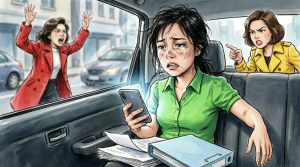
My sister’s palm print flared crimson across my cheek as I sat alone in my car, blood soaking into my collar. Thirty-two years of being invisible to them hardened into a blinding fury. My phone screen glowed with the lawyer’s number while Grandma’s will lay open beside me. My heartbeat thundered in my ears. They wanted my inheritance? I gripped the property deed, a bitter smile pushing through my tears. Blood ties break without a sound.
The imprint of my sister’s hand still stung my face when I locked my car doors and noticed blood marking the collar of my cream blouse.
I sat in the parking lot outside my grandmother’s attorney’s office, shaking so violently I could barely keep hold of my phone. The reading of the will had ended less than ten minutes earlier. My younger sister, Madison, had rushed at me near my car, shouting that I had stolen her future, and struck me hard enough to split the inside of my lip against my teeth. Then she hissed, “You think you won? I’ll take everything Grandma meant for me.”
That was the instant thirty-two years of being second place in my own family finally sharpened into something cold and precise.
My name is Claire Bennett. I’m thirty-two, a high school counselor, and until that afternoon I had spent most of my life trying to earn love from people who had already decided I existed to make Madison’s life easier. Madison was the golden child, the one my mother labeled “sensitive” whenever she lied, spent recklessly, or lashed out. I was the dependable one. The one who drove to appointments, paid deposits, answered late-night calls, and was called selfish the first time I refused.
Only my grandmother, Eleanor Hayes, ever saw the truth without softening it.
She had been the one constant in my life. When my mother dismissed my college plans as “too expensive,” Grandma helped me apply for scholarships. When Madison totaled her second car and my mother demanded I co-sign a loan, Grandma told me quietly, “Do not set yourself on fire to keep people warm who enjoy watching you burn.” And when her health declined two years ago, I was the one taking her to specialists, organizing medications, managing insurance calls, and sitting beside her at night when pain made sleep impossible.
Madison showed up too, but only when she believed money might be involved.
At the will reading, attorney Daniel Mercer wasted no time. Grandma’s lake house, the adjoining land, and most of her savings had been left to me. Madison received a small trust that could only be used for education, medical care, or housing under supervision. My mother received nothing except a sealed letter.
Silence held for three seconds.
Then Madison shot to her feet so fast her chair crashed backward. My mother called me a manipulative snake. She accused me of turning Grandma against them, of taking advantage of a dying woman, of stealing what should have remained “in the real line of the family,” as if I weren’t blood at all. Mercer tried to calm them, but Madison was already crying, screaming, and pointing at me as though I had committed a crime by finally being loved honestly.
I reached the parking lot before she caught me.
Now I sat in my car, my cheek throbbing, when Daniel Mercer called.
“Claire, don’t go home yet,” he said. His voice was controlled but urgent. “Your grandmother anticipated this.”
I tightened my grip on the steering wheel. “What do you mean?”
“The deed to the lake house was transferred to you three months ago through the family trust. It’s already recorded. And your grandmother left instructions in case your mother or sister reacted violently.”
A cold stillness filled the car.
Then Mercer spoke the sentence that changed everything.
“Claire, security just called. Your mother and Madison are already on their way to the lake house with suitcases.”
I looked at the blood on my blouse, then at the property deed lying open on the passenger seat.
For the first time in my life, I didn’t feel hurt.
I felt dangerous.
Part 2
I drove straight from the attorney’s office to the sheriff’s department, my lip swollen, my cheek burning, and my grandmother’s deed clenched in my hand like a verdict.
By the time I arrived, Daniel Mercer had already sent over copies of the trust transfer, the recorded deed, and a note from my grandmother authorizing immediate lock changes if “any unauthorized family member attempts occupancy or removal of household contents.” The deputy who took my statement studied the fingerprint-shaped welt on my face and asked one question.
“Do you want this documented as assault?”
I thought about all the times I had minimized what my family did to me. Being shoved into a wall at sixteen. Madison digging her nails into my arm because I refused to lend her money at twenty-four. My mother calling me cruel for not covering Madison’s rent at twenty-nine. Every incident wrapped in the same rotten excuse: That’s just how family is.
“Yes,” I said. “Document everything.”
From there, I followed a deputy and a locksmith to my grandmother’s lake house just before sunset. The house stood where it always had, tucked among pine trees beside cold February water, its blue shutters slightly faded with age. Madison’s SUV was already in the gravel driveway. My mother’s sedan blocked half the entrance. Two hard-shell suitcases sat on the porch as if confidence alone could claim ownership.
Madison was pulling at the front door when she turned and saw me.
Her mascara was smeared from crying, but rage steadied her. “You are not doing this to me,” she shouted. “Grandma promised me that house.”
“No,” I said, stepping out of my car. “Grandma promised you chances. You wasted them.”
My mother moved faster than Madison. “This is a misunderstanding,” she snapped at the deputy. “Our family is grieving, and Claire is being vindictive.”
The deputy didn’t blink. “Ma’am, the property is legally hers.”
Madison let out a harsh, splintering laugh. “She manipulated a dying woman.”
That might have shaken me once. Years ago, I would have explained, defended, cried. Instead, I lifted the deed and said, “You don’t get to hit me in a parking lot and then move into my house.”
The locksmith changed the locks while Madison screamed herself hoarse. My mother tried tears, then insults, then guilt. She said Grandma would be ashamed of me. She said I was tearing the family apart. She said blood should matter more than paper.
What she meant was that my pain should matter less than Madison’s comfort.
When the new keys were placed in my hand, something inside me settled. Not happiness. Not revenge. Certainty.
I stayed at the lake house that night because Mercer warned me my family wouldn’t stop at one scene. He was right.
At 11:47 p.m., a motion alert from Grandma’s old security system lit up my phone. Two figures on the back deck. Madison and my mother. Madison held a crowbar.
By the time deputies arrived, they had shattered the mudroom window and were halfway inside. Madison stood in broken glass wearing my grandmother’s wool coat—the one she had once mocked as “old lady rich.” My mother insisted they had a right to retrieve “family items,” though the list in her purse included Grandma’s jewelry box, silver service, and the antique painting over the fireplace Mercer had warned me not to let out of sight.
Madison looked straight at me as they pulled her back onto the porch.
“This isn’t over,” she spat.
I believed her.
The next morning, Mercer arrived with coffee, copies of the police report, and a sealed packet labeled in my grandmother’s handwriting.
“For Claire,” it read. “Only if they force your hand.”
Inside were account statements, printed emails, a notebook, and a flash drive.
By noon, I understood why my grandmother had transferred the deed early.
Madison wasn’t just broke.
She had been stealing.