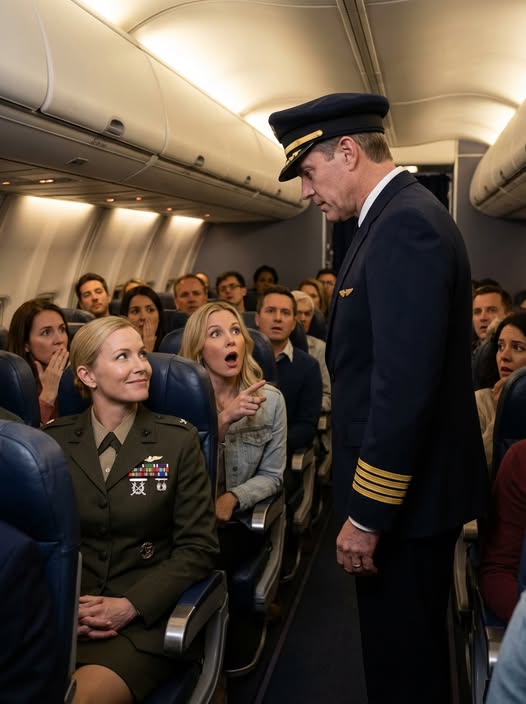
The captain stopped beside my economy seat, and saluted. “General, ma’am.” In one second, the laughter died, my father’s grin vanished, and the family that had mocked me all morning finally realized they had never known who I was. But the real secret wasn’t my rank.
Part 1
The VIP lounge at LAX carried the scent of dark-roast coffee, lemon polish, and the kind of wealth that made people lower their voices even when nobody had asked them to. Floor-to-ceiling glass overlooked the runway. Leather chairs were arranged in tidy little clusters. At the bar, a man in a crisp white shirt uncorked champagne at eleven in the morning as if that were an ordinary Tuesday ritual.
My family looked like they had been born for that room.
My father, Arthur Bennett, stood near the windows with one hand in his pocket and a whiskey in the other, silver hair slicked back so perfectly it looked sprayed into place. My mother, Evelyn, had already found another polished couple with matching carry-ons and was telling them we were headed to Hawaii for my grandparents’ fortieth anniversary celebration. My sister, Chloe, stood in the center of everything in a cream pantsuit, sunglasses pushed up on her head, gold hoops flashing every time she turned beneath the lounge lights.
And then there was me.
I sat off to the side in a low chair, a black duffel at my feet and my old military backpack leaning against my leg. That backpack had survived heat, rain, two deployments, and more airports than I could count. The nylon had faded with wear. One zipper pull had long ago been replaced with a strip of olive cord. Chloe despised that bag more than she despised almost anything I had ever said.
She claimed it made us look poor.
“Harper,” my mother called without even glancing at me, “sit up a little straighter. You look tired.”
I had been awake since 3:30, handling secure messages before dawn, but I only said, “I’m fine.”
That was my role in the family. The one-word answer. The quiet daughter. The sister people described with a tiny shrug, like I existed just off-camera.
I worked for the government.
That was how they always phrased it. Never the military. Never command. Never anything specific, or serious, or important-sounding. Just the government, said in the same tone people used for tax paperwork and DMV lines. Over time, it had become one of the family jokes.
Harper does computer stuff for the military. Basically IT in camouflage. Spreadsheet soldier.
It had started as laziness and become something meaner, but I let them keep their version of the story. Operational security was part of it. So was the simple truth that people who underestimate you tend to get careless.
Two minutes later, Vance Carter arrived wearing the kind of expensive polish some men carry like a second tailored suit. Tall, tanned, perfect haircut, cufflinks that probably cost more than the rent on my first apartment. He kissed Chloe on the cheek, clapped my father on the shoulder, and lifted his phone like he was heading into a board meeting instead of a family vacation.
“Tickets are locked in,” he said. “First class all the way to Honolulu.”
My father grinned. “That’s my son-in-law.” Chloe gave a pleased little half-bow, as if someone had just handed her an award. “You’re welcome.” She pulled a stack of boarding passes from her purse.
Four of them had thick gold edging. “Dad.” She handed him one. “Mom.” “Vance, obviously.”
She kept the fourth for herself and fanned those gold-edged passes once, slow and deliberate. Then she turned toward me with the expression people get when they suddenly remember an obligation they wish they could ignore.
“Oh,” she said.
One word. Enough contempt to fill a page.
She went back into her bag and pulled out another boarding pass. This one looked thinner, slightly wrinkled, like it had already had a rough life at the bottom of her purse. She walked over and dropped it into my hand.
Not handed. Dropped. “Here.” I looked down.
34E. Economy. Middle seat. Near the back. Chloe leaned close, perfume floating over me in a bright expensive cloud. “I figured you’d be more comfortable near the bathroom,” she said softly. “Should feel familiar.”
My father laughed. Actually laughed.
Vance took a sip of champagne and added, “We were being generous, really. Standby would’ve been more your budget.”
My mother made a small sound behind her glass. Not quite laughter. Not quite protest. That was her specialty—letting cruelty happen in a tone soft enough to deny later.
I slid the boarding pass into my jacket pocket and stood.
Chloe blinked. “That’s it? No fight?”
“Seat looks fine.” That answer bothered her more than a full argument ever could have.
My father shook his head. “You really should’ve tried harder in life, Harper.” I swung my backpack over one shoulder. “I did.” The remark passed right through him.
A boarding announcement crackled through the lounge. Chloe flashed her gold-edged pass at me like a final flourish.
“Priority boards first,” she said. “Coach is somewhere out there.” I nodded. “Good to know.”
The main terminal felt like a different country. Loud. Crowded. Honest. Kids sat on the carpet staring at tablets. A man in a Lakers hoodie argued with a gate agent about a carry-on. Somewhere nearby, someone was eating cinnamon pretzel bites, and the sweet buttery smell drifted through the walkway. It all felt more real than the lounge ever had.
At the gate, I stepped out of line and pulled out my second phone.
Government issue. Matte black. No logo.
I entered a memorized sequence and waited for the secure line to connect. “Control,” a voice answered. “Eagle One boarding commercial,” I said quietly. “Maintain passive monitoring on flagged regional traffic. Pacific corridor.”
A beat. “Copy, Eagle One.” I ended the call and stepped back into line as boarding began.
Seat 34E was exactly where Chloe had promised—close enough to the lavatory that I heard the latch click every few minutes. The cabin smelled faintly of cold recycled air, coffee, and industrial cleaner. I slid my backpack under the seat, fastened my belt, and watched the rest of the passengers settle in.
A little later, my family came down the aisle on their way to first class.
Chloe looked down at me with a full-toothed smile. “Comfortable back here?”
“Very.” My father gave a soft snort. “Maybe next year.” Vance slowed beside my row. “Still doing computer work for the military?”
“Something like that.” He chuckled and kept walking.
About twenty minutes after takeoff, the cabin loosened. Seat belt sign off. People stood immediately. Bags opened overhead. Ice clinked in cups. Up front, the first-class curtain shifted as passengers drifted toward the rear lavatory.
Vance appeared at my row holding a paper cup of coffee and his laptop.
“Couldn’t sleep up there,” he said. Then he shifted. The cup tipped.
Coffee splashed across my jacket and down the front of my shirt, hot enough to sting but not enough to burn. The empty cup hit the floor and rolled beneath the seat ahead of me.
Vance did not apologize. He looked down with the faintest smile. “Guess military training doesn’t cover beverage handling.” A few nearby passengers glanced over, waiting. I looked at the dark stain spreading across my jacket. “It happens.”
Disappointment flickered across his face.
Then I saw his laptop.
Black. Thin. Corporate issue. He opened a movie window first, but that was not what mattered. What mattered was the Wi-Fi icon at the top of the screen and the folder he accidentally clicked when turbulence nudged his wrist.
DoD_SYS_A12 He corrected it fast, but not before I saw an email header flash open. External domain. Not familiar. Not good.
Defense contractors do not connect sensitive work devices to public in-flight Wi-Fi unless they are reckless, stupid, or dirty. Vance was not stupid.
I kept my face blank and touched the phone inside my pocket without pulling it out. One command. Silent capture initiated. The plane jolted hard enough to rattle the overhead bins. Then harder.
The seat belt sign flashed back on. Nervous laughter skipped through the cabin in thin little bursts. Somewhere near row twenty, a baby started crying. A flight attendant’s polished voice came over the intercom.
“Ladies and gentlemen, please return to your seats immediately.” From first class, I heard Chloe rise above everyone else. “You can’t just leave us without information.”
My father joined in. “I want to speak to the captain.”
The plane dropped once—sharp, sudden—and a plastic cup skidded down the aisle. Vance half-closed his laptop and stood. He looked irritated, not frightened, which told me plenty.
Then the cockpit door opened.
A tall, gray-haired captain stepped into the aisle and moved past first class without so much as glancing at my family. Chloe actually reached out a hand to stop him. He ignored her. Vance started, “Captain, I’m a government contractor—”
Ignored.
The captain kept walking. Down the aisle. Past premium economy. Past row twenty-five. Past a man gripping both armrests so hard his knuckles had turned white.
Then he stopped beside me. The entire cabin went still. The captain straightened, brought his heels together, and raised a sharp military salute. “General, ma’am,” he said.
And from somewhere up front, I heard Chloe inhale like glass cracking under heat.

Part 2
When an entire cabin goes silent at once, you can hear the airplane itself.
The engines roared steadily beneath the floor. Air whispered through the vents. Somewhere up front, a half-secured service cart rattled. Beyond that, nothing. Not even Chloe.
The captain held his salute.
I unbuckled slowly and stood. Habit settled over me before emotion did—shoulders squared, chin level, voice steady. I returned the salute.
“At ease, Captain.”
He lowered his hand. “Ma’am, Honolulu Center advised us that a senior command officer with Pacific authorization is aboard. We have a navigation systems fault layered on top of storm closures at the nearest civilian fields. There is one viable landing option.”
I already knew what it would be.
“Joint Base Pearl Harbor-Hickam,” I said.
“Yes, ma’am. But base operations require authorization to divert a civilian aircraft into restricted airspace under current conditions.”
Around us, the whispers began.
General?
Did he say general?
What the hell?
The captain held my gaze. “I need your clearance code.”
Up in first class, my father made a small confused noise. Chloe stood in the aisle gripping a seatback, all the color drained from her face. Vance had gone absolutely still.
I reached into my inner pocket and pulled out the black phone. The secure prompt lit the screen. My thumb moved through the sequence without hesitation.
“You’re cleared for emergency diversion,” I said. “Transmit authorization Delta-Seven to base command and request restricted corridor entry. They’ll know who to contact.”
The captain nodded once. “Copy that, General.”
Then he turned and headed back toward the cockpit at nearly a run.
The whispers only grew louder.
I sat down again, fastened my seat belt, and smoothed the front of my coffee-stained jacket. Somehow that stain seemed almost funny now.
A woman across the aisle stared openly. “Are you really—”
“Yes.”
She blinked and leaned back without finishing.
From the front, Chloe finally found her voice. “Harper?”
I looked forward, not at her.
The descent began ten minutes later. The plane angled down through thick cloud and rough air, the kind of heavy chop that made the seat frames creak. Outside the window there was only gray, until suddenly the clouds broke and wet island light appeared below. The runway at Hickam came into view—long and bright, flanked by floodlit hangars, dark military aircraft, and low concrete buildings no civilian passenger mistook for an airport terminal.
We landed hard.
Not dangerously. Just military-runway hard—reverse thrust roaring, deceleration sharp enough to press everyone forward into their belts. A few passengers clapped out of nerves. No one joined them.
Instead of taxiing toward a terminal, we turned toward an isolated piece of ramp lit up like a film set. Black SUVs. Security trucks. Uniformed personnel waiting in a line.
When the aircraft door opened, bright white light poured in.
I stayed seated until the first military police officer stepped inside. He wore full tactical gear and moved with the efficient economy of someone who did not need theatrics. He scanned the cabin once, then looked directly at me.
“General Bennett, ma’am.”
I stood.
That was when my father made his move. He pushed into the aisle from first class, tie crooked, face flushed.
“You should let us through,” he told the MPs. “We’re with her. We’re family.”
The nearest officer did not even look at him. “Sir, return to your seat.”
“You don’t understand,” Arthur snapped. “That’s my daughter.”
A second officer shifted into place, body blocking the aisle. “Sir. Seat.”
Behind him, Chloe stood pale and blinking too fast. “Harper, what is happening?” she asked, and for the first time in years, there was no sarcasm in her voice. Only fear.
Vance said nothing at all. He looked like a man mentally replaying every careless choice he had made in the last two hours.
I walked forward.
My father tried once more. “At least tell them—”
I passed him without stopping.
Outside, the heat hit me first. Hawaii under storm light has its own smell—wet concrete, jet fuel, salt air, tropical earth. Floodlights washed the tarmac in white. Two rows of security personnel stood near the stairs, and beyond them waited a cluster of officers in mixed uniforms—Air Force, Army, Navy. An Air Force brigadier with silver at his temples stepped forward carrying a sealed folder.
He handed it to me. “General, immediate briefing. We have a cyber alert tied to this aircraft.”
That answered one question.
I opened the folder beneath the floodlights. The first page gave me a fast incident summary: anomalous packet bursts from commercial cabin Wi-Fi, flagged encryption signature consistent with classified contract architecture, mirrored under emergency authority.
Confirmation.
Through the oval window in the aircraft door, I could see Chloe’s face close to the glass, blurred.
Good.
Let her watch.
A black SUV took me across the base to the operations building. Inside, the air-conditioning felt aggressive after the tropical damp outside. The command room glowed blue-white with wall displays and workstation monitors—satellite weather, network traces, timestamps. Analysts moved quietly, the way competent people do when they know panic is useless.
Captain Lena Morales met me halfway.
“General.”
“Report.”
She pulled up a network map on the main screen. “Your onboard request initiated passive capture. We identified one high-risk device transmitting over public aircraft Wi-Fi. We mirrored traffic before the flight diverted.”
“Show me.”
The data stream opened.
Packet timing. Destination relays. One node pulsing at regular intervals.
Morales enlarged the device ID.
Corporate contractor machine.
Registered to Carter Strategic Defense.
Vance.
Something inside me went perfectly still.
Another analyst opened a second screen. “He entered through the passenger network but tunneled through encrypted wrapping. Sloppy masking. Either he panicked or he assumed no one on that flight could identify the signature.”
“He assumed wrong,” I said.
The analyst nodded and clicked deeper. Folders populated the display. Architecture diagrams. Access maps. Internal vulnerability assessments for a defense communications system in active procurement.
Not harmless paperwork.
Not even close.
Morales folded her arms. “If this leaves controlled hands, it shortens the path to a breach.”
I scanned file names, then the financial tabs beneath them. Offshore routing. Shell entities. Payment staging.
“Source company?” I asked.
The analyst opened linked registration records. “Working through a Cayman structure. Corporate front for payment intake.”
The first name on the registration was not foreign.
Not anonymous.
It was familiar enough to chill the room.
Director: Chloe Bennett Carter.
The signature at the bottom was hers.
And in a single instant, the worst person in my family stopped being merely petty, loud, and cruel.
She was involved.
Part 3
Most of my adult life has been spent in rooms where reacting too fast could cost far more than pride. So when I saw Chloe’s name on that registration document, I did not gasp. I did not swear. I did not slam a hand on the table.
I just leaned closer.
The signature was hers. Same sharp loop on the C. Same pointless flourish on the tail of the y. Chloe had always signed her name like she expected it to be framed.
Morales studied me. “You know her.”
“She’s my sister.”
That bought exactly one second of silence before everyone went back to work. One thing I’ve always respected about serious professionals: once they know the truth matters more than your feelings, they stop treating you like glass.
The analyst kept clicking. “Three shell companies. Two in the Caymans, one in Delaware. Funds come in as consulting and contract facilitation fees, then move out through layers.”
“To whom?”
“Still tracing.”
A second screen lit up with emails captured from Vance’s open connection on the plane. Most were short, carefully vague, professionally evasive. But one decrypted attachment exposed part of its title:
Exposure Incentives Schedule
I stared at it.
Not security hardening.
Not consulting.
Not even bribery dressed in clean language.
Payment for weakness.
Someone was buying holes in an American defense system, and Vance had carried the price list onto a commercial flight.
Morales exhaled through her nose. “He wasn’t being careless.”
“No,” I said. “He was doing business.”
Some betrayals arrive hot, with humiliation and the urge to destroy something. This one came cold. Clean. Chloe and Vance had mistaken my silence for stupidity for so long that neither had noticed the only thing that mattered: I did not need to win arguments in a room when I could win the board underneath it.
“Secure everything,” I said. “No alerts outside this room. I want continued passive collection. Let him believe he’s still ahead.”
“Yes, ma’am.”
“And no contact with my family until I say so.”
Morales nodded. “Understood.”
The commercial flight was cleared to continue later that afternoon once the storm front shifted west. I reboarded last, alone, carrying no visible sign that I had just spent three hours inside a base operations center reading evidence that could send my sister to prison.
Seat 34E was waiting.
Chloe twisted around before I even sat down. “Where did you go?”
“Work.”
She searched my face. “What kind of work needs soldiers?”
“The boring kind.”
That irritated her, which helped. Irritated people cling to familiar scripts. My father leaned over from the front and chuckled.
“Military overreaction,” he said. “Probably thought you mattered more than you do.”
Chloe recovered quickly. “Exactly.”
Vance said nothing.
He watched me once when he thought I wasn’t looking, then looked away too fast. Fear wears different faces. Some people get louder. Some freeze. Vance had gone tight around the mouth, like a man already drafting explanations.
We landed in Honolulu under a bruised purple sunset.
The resort sat on a curved stretch of shoreline north of Waikiki—carved stone, torchlight, tropical flowers arranged so perfectly they looked expensive even from a distance. Our private dining room overlooked the water. Glass walls. White tablecloths. A string quartet somewhere far enough away to sound costly rather than intrusive.
Everyone acted as if the afternoon had been awkward instead of life-altering.
My mother admired the orchids. My father toasted my grandparents before they even arrived at the table. Chloe slid effortlessly back into the center of attention as if nothing had ever shifted.
She did not even open the menu.
“We’ll start with the seafood tower,” she told the waiter. “And the Wagyu tasting. Actually, for the whole table.”
The waiter, who looked as though he had been trained to remain composed through aristocratic divorces, simply nodded. “Very good, ma’am.”
The food arrived in stages—oysters on crushed ice, butter-poached lobster, thin slices of seared beef still pink at the center. The room smelled of charred fat, white wine, salt, citrus. My family kept talking over all of it, floating over the day’s surface with the skill of people who do not want to look directly at a crack.
Not one of them asked what had actually happened on that plane.
That was the thing about my family. They never wanted the truth. They wanted a version of events that preserved the pecking order.
By the time dessert menus arrived, Chloe was glowing again. She had her laugh back. My father had gone from loud to louder. Vance had loosened his tie, but not his expression.
Then the waiter returned with the check folder and laid it discreetly beside Chloe.
She did not even glance at it.
She slid it across the table until it stopped against my water glass.
The movement was so smooth she must have imagined it earlier.
“Well,” she said with a smile, “since you’re apparently a big deal now.”
Arthur laughed. “Yeah, General. Put the taxpayers to work.”
My mother gave me that hopeful look she used when she wanted ugliness to pass quickly. Not because she disapproved of Chloe, but because she disliked public discomfort.
I opened the folder.
A little over three thousand dollars.
I closed it and reached into my jacket for my travel card. Matte black titanium. Heavier than a normal credit card. Small government insignia engraved in the corner. The waiter saw it and his posture shifted instantly—not dramatically, just enough.
“Of course, ma’am.”
He took the card with both hands.
My father frowned. “What kind of card is that?”
“Government travel authorization.”
Chloe rolled one shoulder. “Convenient.”
“Sometimes.”
The waiter returned, placed the receipt in front of me, and stepped away. Dinner should have ended there—stupid, expensive, clean. But I was done pretending.
I folded the receipt, set down my pen, and looked directly at Vance.
“Something interesting happened today,” I said.
He stopped moving.
“Oh?”
“The Department of Defense opened a contract audit.”
Arthur waved a dismissive hand. “That sounds unbearably boring.”
I kept my eyes on Vance. “They’re looking at offshore payment routes.”
A beat.
Then another.
Chloe’s smile thinned. “What does that have to do with us?”
I lifted my wine and let the silence stretch.
“Depends,” I said. “How often do you do business in the Cayman Islands?”
Vance’s fork slipped from his fingers and struck the plate with a sharp metallic clink.
Nobody at the table breathed for a full second.
He looked at me then—not like a smug brother-in-law being teased at dinner, but like a man who had just realized the floor beneath him was not floor at all.
Part 4
The family villa sat behind palms and black lava rock, with wide glass doors facing the ocean and a private pool glowing blue after dark. It smelled like polished wood, expensive sunscreen, and the damp sweetness of flowers that had clearly been replaced before dawn.
Chloe walked in first and began assigning rooms as if she owned the place.
“Mom and Dad upstairs. Vance and I take the ocean suite, obviously. Harper, you get the room by the patio.”
The room by the patio was smaller, darker, and close enough to the pool equipment closet that I could hear it humming through the wall.
“Works for me,” I said.
That disappointed her, which almost made it worth it.
Inside the room, I set my duffel down and took out a slim black tablet. Government issue. Hardened shell. Secure environment. It looked dull enough to bore any civilian, which was part of its beauty. I carried it back to the living room, set it on the coffee table with the screen dim but live, then stretched and said, “I’m going for a walk.”
No one stopped me.
The beach was nearly empty. Resort torches threw gold patches over the sand, and beyond them everything turned silver-blue under the moon. The surf came in slow and even. Salt hung in the air. Somewhere farther downshore, a couple laughed softly into the wind.
I walked until the villa was just a cluster of lit windows behind the palms. Then I pulled out my phone and opened the tablet feed.
The angle gave me half the living room and the coffee table. Audio came in a second later—ice clinking in glasses, my father opening the minibar, Chloe’s heels on tile.
I watched Chloe notice the tablet.
“What’s that?” my mother asked.
“Harper’s,” Chloe said.
The screen brightened under her touch.
Vance appeared behind her a moment later, face pulled tight. “Leave it.”
Chloe laughed, brittle and careless. “If she left it unlocked, that’s her problem.”
“It’s military hardware.”
“It’s a tablet.”
“It’s her tablet.”
That quieted her for about two seconds.