“He cut me off nine years ago because I chose the Navy over the family garage,” I explained, looking out at the dark parking lot. “Grandmother kept in touch through letters, and she left me the house because she knew I had nowhere else to call home.”
Jenkins informed me that the county would be filing charges for assault and property damage regardless of my personal input. He mentioned that the neighbor’s security camera had captured the entire approach, leaving very little room for my father to deny what happened.
I spent the rest of the night drifting in and out of sleep, thinking about the nine years I spent on gray ships and in cold barracks. My grandmother’s letters had been my only anchor, always telling me that duty makes a person strong but shouldn’t make them hard.
The hospital chaplain stopped by the next morning to ask if I needed to pray, but I told him I just needed a moment of silence. The doctor eventually cleared me for discharge with a list of instructions for rest and a follow-up appointment for the following week.
I looked at my phone and saw a string of missed calls from my mother and sister, but the only message I opened was from Mr. Henderson. “We saw the lights, Commander, and we are all rooting for your recovery,” the text read, bringing a small smile to my face.
I didn’t leave my hometown in anger all those years ago; it had started as a slow silence that eventually turned into a canyon between us. My father wanted me to turn wrenches in a dark shop, but I had a hunger for the horizon that he couldn’t understand.
When I first told him I was heading to Officer Training Command, he laughed and told me I wouldn’t last a week under real pressure. My mother tried to play both sides, but she eventually folded under my father’s shadow, leaving me to walk down that gravel driveway alone.
The Navy gave me the structure I craved, teaching me how to lead and how to survive in a world that doesn’t care about your feelings. I became a woman who could navigate a destroyer through a storm, yet I still carried my grandmother’s letters in my footlocker.
She never mentioned the feud in her writing, instead choosing to tell me how proud she was of the pictures she saw in the local gazette. When she passed away while I was on deployment, it felt like the last light in my world had been extinguished.
Returning for the funeral was the hardest thing I’d ever done, standing there in my dress blues while my father refused to even look at me. The lawyer, Mr. Thorne, called me into his office a few days later to read the will that would change everything.
“To my granddaughter, Callista, I leave the house on Willow Lane,” he read, his voice echoing in the small, wood-paneled office. He told me that she had been very specific about wanting me to have a harbor to return to after my years at sea.
Moving into the house felt right, even if the neighbors whispered about the “Commander” who had returned to claim her inheritance. I spent weeks fixing the porch and planting new gardens, trying to honor the woman who had believed in me when no one else would.
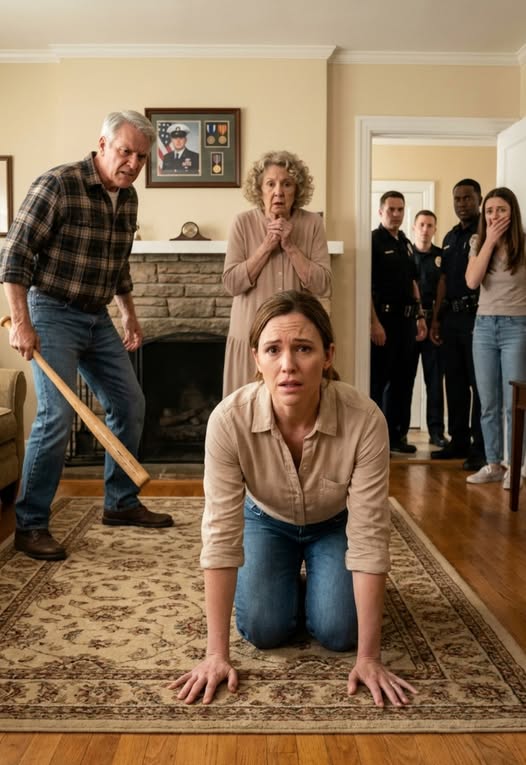
My parents showed up a month later, not with flowers, but with demands that I sell the property to bail out my sister’s failing business. When I refused, the tension escalated from cold phone calls to the moment my father showed up with a baseball bat in his hand.
After the hospital, I returned to a house that felt hollow and broken, staring at the shattered glass and the dent in the doorframe. The prosecutor called to ask if I wanted to push for the maximum sentence, but I told him I only wanted my peace and my safety.
At the hearing, I stood tall in my uniform, watching my father crumble in his seat as the judge ordered a year of no contact and full restitution. My mother wept in the back row, but for the first time in my life, I didn’t feel responsible for her tears.
Months passed, and the physical pain in my ribs faded into a dull ache that only showed up when the weather turned cold. My sister eventually came by to apologize, admitting that the greed had blinded her and that she missed having a sister more than she needed the money.
I eventually sat down with my father in a neutral setting, listening to him stumble through an apology that was years overdue. He admitted that seeing me in that uniform made him realize he didn’t even know the woman I had become.
I didn’t fix my family overnight, but I did fix the house, and I learned that forgiveness isn’t about forgetting the blow. It’s about standing upright in the aftermath and choosing to be the person my grandmother always knew I was.