Part V: Custody
The legal fight was short.
That was the funny part.
Julian and Catherine had money. Good lawyer too. But they also had the note, the thermometer reading, the ER report, the cruise posts, the text message, and a child who arrived at the hospital half-dead from heat and neglect.
Their attorney took one look at the stack and told them to stop talking.
The judge didn’t just grant me permanent custody.
She stripped them of visitation until they completed psychological evaluations.
Paperwork can be beautiful when the facts are clean.
But the court order was the easy part.
The hard part was my house.
Maya recovered physically in two weeks.
Mentally, she was still living in that hot room.
She asked permission to eat. Permission to use the bathroom. Permission to leave books on tables. If she coughed, she apologized immediately and backed into corners like punishment was already on its way.
“Sorry, Grandpa,” she’d whisper. “I’m not being dramatic. I’ll be quiet. Please don’t send me away.”
That was the real case.
Not family court. Not emergency petitions. Not legal briefs.
That.
So I built routines.
Pancakes on Saturdays.
Dog walk at four.
Cartoons after dinner.
I stopped wearing suits around the house. Wore old flannel and soft shirts instead. I read to her. Sat with her. Stayed predictable.
Slowly, the child came back.
Not all at once. Never that.
But piece by piece.
She liked astronomy. She had a vicious dry sense of humor when she felt safe enough to use it. She started leaving books on the coffee table without flinching. She stopped asking before pouring water.
Progress in damaged children is not dramatic.
It’s usually a hand unclenching.
Part VI: The Fever
Months later, winter hit Alabama hard.
One Tuesday night, the house smelled like cedar and beef stew. Maya sat at the kitchen table working on a solar system project.
Then she sniffled.
Then coughed.
A wet cough. Real one.
She froze.
I watched the old fear arrive in her face before I even stood up.
“I’m sorry,” she blurted. “I’ll go to my room. I won’t bother you. I’m sorry I’m sick.”
I turned off the stove.
Walked over.
Pulled out the chair next to her and sat down so we were eye level.
“Maya. Look at me.”
She stared at the floor. One tear dropped onto cardboard Jupiter.
I lifted her chin.
“Do you remember the day I brought you here?”
She nodded once.
“I made you a promise,” I said. “You are never a burden. Getting sick is not a crime. Needing help is not failure.”
Then I picked her up.
She was bigger now, but still light enough.
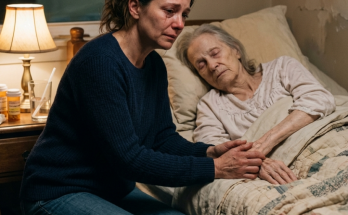
I carried her to the big recliner, wrapped her in the thick wool blanket, got her tea with honey, a cool cloth, and sat down beside her.
She watched me the whole time.
Waiting.
For impatience. Anger. Disgust. The thing she knew best.
It never came.
I stayed there six hours.
Read three chapters of The Hobbit.
Checked her fever.
Changed the washcloth.
Let her sleep with her head against my arm.
At around three in the morning, her fever broke.
She woke up slow and looked at me in the dim light.
“You stayed awake.”
“Of course I did.”
“You’re tired,” she whispered. “I’m taking up your time.”
I kissed the top of her head.
“In this house, Maya, you will never fight pain alone,” I said. “You are the only priority.”
She let out one long breath.
And for the first time, she didn’t apologize.
She just pulled the blanket tighter and went back to sleep.
That was the moment I knew she finally believed me.
Not the court order.
Not the judge.
Not the hospital.
That.
A sick child in a warm chair learning that care could arrive without a bill attached to it.
That was home.
The End.