My name is Penelope Marsh, and the night my parents tore our family apart started with roast beef, gleaming silverware, and a man in a cheap designer blazer pretending he was wealthy.
I was thirty-nine weeks pregnant, swollen, drained, and foolishly hopeful. My husband, Harrison, was stuck at work dealing with a server crisis, so I drove alone to my parents’ house in Round Rock after my mother called four times insisting this dinner was “important for the family.” By family, she meant my younger sister Valerie. She always meant Valerie.
Valerie’s new boyfriend, Dominic Ferrara, sat in my father’s chair like he owned the place. He spoke about his tech startup, Apex Dynamics, throwing around phrases like “machine learning architecture” and “nine-figure valuation.” My father, Gregory, leaned toward him like a starving man smelling fresh bread. My mother, Beatrice, kept refilling Dominic’s wine glass as if she were pouring liquid gold. I sat near the end of the table, the invisible daughter, the dependable one, the one who never caused trouble.
Then the first real contraction hit.
It wasn’t the practice pain I’d felt all week. This one wrapped around my spine and tightened until my vision blurred. I gripped the table and breathed through it while Dominic explained how investors were “lining up.” My mother looked irritated.
“Penelope, stop fidgeting.”
Nine minutes later, another contraction came. Stronger. Lower. I texted Harrison under the table: I think labor is starting. Trying to leave soon. Please call when you can.
No one noticed my trembling hand. No one noticed the sweat down my neck. They were all watching Dominic sell a dream. Valerie stroked his sleeve, glowing like she had personally rescued us all from poverty.
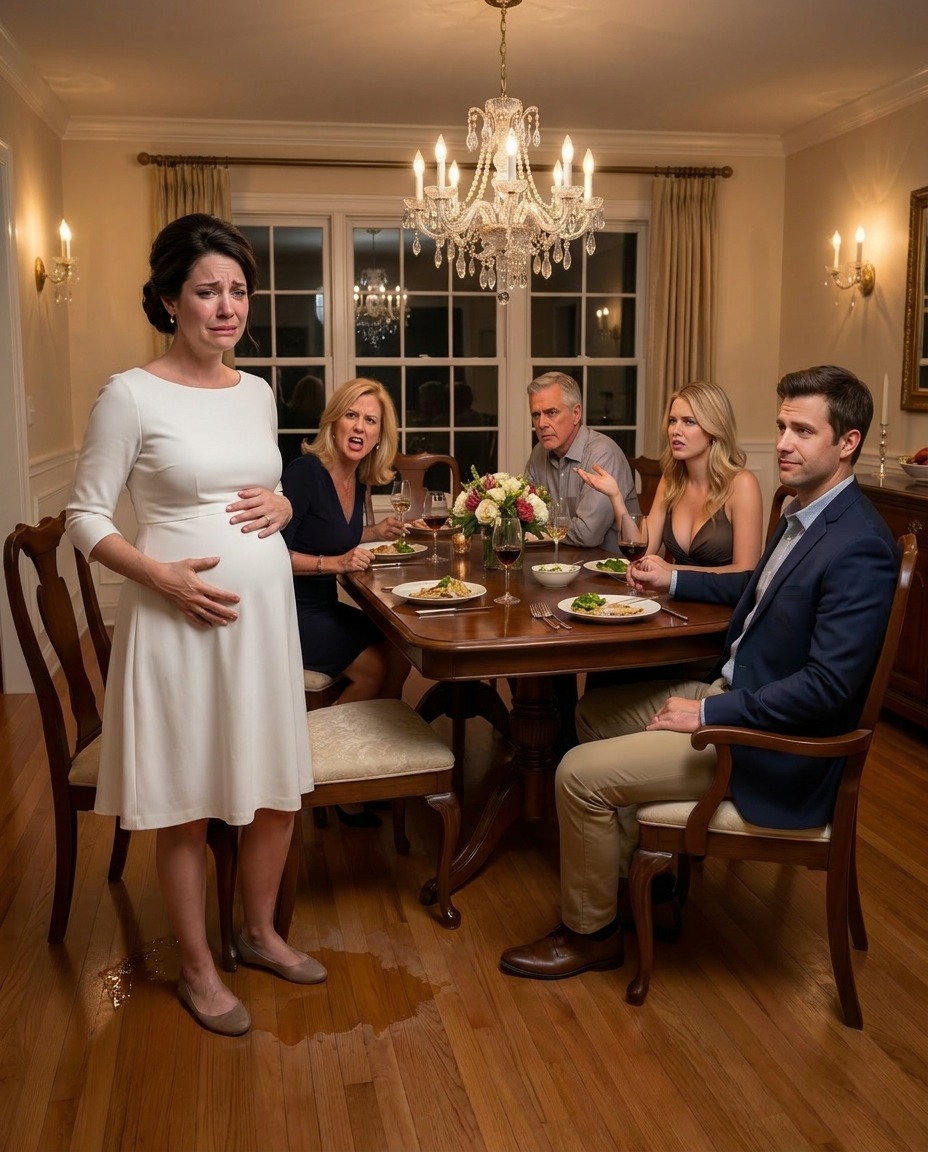
At 7:44 p.m., my water broke.
Warmth spread beneath me, unmistakable and humiliating. I pushed back from the table and stood. “I’m in labor,” I said. “The contractions are close. I need to go to Dell Medical now. One of you needs to drive me.”
For one second, the room went quiet.
Then my mother’s lips tightened. “Are you serious right now? Dominic was just getting to the important part.”
I stared at her, certain I’d misheard.
“Mom,” I said, my voice breaking. “My baby is coming.”
Valerie sighed. “God, Penny. Everything always has to be about you.”
My father folded his arms. He looked at Dominic, then at me, and I saw him weigh the cost of compassion. “This dinner could change our future,” he said. “We can’t abandon it because of your bad timing.”
Another contraction bent my knees. I reached for the wall.
“Dad, please.”
He lifted his wine glass. “Call a cab. We’re busy.”
Seven words. That was all it took.
I walked out alone. On the porch, a contraction dropped me to my knees. Through the dining room window, I saw them sit back down. My mother laughed at something Dominic said.
So I crawled to my car, pulled myself behind the wheel, and drove toward Austin in active labor. On Interstate 35, a semi-truck drifted into my lane as another contraction blinded me, and I screamed—not from pain, but because I realized my son and I might die while my parents ate dessert.
Part 2
I slammed the horn with the heel of my hand. The semi-truck swerved back into its lane, missing my mirror by inches. My whole body trembled, but I kept driving because there was no one else. I counted the white lines on the highway to stay conscious. One, two, three. Breathe. Don’t close your eyes. Your baby needs you.
At the next red light, I used the steering wheel button to call my best friend, Jasmine Okonkwo. She answered on the second ring.
“Jazz,” I gasped. “I’m in labor. I’m driving myself to Dell Medical.”
For half a second, she said nothing. Then her voice turned cold and sharp. “Where is Harrison? Where are your parents?”
“Harrison’s phone is off because of work. My parents told me to call a cab.”
“They did what?”
I heard keys, a door, movement. Jasmine didn’t waste time pretending everything was fine. “I’m leaving now. Keep driving. Do not touch your phone. I’m calling Harrison’s office, and I’ll get security to drag him out if I have to.”
When I reached the emergency entrance at 8:31 p.m., I parked crookedly with the engine still running. I managed four steps before a security guard called for a wheelchair. Two nurses rushed out. One asked how far apart my contractions were. When I told her I had driven myself, her jaw tightened, but she didn’t say what we both knew: I should never have been forced to do that.
Harrison burst through the triage doors twenty minutes later, still wearing his work badge, his shirt soaked with sweat. He grabbed my hand and kept saying, “I’m here. I’m sorry. I’m here.” I believed him because he was.
Our son was born just after midnight, furious and perfect, six pounds and four ounces. The moment they placed him on my chest, he stopped crying. His tiny fist curled against my collarbone, and I understood something my parents had never taught me: family is not blood. Family is who runs toward you when everything is on fire.
At 2 a.m., my phone lit up with missed calls. Four from my mother. One from my father. No messages asking if I was alive.
I played the voicemails on speaker.
My mother’s voice was sharp, not worried. “Penelope, your father and I are incredibly disappointed in your dramatic exit. Valerie was in tears. You obviously had Braxton Hicks and overreacted for attention. Call tomorrow and apologize.”
Then my father: “That dinner involved real investment opportunities. Actual money. You know things have been tight. Let us know when you’re done pouting.”
The room fell silent. Harrison picked up my phone without asking and blocked my mother, my father, and Valerie. Then he blocked them on his own phone too. The silence that followed felt like oxygen.
For one week, I tried to recover. Harrison’s parents, Calvin and Loretta, drove from Dallas with groceries, casseroles, diapers, and the kind of quiet care that made me cry in the shower. Jasmine came every day. She held my son so I could sleep and cursed my parents with a creativity that deserved an award.
But blocked numbers didn’t stop them. Fake social media accounts appeared, leaving comments calling me selfish, unstable, and jealous of Valerie’s “successful man.” Harrison tracked the accounts, locked down every profile, saved screenshots, and told me not to respond.
Then, exactly one week after the birth, the doorbell rang.
On the camera, I saw my parents and Valerie standing in the hallway with blue balloons and a cheap gift bag. They looked offended before I even opened the door.
My mother smiled like nothing had happened. “Penelope, sweetheart, we came to see our grandson.”
I stood in the doorway, still sore, still bleeding, holding the strength they had mistaken for weakness my entire life.
“What grandson?” I asked. “A week ago, when I begged for help, you saw an interruption.”