“You should have tried practical before Maui,” I said.
He exhaled sharply. “This is about one trip?”
“No,” I replied. “It’s about the fact that all of you sat in rooms and cars and airports for days knowing you were taking a vacation I paid for, and not one of you had the decency to tell me.”
That landed harder than anything else I’d said.
Because it was so simple.
No drama. No therapy language. Just the plain ugliness of a coordinated exclusion.
My mother started crying in the background. Real crying this time, maybe. Or maybe just more desperate. With her, the difference had never helped much.
Then came the line I had been waiting for.
“We thought you’d understand.”
There it was.
The entire family contract in six words.
We thought you’d understand.
Understand being left out.
Understand paying anyway.
Understand that your siblings mattered more because they had spouses, children, and louder needs.
Understand that being useful was your love language because they had trained you into it.
“No,” I said. “You thought I’d absorb it.”
That was the closest anyone came to silence as confession.
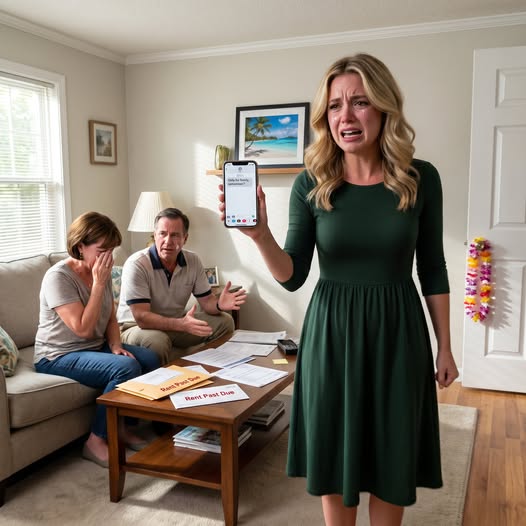
The next week unfolded in small, predictable ways. My mother sent long texts about how family shouldn’t “keep score.” My father called me selfish once and regretted it immediately when I said, “You only say that when I stop being convenient.” Caleb’s wife messaged me saying the kids loved the trip and didn’t know anything about adult issues, which was true and irrelevant. Lindsey eventually admitted she assumed I had chosen not to come and then went quiet when I asked why she never once thought to confirm that with me.
No one had a good answer.
Of course they didn’t.
The honest answer would have been too embarrassing: because somewhere in their minds, I was no longer a person who needed to be considered before decisions were made. I was infrastructure. A funding source with opinions best ignored until billing day.
I didn’t resume the rent payments that month.
Or the next.
They figured it out, because people always do when they have to. My father sold antique furniture he had always called untouchable. My mother stopped buying expensive skincare from the neighbor’s daughter. Caleb suddenly found five hundred dollars a month he claimed he “didn’t realize” he could spare. Lindsey started covering the utilities. The world didn’t end. What ended was the illusion that only I had the capacity to sacrifice.
That mattered more to me than the money.
Because for years, my family had built itself around the idea that my flexibility was permanent and therefore morally available. Once I removed it, everyone else discovered they were far less helpless than they liked to pretend.
Months later, my mother invited me to Thanksgiving with a strange new softness in her voice.
I went.
Not because everything was healed. It wasn’t. Not even close. But I wanted to see whether the room felt different.
It did.
No one mentioned Hawaii. No one asked me to pay for anything. My father thanked me when I brought wine, which had never happened before in my entire adult life. Caleb’s wife asked about my work and actually listened. Lindsey looked guilty enough to almost be useful.
And when my mother started to say, “We didn’t mean—” I held up one hand and she stopped.
That was new too.
I never got a real apology.
Families like mine rarely give clean ones. They offer changed behavior, awkwardness, small acts of caution, and the occasional careful sentence where entitlement used to sit.
It’s not justice.
But it is evidence.
And sometimes, that has to be enough. Especially when the real victory was never making them feel bad.
It was making them finally feel the cost.
Because when they told me Hawaii was “only for family,” they thought they were excluding me from a vacation.
What they actually did was end the subsidy.
My brother stole my ATM card and withdrew all the money from my account. After empty my account, he kicked me out of the house, saying, “Your work is finished, we got what we wanted, don’t look back at us now.” Parents laughed, “It was a good..
Part 2 of 2