My Karen Sister raised my rent to $6,800 in the middle of family dinner, then leaned back like she had finally put me in my place. Everyone laughed—my parents, my cousins, even my brother—like watching me get humiliated was the night’s entertainment. I didn’t argue. I didn’t beg. I just smiled, because they had no idea the house they were mocking me in wasn’t hers anymore. And what happened next made my Karen Sister regret every word she had said.
Part 1
The fork in my hand felt like it weighed a pound.
It wasn’t the steak. It wasn’t the chandelier. It wasn’t the crystal glasses catching the light like little spotlights aimed at my face.
It was the table. The long, polished, too-perfect mahogany table in my sister Madison’s dining room, where everything was always staged like a catalog spread. The flowers in the center weren’t “flowers,” they were an arrangement. The napkins weren’t “napkins,” they were linen folded into sharp, silent judgment.
Madison sat at the head like she owned the air. She always had. Three years older, three inches taller in heels, and a lifetime of acting like her success was a favor she performed for the family.
My mother dabbed at the corners of her mouth, careful not to smear her lipstick. My father carved his prime rib the way he did everything: quietly, precisely, like it was beneath him to struggle with anything. My brother Tyler was half-present, thumb scrolling on his phone. Madison’s husband Marcus poured himself another glass of red wine and didn’t bother pretending it was for “pairing.” It was for comfort. For confidence. For the version of himself he liked more.
Madison set her fork down with a little click.
“So,” she said, voice syrupy. “Emma.”
My name sounded like she was about to scold a dog.
I swallowed. Set my fork down too. “Yeah?”
Madison smiled, but it didn’t reach her eyes. It never did when she was about to enjoy herself. “Marcus and I have been talking. We need to discuss your living arrangement.”
There it was. That tone.
Same tone she used when we were kids and she wanted Mom to know I’d stepped on her territory. Same tone at my college graduation when she announced her engagement during dessert. Same tone at my wedding reception when she leaned in and whispered, congratulations, you finally caught up.
The basement apartment had been my parachute after Derek. After the divorce. After the debt I didn’t even know existed until it was strangling me. Madison had offered it with a saintly smile: Eight hundred a month. Furnished. Separate entrance. “No pressure,” she’d said, like she was giving me a spa weekend instead of a place to keep my life from spilling into the street.
I’d taken it because pride doesn’t pay for shelter.
I kept it spotless. Paid on time. Lived small. Made myself easy to ignore.
Madison folded her hands. Her diamond bracelet flashed, as if the chandelier respected it.
“We’ve realized,” she said, “that the rent you’ve been paying is significantly below market value.”
Marcus nodded along like this was a quarterly report.
Madison went on, voice bright. “So, starting immediately, your rent will be… six thousand eight hundred dollars a month.”
For a second, I thought I’d misheard her.
Then I saw the little twitch at the corner of her mouth. The satisfaction.
My mother made a strangled sound. “Madison—”
“It’s fair,” Madison cut in smoothly. “Comparable units in this neighborhood go for even more.”
Tyler looked up from his phone. “Wait. What?”
Marcus swirled his wine. “We’re losing money, honestly. We’ve been subsidizing Emma for two years.”
Subsidizing.
Like I was a charity case they’d sponsored for the holidays.
Madison tipped her head, studying me like she was waiting for tears. “You’re thirty-four, Emma. You can’t… depend on us forever.”
My father chuckled behind his napkin, like this was a harmless joke. My mother’s laugh came out nervous and thin. Even Tyler’s mouth twitched, then he caught himself and looked away.
I let it happen. I let the laughter land and settle and warm Madison’s skin like sunlight.
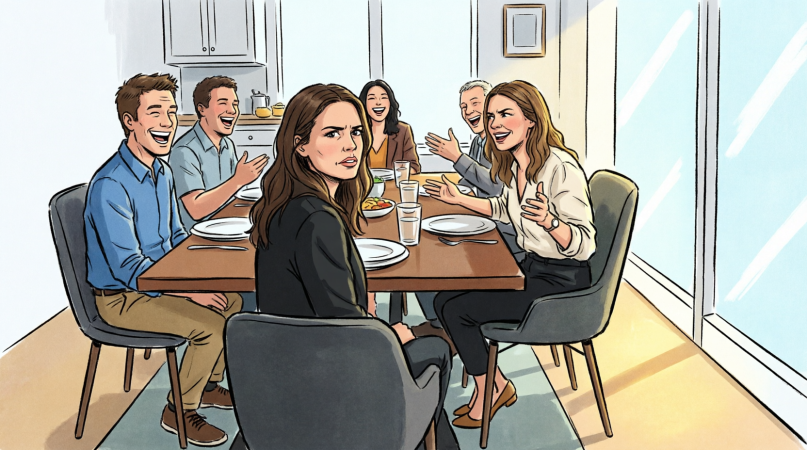
Because here’s the thing nobody tells you about rock bottom: once you hit it, you stop fearing the fall. There’s nothing left to lose. And that’s where power hides—quietly, patiently—waiting for you to notice.
Madison leaned forward, voice dropping like she was being kind. “So what do you say? Can you handle it? Or should we find a real tenant?”
I looked around the table.
My mother, anxious, hoping I’d make it easy by apologizing for existing.
My father, amused, as if my humiliation was proof the universe still made sense.
Marcus, interested, like he was watching a financial documentary.
Tyler, uncomfortable, trapped between loyalty and decency.
Madison, glowing.
And something in me unclenched.
I smiled.
Not a polite smile. Not a “please don’t hurt me” smile.
A real one.
Madison’s eyebrows lifted. “What’s funny?”
I picked up my water glass, took a slow sip, and set it down.
“That’s actually perfect timing,” I said.
“Perfect timing,” Madison repeated, like she tasted something sour. “Emma, you can’t afford sixty-eight hundred dollars a month.”
“Oh,” I said lightly. “I could. But I won’t need to.”
Silence rolled across the table.
My mother blinked. Marcus paused with his fork halfway to his mouth.
Tyler’s phone lowered completely.
My father’s knife stopped.
Madison’s smile faltered. “What does that mean?”
“It means,” I said, still calm, “I’m moving out. My closing is next Thursday.”
“Closing?” my father echoed.
“On my house,” I said.
Madison went still. “Your… house.”
“Three-bedroom,” I added. “Old Victorian. Riverside district.”
That got her.
Riverside was the neighborhood Madison always talked about like it was a private club. “If we ever move,” she’d say, swirling wine at parties, “it would have to be Riverside. But the prices are insane.”
Now she stared at me like I’d claimed I was buying the moon.
“With what money?” she snapped, composure cracking. “You’re a paralegal.”
“I was,” I said. “I passed the bar earlier this year.”
My mother’s hand flew to her chest. “Emma—what?”
“I work as an associate attorney now,” I continued. “Same firm that hired me as a paralegal. They sponsored my prep. I studied. I passed. They promoted me.”
Marcus swallowed. “How much does that pay?”
“Starting salary is one-forty,” I said. “Plus bonus.”
My father’s eyes sharpened, like he’d just realized he’d been wrong and didn’t like it.
Madison’s face flushed. “You’ve been living in my basement while making that?”
“For six months,” I corrected. “Before that, I saved. Aggressively. Lived cheap. Did the boring stuff that works.”I glanced at Tyler. “Remember last Thanksgiving when you laughed because I brought my own Tupperware instead of eating out with everyone?”
Tyler winced. “Yeah.”
Madison’s voice tightened. “So you’re just—what—rubbing it in?”
“No,” I said. “I’m answering your question.”
Then I reached into my purse and pulled out my phone. Scrolled. Stopped.
“Also,” I added, “Madison, do you remember signing those papers I brought you last year? The ones you witnessed?”
Her eyes narrowed. “What papers?”
“You were hosting your book club,” I said. “You didn’t look at them. You just signed.”
Madison’s lips parted, confused and suddenly wary.
“Those were formation documents for an LLC,” I said. “My LLC.”
Tyler’s voice came out strangled. “Emma.”
I tapped the screen. “The LLC bought a four-unit apartment building downtown. Six months ago.”
For a heartbeat, nobody breathed.
Then my mother whispered, “You own an apartment building?”
“The company does,” I said. “I’m the sole member.”
Madison’s chair creaked as she shifted, like her body was trying to find an exit without standing up.
Marcus stared at me with a hungry kind of respect now, the way people look at money when it’s finally in the room.
“I’ve been thinking about expanding,” I went on, tone casual, like I was talking about trying a new coffee shop. “There’s a commercial property coming up for auction. Former restaurant space in the arts district.”
I turned to Marcus. “Didn’t you say you’ve been looking for a location for your farm-to-table concept?”
Marcus blinked. “I… yeah.”
“This one’s estimated around eight hundred,” I said. “Needs work, but the traffic is incredible.”
Madison finally found her voice, sharp and high. “This is ridiculous. You expect us to believe you’re suddenly some kind of… real estate investor?”
“I’m not sudden,” I said. “I’m quiet.”
I looked directly at her.
“And I’m done being your punchline.”
The table was so still it felt like the chandelier was holding its breath.
I stood up, placed my napkin neatly beside my plate, and picked up my purse.
“Dinner was lovely,” I said. “Thanks for hosting.”
My mother’s voice wobbled. “Emma, don’t leave like this.”
“I’m not leaving like anything,” I said gently. “I’m just leaving.”
I turned toward Madison. “I’ll be out by Wednesday. You can list the basement for whatever price you want. Maybe you’ll find someone willing to pay sixty-eight hundred.”
Madison’s jaw clenched. “You’re doing this to embarrass me.”
“No,” I said. “You did that all by yourself. I’m just not helping anymore.”
When I reached the entryway, Tyler followed, catching up to me with quick steps.
“That was insane,” he whispered. “In a good way.”
I opened the door, cool air brushing my face. “It wasn’t about being insane.”
“It was about—what—revenge?”
I paused. Looked at him.
“It was about boundaries,” I said. “And it was about me remembering who I am.”
He nodded like he understood more than he wanted to admit. “You okay?”
The question hit harder than Madison’s rent number.
Because it was the first real question I’d heard at that table in two years.
I exhaled. “Yeah. I’m okay.”
Behind us, the dining room erupted into muffled voices. Madison, furious. My mother, panicked. My father, low and gruff. Marcus, quiet and calculating.
I stepped into the night.
And smiled again, to myself this time, because the part they didn’t understand was simple:
I wasn’t escaping.
I was arriving.
Part 2
The next morning, my phone was a war zone.
Seven missed calls from Madison. Two from my mother. One from Marcus. A text from Tyler that just said: Proud of you. Also, please don’t let her murder you.
I made coffee in the little kitchen that had been my world—outdated cabinets, a humming fridge that sounded like it was aging in dog years—and I let the quiet settle around me.
It was strange, how peaceful it could feel to finally be the villain in someone else’s story.
I didn’t call anyone back right away.
I had work. Real work. The kind of work that didn’t care about my family’s hierarchy.
At the firm, nobody called me “the divorced one.” Nobody talked to me like I was a lesson. They cared if my research was airtight, if my drafting was clean, if my arguments held up under pressure. My boss, Catherine Morrison, cared if I was sharp.
Catherine was the one who’d looked at me during my divorce—eyes red from crying, hands shaking as I slid bank statements across her desk—and said, “You’re not stupid, Emma. You were betrayed. There’s a difference. And you don’t have to stay broken.”
She didn’t say it like comfort. She said it like instruction.
After I finished a morning hearing and sent off a round of revisions, I checked my voicemail.
Madison’s message was first.
Her voice was tight, clipped, vibrating with humiliation. “You made me look like an idiot. Call me back.”
My mother’s message followed, softer. “Honey, your father and I didn’t know. We should have known. Please call.”
Then Marcus, which surprised me. “Emma, I… look. I want to talk about that commercial space you mentioned. If you’re serious.”
I stared at my phone, thumb hovering.
Then I got another call—this one from my father.
I answered.
“Emma,” he said, voice low. “Can you meet me outside? At Madison’s. Just ten minutes.”
It wasn’t a request. But it also wasn’t an order. It was something in between, like he was trying on a different way to be.
I should’ve said no.
But curiosity is a kind of courage too.
That evening, I drove back to Madison’s house. Her suburban fortress looked the same as always—perfect lawn, tasteful porch lights, the kind of home that said we don’t have problems here, we outsource them.
My father was waiting on the front step, hands shoved in his pockets. He didn’t hug me. We weren’t a hugging family. But he nodded, which in our language was an entire paragraph.
We stood in the cold, the porch light casting shadows across his face.
“I laughed,” he said finally. “Last night.”
I waited.
“That wasn’t right.” He cleared his throat. “I thought Madison was… helping you. And maybe she was, but I didn’t see the other part.”
“The part where she got to feel taller,” I said.
He nodded once, like it hurt to admit. “I didn’t see you rebuilding. I assumed you were… stuck.”
I almost laughed at the word stuck. Like I’d been sitting still. Like all those early mornings, all those nights studying until my eyes burned, were just me idling.
But anger wasn’t the point anymore.
“I didn’t broadcast it,” I said. “I didn’t want opinions. I didn’t want advice. I didn’t want Madison turning it into a competition.”
My father looked down at the steps. “You passed the bar.”
“Yes.”
“You bought a house.”
“I’m closing next Thursday.”
He was quiet for a moment. Then: “I’m proud of you.”
The words landed like something heavy and warm.
My father didn’t hand out pride the way other people did. It wasn’t casual. It wasn’t easy. It was a currency he guarded like it mattered.
My throat tightened. “Thanks, Dad.”
He shifted, uncomfortable with emotion. “Your mother wants to come see the place when you’re settled.”
“She can,” I said. “You too.”
He nodded again. “Madison is inside. She’s… upset.”
“I noticed,” I said.
My father’s mouth twitched, almost a smile. “You always were the calm one.”
I thought of my nights in that basement, panic sitting on my chest like a weight, and I almost corrected him. Calm wasn’t something I’d been. Calm was something I’d built.
“I should go,” I said.
He reached out, clapped my shoulder once—awkward, quick—and stepped aside.
Inside, Madison was pacing in the entryway like a storm trapped in designer clothes. Marcus stood near the kitchen, arms folded, looking tired in a way money couldn’t fix.
Madison spun toward me. “So you’re just going to waltz in here like you didn’t blow up my life?”
“I didn’t blow up your life,” I said. “I answered your performance.”
Her eyes flashed. “You embarrassed me.”
“You tried to embarrass me,” I corrected. “I just didn’t play my part.”
Madison’s breath came fast. “You could’ve told us.”
“Why?” I asked. “So you could make it about you? So you could ‘help’ me again and remind me every holiday?”
Her face tightened like I’d slapped her.
Marcus cleared his throat. “Emma, about the property auction—”
Madison whipped toward him. “Not now!”
I held up a hand. “It’s fine. Marcus, email me the details. I’ll look at them.”
Madison snapped back to me. “You think you’re better than us now?”
I studied her. Really studied her.
She wasn’t angry because I’d lied. She was angry because the story she’d been telling herself—successful Madison, broken Emma—had cracked.
“I don’t think I’m better,” I said slowly. “I think I’m free.”
Madison’s laugh came out sharp. “Free. From what? Responsibility?”
“From needing you to approve of me,” I said. “From being grateful for scraps. From being the family’s cautionary tale.”
My mother’s voice drifted from the dining room. “Madison, please—”
Madison ignored her. “You lived here because you needed us.”
“I lived here because I needed shelter,” I said. “And I paid for it.”
Madison’s chin lifted. “We charged you below market.”
“You charged me what you wanted,” I said. “And I accepted because it was better than sleeping in my car.”
The room went still.
Marcus’s face tightened; he looked away, uncomfortable.
Madison’s eyes widened, just a fraction.
For the first time, I saw something besides smugness in her. Something like shame, caught off guard.
I exhaled. “I’m not here to punish you. I’m here to tell you I’m leaving Wednesday, and I want it clean.”
Madison’s voice dropped, quieter now, but still barbed. “And the LLC papers. You had me sign those like an idiot.”
“You witnessed them,” I said. “That’s what witnesses do.”
Madison’s eyes narrowed. “Did you do that on purpose? So I’d be part of your little scheme?”
“No,” I said honestly. “I did it because you were there, and I needed a signature, and I didn’t want to ask you for anything else.”
Marcus stepped forward. “Emma—look, I know last night was… a lot. But I really am serious about the restaurant. If you’re willing to consider investing—”
“I’m willing to consider numbers,” I said. “Not feelings.”
Madison made a sound like offense was her native language.
I turned to her. “If you ever want to have a relationship that isn’t built on you standing on my neck, you’ll have to change how you talk to me.”
Madison’s jaw worked, like she was chewing glass. “So you’re giving me an ultimatum.”
“I’m giving you a boundary,” I said. “You can accept it or not. But I’m not negotiating my dignity at the family table anymore.”
For a second, she looked like she might cry.
Then she straightened, armor snapping back into place. “Fine. Leave. See if your little house makes you happy.”
I smiled, small and genuine. “It already does.”
I walked out before she could say anything else.
In my car, I sat for a moment with my hands on the steering wheel, breathing.
The old me would’ve shaken. Would’ve replayed every word. Would’ve wondered if I’d gone too far.
The new me just felt… clear.
Because the truth was, Madison couldn’t raise my rent anymore.
Not because I had money now, though I did.
But because she didn’t own my safety anymore.
Part 3
Wednesday came fast.
I packed in quiet bursts between work and sleep. Boxes stacked like proof. My basement apartment emptied room by room, the walls revealing faint scuffs where my desk had sat, where I’d taped up schedules for bar prep, where I’d written myself small reminders on sticky notes: Keep going. Don’t quit. Future you is watching.
On my last morning there, I swept the floor twice, wiped down the counters until they shined, and left the key on Madison’s kitchen counter with a simple note.
Thank you for the roof. I’m taking it from here.
I didn’t wait to see her reaction.
Closing day felt almost anticlimactic, like the climax had already happened at that dinner table.
I sat in a conference room with a stack of documents thick enough to qualify as furniture. My realtor slid papers toward me. My attorney—someone I’d hired even though I could technically do it myself because I’d learned the value of having a team—watched for details.
I signed my name again and again and again until my hand cramped.
Then the seller’s agent handed me a small ring of keys.
My keys.
My house.
I walked through the front door alone first.
The Victorian smelled like dust and old wood and second chances. Sunlight poured through tall windows, catching the worn edges of the floorboards. The place needed work. The kitchen was stubbornly stuck in the 1980s. The paint colors were choices someone had made during a fight.
But the bones were solid.
The house felt like something that had survived its own story—and was ready for another.
An hour later, Catherine arrived with cheap champagne and plastic cups because she believed in celebrations that didn’t wait for perfect.
“You did it,” she said, grinning.
“I did,” I said.
We clinked cups in the empty living room.
“You know,” Catherine added, leaning back against a doorway, “your sister thought she was humiliating you.”
“She was,” I said.
“And you smiled.”
“I did,” I agreed.
Catherine’s eyes gleamed. “Because you knew.”
I looked around at the empty rooms, the quiet, the space that belonged to me.
“Because I knew,” I said.
The weeks after that were busy in the best way. I painted walls. Scheduled contractors. Pulled up carpet to reveal hardwood worth saving. I learned my neighbors’ names. I ran miles along the riverwalk early in the morning, feeling like I was moving forward on purpose.
Work got heavier too. My caseload grew. I started specializing in divorces with complicated finances—hidden assets, secret accounts, spouses who smiled while lying. I could spot the patterns. I knew the language of manipulation, the way it tried to make you doubt your own memory.
When a client cried and said, “I feel stupid,” I didn’t comfort her with clichés.
I said, “You’re not stupid. You’re being played. Let’s end the game.”
Meanwhile, Marcus emailed me his restaurant plan.
It wasn’t bad. It was just unfinished—like him.
I marked it up in red and sent it back with notes: show your numbers, not your dreams. Identify your risks. Build contingencies. Stop assuming passion is a business model.
He called me that night, voice a mix of defensive and grateful. “You’re brutal.”
“I’m honest,” I said.
Silence. Then: “Can you… help me do it right?”
I thought of Madison at the head of her table, smug with superiority. I thought of Marcus’s exhausted face, the way he looked like he’d been holding his breath in his own life.
“Yeah,” I said. “I can help you do it right. If you’re willing to work.”
He did work.
And when the commercial property auction came, I won it.
Not by throwing money at it—by preparing. By knowing my ceiling and refusing to get emotional. By remembering that calculated risk was different from gambling.
Madison didn’t come to my housewarming party a month later until she was almost an hour late. When she arrived, she wore her perfect smile like a mask and walked through my renovated living room as if she was touring a property she might buy.
“It’s… nice,” she said, like that word cost her.
“Thanks,” I said, not biting, not begging.
My parents showed up early. My mother brought a casserole like I was still twenty-two and fragile. My father walked through the house quietly, touching the crown molding, studying the woodwork.
“This is solid,” he said, which in Dad-language meant you did good.
Tyler showed up with his girlfriend and announced, loudly, “I always knew Emma was secretly Batman.”
I laughed harder than I expected.
Late in the evening, after the last guest left, Madison lingered on my porch.
“Can we talk?” she asked.
I didn’t owe her conversation. But I wanted to know who she was when she wasn’t performing.
So I nodded.
We sat side by side, the street quiet, the porch light warm.
Madison stared at her hands. “I was jealous,” she said finally, voice flat with the honesty she usually avoided.
I didn’t speak.
“I built my whole identity on being first,” she continued. “First marriage. First house. First promotion. And when you… when you crashed… it made me feel safe.”
That landed in my chest like a stone.
Madison swallowed. “And then you stood up at that dinner and showed me you were never… less. You were just rebuilding. And I hated that I didn’t know.”
“You didn’t ask,” I said quietly.
“I know,” she whispered.
Silence stretched.
Then she said, “I’m sorry.”
It wasn’t dramatic. It wasn’t cinematic. It didn’t erase the last two years, or the way she’d used my low point as a stage.
But it was real.
I exhaled. “I’m not looking for you to grovel.”
Madison nodded stiffly. “Then what do you want?”
I looked out at the street, at my house behind me, at the life I’d built with my own hands.
“I want you to treat me like an equal,” I said. “Not a rival. Not a charity case. Not a cautionary tale.”
Madison’s throat bobbed. “I can try.”
“Don’t try,” I said gently. “Do.”
She sat with that.
Then she nodded again—smaller this time. “Okay.”
When she left, I stayed on the porch a while longer, letting the quiet wrap around me.
My phone buzzed with a text from Catherine.
Auction went well. Proud of you. Also, you’re buying more property than some people buy shoes. Don’t get cocky.
I smiled.
Because the ending I’d needed wasn’t Madison apologizing.
It wasn’t my family finally clapping for me.
It was this:
I had a roof nobody could threaten. A future nobody could hold hostage. A life built on decisions instead of desperation.
And that meant, no matter what my family did next—no matter what Madison tried next—there was one thing she could never do again.
She could never raise the price of my peace.