My son was asleep on a hospital bench with one shoe missing when I discovered my mother had left him there alone. I was still trembling from anesthesia, my stitches burning beneath my skin, when the nurse leaned close and whispered, “Mrs. Carter, we thought his grandmother was with him.”
The hallway seemed to tilt beneath me. Eli was only four. He was curled beneath my coat, his cheeks marked with dried tears, one tiny hand wrapped around a juice box someone had given him.
“Where is my mother?” I asked.
The nurse looked away. I called my mother with shaking fingers. She answered on the third ring, laughing at something in the background.
“Mom,” I said, my voice rough. “Where are you?”
“Oh, sweetheart. You’re awake?”
“Where are you?”
There was a pause. Then she answered carelessly, like it meant nothing.
“At Melissa’s. Your sister needed us more.”
My blood went cold.
“Eli was alone.”
“He was in a hospital, Rachel. Stop being dramatic.”
I stared at my little boy, the child I had trusted her to protect while doctors operated on me.
“You left my son sleeping on a bench.”
“And Melissa was having a crisis,” she snapped. “Her husband threatened to stop paying for her car. You always figure things out, don’t you?”
There it was. The family motto. Rachel manages. Rachel forgives. Rachel pays. Rachel stays quiet. Then my father took the phone.
“Don’t start trouble tonight,” he said. “Your mother did her best.”
I almost laughed. Her best was abandoning a preschooler beside a vending machine.
“Do not come to my house,” I said.
Mom sighed. “You’re emotional. We’ll talk tomorrow.”
“No,” I said. “We won’t.”
That night, I signed myself out of the hospital against medical advice, held Eli on my lap in the taxi, and went home. The porch light was on. My mother’s casserole sat on the steps like an insult. I called a locksmith. He arrived at 10:47 p.m. and changed every lock while Eli slept on the couch.
“You’re sure about this?” he asked gently.
“Yes.”
When the final deadbolt clicked into place, something inside me finally settled. My phone buzzed. Melissa: You’re being cruel. Mom is crying. Then Mom: Don’t punish us because you’re jealous. I stared at the messages, then opened the locked drawer in my desk. Inside were copies of bank transfers, text messages, medical proxy forms, and the deed to the house they still believed belonged to “the family.” They had always mistaken my silence for weakness. That was their first mistake. Their second was believing the old key still mattered.
The next morning, my mother arrived before sunrise. First, I heard the scraping sound. Metal against metal. Then the angry twist of her old key in the lock. Through the security camera, I watched her frown, try again, then pound on the door.
“Rachel! Open this door!”
Eli stirred behind me.
“Mommy?”
“It’s okay, baby,” I whispered. “We’ll have pancakes soon.”
My mother shouted through the door.
“You changed the locks? On your own mother?”
I opened it with the chain still latched. She stood there in her church coat, face powdered, eyes hard.
“You embarrassed me,” she hissed.
“You left my son alone.”
“He was fine.”
“He was terrified.”
She rolled her eyes.
“You always exaggerate. Melissa says you’re using your surgery for attention.”
My father appeared behind her, holding the casserole dish.
“Let us in.”
“No.”
His face darkened.
“This is our house too.”
I smiled faintly.
“No, Dad. It isn’t.”
For the first time, he hesitated. My mother recovered faster.
“After everything we’ve done for you? Watching your child? Helping you after Daniel left?”
“Daniel died,” I said quietly. “He didn’t leave.”
She waved the words away like my grief was dust.
“You know what I mean.”
Yes. I knew exactly what she meant. After Daniel’s accident, they had moved in “temporarily.” Then they stayed. They used my guest room, my groceries, my car, and my name. Mom told people she was raising Eli because I was “fragile.” Dad told relatives he had “kept a roof over our heads.” But the truth was sitting in emails, receipts, and signatures. The house had been bought with Daniel’s life insurance. Only my name was on the deed. My parents had not paid a single mortgage payment. But they had used my emergency credit card for Melissa’s salon renovation. They had signed my name on a so-called “family loan” while I was in grief counseling. They had convinced me, exhausted and broken from loss, that fighting them would destroy the family.
Now they stood on my porch, furious that the servant had locked the castle.
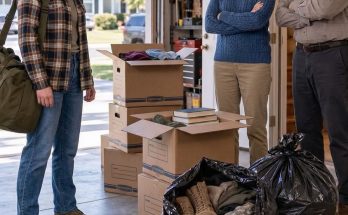
“You have until five tonight to collect your things,” I said. “I’ll pack them.”
Mom’s mouth fell open.
“You’re kicking us out?”
“You threw my son away first.”
Dad stepped forward.
“Careful, Rachel.”
There it was. The old voice. The one that used to make me feel fifteen again. Small. Apologetic. Desperate to be approved of. But behind him, my new camera blinked red. Recording. I looked him straight in the eye.
“Threaten me again.”
He stopped. Mom laughed, sharp and ugly.
“Who do you think you are?”
I closed the door. By noon, my phone was exploding. Aunt Linda: Your mother says you had a breakdown. Melissa: Mom says you’re refusing to let them get their belongings. That’s illegal. Dad: You owe us $38,000 for childcare. That one almost impressed me. I forwarded everything to Mara Singh, my attorney. Six minutes later, Mara replied: Excellent. Keep letting them talk.
People underestimated me because I cried easily. They forgot I had been a forensic accountant before motherhood, grief, and surgery hollowed me out. Numbers had always obeyed me better than people. For months, I had quietly been rebuilding statements, tracing withdrawals, saving messages, and documenting every insult, every unauthorized charge, every lie. And now my mother had left my child alone in a hospital.
At 2:13 p.m., the hospital’s risk manager called. I gave my statement. The nurse gave one too. The cameras had captured everything. At 4:55, a moving van pulled up outside. It wasn’t one I had ordered. Melissa stepped out first, wearing sunglasses and smiling like a cheap movie villain. Mom followed, holding her old key between two fingers.
“You don’t get to decide,” she said. “Families share. Houses share. Children share.”
She shoved the key into the lock again, as if arrogance could reshape metal. It did not turn. Melissa smirked.
“This is why nobody likes you, Rachel. You think you’re better than us because Daniel left you money.”
This time, I opened the door fully. Behind me stood Mara in a navy suit, holding a folder thick enough to ruin lives.
“No,” I said. “I’m better because I kept receipts.”
Part2: I woke up from surgery to find my four-year-old son abandoned on a hospital bench, crying into my coat. When I called my mother, she didn’t panic. She laughed and said, “Your sister needed us more.” That night, with stitches still burning, I changed every lock on my house. But the real nightmare began the next morning—when she returned with her old key, certain it would still open my door.
I woke up from surgery to find my four-year-old son abandoned on a hospital bench, crying into my coat. When I called my mother, she didn’t panic. She laughed and said, “Your sister needed us more.” That night, with stitches still burning, I changed every lock on my house. But the real nightmare began the next morning—when she returned with her old key, certain it would still open my door.
Part 1 of 2