“Property Deed in favor of Claire Davis.”
Robert looked up. He no longer had the color of a powerful man. He had the color of a man who’d been caught.
—”What is this nonsense?” —”It’s not nonsense,” I replied. “It’s the deed to the house.”
His fingers gripped the pages. —”I paid for this house.” —”No, Robert. You paid for the drapes, the armchairs, and the dinners where you bragged about rescuing me. My dad bought this house before he died. He left it in my name, and when Matthew turned five, I put it into a trust for him too.”
Matthew squeezed my hand. I felt his freezing little fingers.
Robert looked toward the entryway. There, hanging over the door, was the bronze sign he had custom-made three years ago. “The Sterling Residence.”
But it was no longer screwed to the wall. It was tied with a piece of twine, crooked, hanging like roadkill. Beneath it, written in black marker on a white piece of poster board, Matthew had written in his messy handwriting: “This house does not kick out kids.”
Robert read the phrase. And then he finally lost his voice. —”You took down my last name.” —”No,” I said. “I took down a lie.”
His gaze filled with fury. —”Claire, make no mistake. I gave you a life you never would have had.”
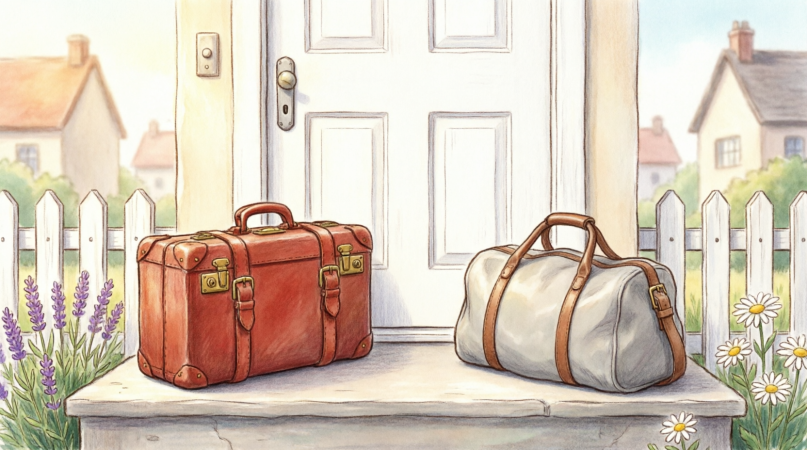
I laughed softly. Not because it was funny. Because suddenly I saw the absurdity of it all. A man standing in front of five suitcases, in a house that wasn’t his, telling me he had given me everything.
—”You gave me fear,” I told him. “You gave me silences. You gave me dinners where I had to watch every word so you wouldn’t get upset. You gave me expensive clothes so I’d look happy in your photos. But life, Robert, he gave me life.”
I looked at Matthew. My little boy swallowed hard. —”And I almost let you take it away from him.”
Robert folded the papers and threw them onto the suitcase. —”This isn’t over.” —”No,” I replied. “It’s not over. There’s also a separation petition, an inventory of your belongings, and a letter from my attorney. You have forty-eight hours to pick up whatever is left. Today, you leave with what’s here.”
His eyes locked onto me. —”You lawyered up?” —”Months ago.”
That hurt him more than the suitcases. Because Robert could forgive a tear. He could defeat a scream. But a prepared woman disarmed him.
—”Months?” he repeated. “While you slept next to me.” —”While you told me Matthew was a burden. While you shushed him at the dinner table. While you turned off his TV even though he got straight A’s on his homework. While you bought your grandkids electric bikes and told him not to waste water by showering so much.”
Matthew lowered his head. There was the wound. The one I had seen, but hadn’t wanted to look at entirely.
Robert clicked his tongue. —”Childish drama.” —”No,” I said. “Adult scars starting early.”
He walked toward Matthew. I stepped in front. —”Don’t come any closer.”
Robert stopped as if an invisible wall had hit him in the chest. —”You spoiled him. That’s why he manipulates you.”
Matthew let go of my hand. He took a step to the side. Small. Barefoot. But firm.
—”I’m not manipulating anyone, Robert,” he said in a very quiet voice. “I just wanted you to love me a little bit.”
The silence broke from the inside out. Robert opened his mouth. He said nothing. Because there was no possible defense against a child begging for crumbs.
I felt something burning in my throat. All the afternoons Matthew turned down the volume on his cartoons. All the times he stopped inviting friends over because Robert said “other people’s brats smelled like dirt.” All the nights he asked me if he could eat dinner in his room so he wouldn’t be a bother. My son had been shrinking inside his own home. And I, terrified of being alone, had confused peace with silence.
—”Matthew,” I whispered. He looked at me. —”Forgive me.”
His little face changed. —”Mom…” —”No, my love. Listen to me. You never had to be quieter so they would love me. You never had to get better grades to earn a plate at the table. You never had to hide your dinosaurs because someone thought it was childish for you to be a child.”
His eyes filled with tears. —”I thought I did.”
I hugged him. And there, in front of Robert, we both cried. Not in defeat. But as a cleansing.
Robert ran his hand through his white hair. —”Are you done with the family theater?” I lifted my head. —”No. The show you don’t direct is just beginning.”
Then the doorbell rang. Robert frowned. —”Who did you call?”
I opened the door. My sister Ellie walked in first, with her big purse and her “not even scared of the devil” face. Behind her came my mom, Theresa, leaning on her cane. And finally, Attorney Valerie Newman, my lawyer, holding a blue folder with a calmness that was more intimidating than any shouting.
Robert let out a laugh of disbelief. —”You brought an audience?” My mom looked him up and down. —”No, old man. She brought witnesses.”
Robert turned red. —”Theresa, stay out of this.” —”I’m stepping in because my grandson lives here. And because twenty years ago I buried my husband, but I didn’t bury my dignity. He built this house working the early morning shifts at the bakery. You just came and slapped your last name on it, as if these walls didn’t have a memory.”
Robert gritted his teeth. —”Claire, this is humiliating.” —”Humiliating was my son offering to go live with his grandma so I wouldn’t be left alone.”
No one spoke. Not even Ellie, who always had a word ready.
The lawyer took a step forward. —”Mr. Sterling, here is the copy of the documents proving the ownership belongs to Ms. Claire Davis. You are also hereby notified of the termination of marital cohabitation at this residence. Your main belongings have been packed, inventoried, and photographed. You can review the list.”
Robert took the folder like it was poison. —”My children are going to hear about this.” —”Perfect,” Ellie said. “Let’s see if they finally come visit you.”
That was a low blow. But it was true. Robert’s three adult children only showed up on Christmas, for birthdays at expensive restaurants, or when they needed a co-signer for a loan. I had catered to them for years. I poured their coffee. I packed up their leftovers. I babysat their kids. They called me “Clarey” as if I were the help, not their father’s wife.
And Robert, whenever Matthew asked for an ice cream, would say: —”Don’t push your luck, kid. Money doesn’t grow on trees.”
Money sure grew for others. Just never for my son.
Robert walked over to the bar cart and poured himself a whiskey. —”I’m not leaving.”
The lawyer didn’t lose her cool. —”Then we will call the police to file a report of the conflict and prevent any escalation. It’s your choice whether you leave through the door or with a police record.”
He stopped with the glass halfway to his mouth. His power had always depended on no one ever contradicting him. That night, there were too many of us saying no.
—”Claire,” he said, changing his voice. “Let’s talk in private.”
There it was. The soft tone. The one he used after hurting me. The one that came with flowers, trips, and a card with no apologies. It used to break me. Not tonight.
—”I have nothing to discuss in private with a man who asked a mother to abandon her son.”
Robert looked at Matthew. For the first time, he seemed to really see him. Not as noise. Not as a dumped backpack. But as a child.
—”I didn’t mean he should go out on the street.” —”No,” Matthew said. “You said you wanted peace.”
Robert looked down. Matthew took a deep breath. —”I wanted peace too. But not the peace of having to be quiet. The peace of being able to laugh without someone getting mad.”
My mom started crying in silence. Ellie wiped her nose with the back of her hand. I felt Matthew age an entire year in that one sentence.
Robert set his glass on the bar. —”At your age, you don’t understand.” —”I do understand,” my son replied. “I understand that my mom chose me.”
The living room stood still. Robert looked up at me. There was anger. But also something resembling fear. Not the fear of losing a house. The fear of not being chosen. What irony. He, who forced me to choose. He, who believed a child couldn’t compete with a last name, a bank account, and a man with a driver. He had just discovered that a mother doesn’t compare. A mother just knows.
—”You’re going to regret this,” he muttered.
I took a breath. I looked at the suitcases. I looked at the hanging sign. I looked at my son. —”I regret waiting so long. That I do.”
Robert stood still. Then he walked toward his suitcases. He didn’t pick them up right away. It was as if he was still waiting for me to run over, touch his arm, tell him no, tell him I just snapped, that Matthew could spend a few days with my mom and then everything would go back to normal.
But I didn’t move. Ellie opened the door. The cool night air rushed in. Robert grabbed two suitcases. They were heavy. Of course they were heavy. Inside were his suits, his shoes, his expensive colognes. But they also carried the weight of every slight.
He walked out onto the porch. The driver wasn’t there. I had canceled the service that morning.
Robert turned around. —”Where’s my SUV?” —”In the garage. The keys are in the small envelope. The gate remote, too. After today, the automatic access won’t work. I changed the system.”
His face fell. —”That too?” —”That too.”
Matthew walked up to the bronze sign. He took it down carefully. For a second I thought he was going to throw it. But he didn’t. He handed it to Robert.
—”You forgot your last name.”
Robert took it. The plaque was heavy. It bent his wrist down a little. I will never forget that image. A seventy-six-year-old man carrying his last name as if he suddenly didn’t know where to put it.
—”You’re going to need me,” he said, more out of habit than conviction. —”Maybe,” I replied. “But my son will never again need me to betray him just to keep a man around.”
Robert looked at Matthew. He wanted to say something. Maybe an apology. Maybe one last cruelty. In the end, he said nothing.
He walked toward the garage, dragging the suitcases over the stone driveway. Every wheel sounded like a final period. When the engine started, Matthew covered his ears. I hugged him from behind. —”He’s leaving,” I told him. —”What if he comes back mad?”
My sister locked the front door. My mom touched the wooden mezuzah my dad had placed on the doorframe, even though he wasn’t really religious. He used to say houses needed charms, even invented ones. —”This house has women,” she said. “And it has memory. Those who don’t respect it don’t come in.”
The SUV pulled out. The gate closed. And for the first time in years, the silence didn’t scare me. It was a different kind of silence. It wasn’t the silence of walking on eggshells. It wasn’t the silence of stifled laughter. It wasn’t the silence of asking for permission. It was the silence after lifting a boulder off your chest.
Matthew let go of me and ran to the center of the living room. He stood there, looking around. —”Can I turn on the TV?”
The question broke me. Not because of the TV. Because of the permission.
—”You can turn on the TV, you can laugh, you can throw pillows, you can leave your dinosaurs on the table, and you can invite Dylan over whenever you want. This is your house too.” —”Really?” —”Really.”
He ran upstairs. A few seconds later, we heard drawers opening, footsteps, things falling. Ellie smiled. —”He’s unpacking his childhood.”
My mom sat in Robert’s favorite armchair, the one no one was allowed to sit in because “it would ruin the leather.” She adjusted her cardigan. —”The lord’s throne is quite comfortable.”
We laughed. We laughed so hard that Matthew ran downstairs scared, hugging a bunch of plastic dinosaurs. —”What happened?” —”Nothing,” I said, wiping my tears. “We’re just learning how to make noise.”
I didn’t cook a fancy dinner that night. We ordered pizza. Matthew ate two slices sitting on the rug, right where Robert never allowed any crumbs. Ellie put on some music. My mom found a box of Christmas lights and strung them around the window, even though it was April. —”So the house knows it’s a party,” she said.
Matthew taped his poster board to the door, where the plaque used to be. “This house does not kick out kids.” Then he took a red marker and added: “Or moms.”
I stared at those words. And I realized that I, too, had been a kicked-out child many times. Kicked out of conversations. Kicked out of decisions. Kicked out of my own joy. Robert never threw me out on the street because he didn’t need to. He had thrown me out of myself. But that night, I started to come back.
Later, when Ellie and my mom went to the guest room, I went upstairs to put Matthew to bed. He was sitting on his bed, his dinosaur backpack by his side.
—”Mom.” —”Yes, sweetheart?” —”Did Robert leave because I did something wrong?”
I sat next to him. I took his hands. —”No. Robert left because he wanted to put conditions where there should have been love. And when someone truly loves you, they don’t ask you to disappear.”
Matthew thought for a moment. —”Are you sad?”
I didn’t lie. —”Yes. A little bit. Sometimes you can be sad and sure at the same time.” —”Did you love him?”
I looked at the window. Outside, the night was still. —”I loved the idea of a family. I loved not feeling alone. I wanted to believe that someone could take care of us. But I confused being given things with being given affection.”
Matthew nodded as if he were tucking that phrase away in a secret place. —”I’ll take care of you, Mom.”
I hugged him. —”You don’t have to take care of me like an adult. You just have to be a child. I’m going to take care of you.”
 PART2: My 76-year-old husband ordered me to kick out my ten-year-old son because he wanted “peace.” So, I packed the bags. He thought I was going to choose him. My little boy heard everything from the stairs. And that night, when Robert returned from the firm, he found his last name hanging on the door like a death sentence.