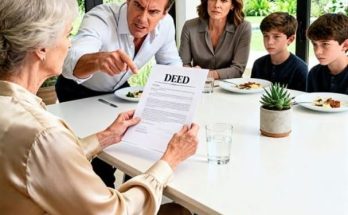
The prosecution did not want Ryan in the courtroom. Neither did I.
The defense initially insisted. Then the judge reviewed a recorded forensic interview conducted days after the poisoning. She allowed portions.
Ryan would not testify live. I thanked her silently.
The recording played on a monitor. Ryan looked tiny.
Hospital bracelet still on his wrist.
A child interviewer sat across from him. She asked what he remembered. “Dad made dinner.”
“What happened?” “My mouth felt funny.”
“Then?” “I got sleepy.” “What did your dad do?”
Ryan looked down. “He told me to close my eyes.”
“Did that feel normal?” “No.”
“Why?” “Because Mom looked scared.”
The interviewer asked about the juice. “Dad poured it.” “Did he drink the same juice?”
“No.” “Did he eat the same chicken?”
Ryan shook his head. “He said he wasn't hungry.”
Then came the part nobody expected.
“Did your dad say anything before dinner?” Ryan nodded. “What?”
“He told me we might go on a trip.” My entire body went still.
The interviewer kept her voice neutral. “What kind of trip?” “He said maybe someplace with monkeys.”
Costa Rica. “Did he say when?”
“Soon.” “Did he say if your mom was coming?”
Ryan shook his head. “He said it might just be a boys’ trip.”
The courtroom shifted. Andrea Moss glanced at the jury. Ethan looked at the table.
The defense had claimed the flight was an emergency plan created after I became unstable. Ryan’s memory placed the trip before dinner.
Before any supposed emergency. Before the poisoning.
Premeditation.
The prosecution followed with airline records. The tickets had been purchased nine days earlier. The same day Ethan searched how long a sedated child could travel.
That combination was devastating. The defense changed tone.
Now they suggested Ethan planned to leave with Ryan but never intended to kill me. Again. Andrea responded with my toxicology.
The compound in my food reached a concentration capable of causing respiratory failure. Ethan searched lethal range.
He searched accidental overdose appearance. He searched whether vomiting reduced absorption.
Not protection. Not escape.
Planning. The final major witness was a financial investigator. He explained Ethan’s hidden accounts.
The stolen credit. The attempted insurance application.
The Costa Rica transfers. Then he showed one transaction.
A payment to Marcus.
Description: Photography. That connected Ethan directly to the surveillance.
The defense objected. Overruled.
The jury saw everything. Not one dramatic confession. A structure.
Money. Drugs.
Travel. Photos.
Documents. Lies.
The prosecution’s closing argument was almost quiet. Andrea stood before the jury. “This case is not about a marriage ending badly.”
She paused. “It is about a man who decided divorce required too much uncertainty.”
Another pause. “So he designed a world in which his wife would be dead, his son would be removed, and everyone left behind would believe an accident had occurred.” She pointed to the evidence table.
“He did not make one terrible decision.”
“He made hundreds.” The defense said the prosecution had built certainty from interpretation. They emphasized Nathan.
Celeste. Daniel.
Marcus. People with motives to blame Ethan. They argued the dinner went wrong because Ethan panicked.
They argued he never wanted Ryan dead. That part was probably true.
It did not save him. Attempted kidnapping did not become love because the child survived.
The jury deliberated two days. I barely ate.
Ryan stayed with my sister. I slept at Nora’s house. On the second afternoon, the call came.
Verdict. We returned.
Ethan stood. I did not look at him.
Guilty.
Attempted first-degree murder. Guilty. Attempted kidnapping.
Guilty. Child abuse.
Guilty. Fraud-related counts. Guilty.
Evidence tampering. Guilty.
Some lesser counts were mixed. I stopped hearing them.
My knees weakened. Andrea touched my elbow.
Breathe. I did. Ethan showed almost nothing.
Then the judge remanded him for sentencing. As officers moved him away, he turned.
“Emily.” I looked at him before anyone could stop me.
He smiled faintly.
Not warmly. Precisely. The same smile from dinner.
“You know I never wanted to hurt Ryan.” The courtroom froze.
I stared at him. Then answered. “You planned to erase his mother and steal his life.”
His smile disappeared. “That is hurting Ryan.”
Officers led him away. I thought verdict would feel like an ending.
It did not. Because Ryan still had a father.
Even from prison. And weeks later, a letter arrived addressed to him. From Ethan.
The verdict night was strangely quiet. No celebration.
No champagne. No dramatic relief.
I picked Ryan up from my sister’s house.
He knew the jury had decided. “What happened?” “Guilty.”
“All of it?” “Most of it.”
He sat in the passenger seat. Then asked: “So he’s not coming home?”
“No.” “How long?”
“A very long time.” He looked out the window.
I expected relief. Instead, he cried.
I pulled over. “Hey.” “I’m stupid.”
“No.” “I’m crying because Dad’s going to prison.”
“That is not stupid.” “He hurt us.”
“Yes.”
“I still don’t want him there.” I understood. Children do not divide parents into legal categories.
A father can be dangerous and still be the man who taught you to ride a bike. Ryan cried for both.
I let him. At home, he asked for cereal for dinner. I said yes.
We ate at the round table. Waffles begged beneath it.
No speeches. No lessons.
Just cereal. That night, I realized verdicts do not give families closure.
They give structure. A locked door. A sentence.
A boundary enforced by law. Healing happens elsewhere.
Usually in kitchens. Cars.
Therapy rooms.
Bedrooms after nightmares. The places no jury sees. For several weeks after the verdict, Ryan asked the same question in different forms: what if the jury had believed Dad?
I told him the same thing each time. The verdict mattered, but our safety did not depend only on twelve strangers understanding us.
We had evidence, legal protection, therapists, family, and each other. The next morning, I woke expecting to feel different. I did not.
The coffee tasted the same. The dog needed to go outside.
Ryan had forgotten homework on the table. Justice had happened, but life had not transformed into a ceremony.
I found that comforting. It meant the verdict could become part of our life without becoming the whole of it.
I kept the verdict sheet in a locked drawer. Not displayed. Not framed.
I did not want justice turned into décor. But I wanted the record close enough that, if Ryan ever doubted his memory because of something Ethan wrote, the facts would remain available.
A month after the verdict, the prosecutor mailed me a copy of the final judgment. I almost threw the envelope into a drawer unopened.
Instead, I read every page once.
The language was dry. Counts, statutes, findings. Nothing about fear.
Nothing about Ryan gripping my wrist. Still, the document mattered because institutions had named what happened without asking me to soften it.
I showed Ryan only the first page. He read his father’s name. Then the word guilty.
“That’s official?” “Yes.”
He handed it back. “Okay.”
For him, that was enough. I understood then that I did not need to make justice emotionally satisfying.
It only needed to be real, durable, and strong enough to protect the life we were rebuilding.