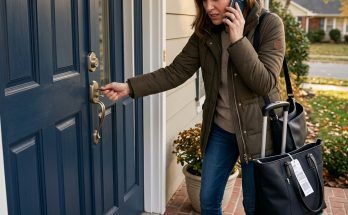
Winter came softly to Austin. The trees thinned without ever looking truly bare, and Mom began drinking coffee on the patio in a cardigan every morning.
The first time I saw her sitting where the bucket used to be, I stopped inside the doorway. She noticed.
"What?" "Nothing."
"You keep saying that." I walked out.
She had a crossword open across her lap. The outdoor kitchen cabinets were clean.
Not polished. Not perfect.
Just clean enough. That mattered too.
Life was becoming ordinary again. Khloe had moved into her own apartment and started a new job with a medical billing company.
The salary was not impressive, but she was proud of paying her own rent.
Every month, two hundred dollars went to Mom. Once, she sent it three days late.
Instead of hiding, she called.
"My car needed a repair.
I should have told you before the due date." Mom said, "Thank you for telling me." Then they agreed on the new date.
No guilt. No threats.
No pretending. I wished all repair worked that neatly.
It did not. Julian's civil payments had become irregular.
Paul sent explanations. A business slowdown.
Vehicle-sale delay. Cash-flow problems.
Harrison enforced the agreement the boring way. Not with midnight confrontations.
Letters. Deadlines.
Documentation. Eventually, the missed amount was cured.
I did not speak to Julian once. That was intentional.
Then an envelope arrived at Mom's house with no return address. She called me before opening it.
"Should I be worried?" "Is it ticking?" "Natalie." "Sorry." I drove over.
The envelope contained copies of old business records and a handwritten note from Julian.
No threat. No apology either.
The note said he had found additional documents while clearing storage and was returning them because the settlement required it. Among the papers was a photocopy of Mom's Social Security card.
Another copy of her driver's license. A bank authorization form.
And the original printout of the second credit-card approval email.
Mom sat at the kitchen table staring at them.
"He kept these all this time." "Apparently." "Why send them now?" "Because he's required to." She read the note again.
At the bottom, Julian had written one additional line. I never meant to hurt you.
Mom laughed once. The sound was bitter.
"Is that supposed to help?" "No." She pushed the note away.
I photographed everything and sent copies to Harrison. The originals went into a secure envelope.
That should have been the end of it. Instead, the note unsettled Mom for days.
Not because she believed him. Because part of her wanted to.
"I keep thinking maybe he really didn't mean it," she admitted during dinner. "Maybe he didn't." She looked at me, surprised. I continued. "People can hurt you without planning to become the person who hurts you." Mom stared at her plate. "Does that make it better?" "No." "Then why say it?"
"Because intent and consequence aren't the same thing." She nodded slowly.
Julian may not have moved into the guest suite with a two-year plan to control the house. Khloe may not have accepted a grocery card intending to spend thousands on herself.
Mom may not have decided one morning to surrender her voice.
I may not have decided to let money substitute for attention. Most damaging patterns do not arrive announcing themselves.
They grow through permissions nobody notices until the permissions become a structure. That was what had happened to us.
The envelope triggered another choice. The bank's investigation had progressed far enough that Mom was asked whether she wished to provide an additional formal statement about the identity documents and approval email.
Harrison explained that cooperating could support whatever action the issuer chose to take. Mom became anxious.
"I don't want to ruin his life." Khloe was present.
She looked at her mother for a long time.
"Mom, telling the truth isn't ruining his life." Mom's eyes moved toward her.
Khloe swallowed.
"I used to say things like that when I wanted you not to tell Natalie." The honesty changed the room.
Mom looked at the papers.
"I don't want revenge." "Then don't make it revenge," I said.
"What if something serious happens to him?" "That's not yours to decide."
She frowned.
"That sounds cold." "It's not.
You tell the truth. The bank decides what it means.
If authorities become involved, they decide what it means. You don't have to exaggerate or protect." Harrison had said almost the same thing.
Facts first. Conclusions later.
Mom provided the additional statement.
She described what she remembered. Where she was uncertain, she said she was uncertain.
Where she knew, she said she knew. She did not call Julian evil.
She did not excuse him. When it was finished, she signed her name.
Then she asked for a copy.
"Why?" "Because I'm keeping my own paperwork now."
Harrison smiled.
"Good habit." Weeks passed.
We received no dramatic phone call. No squad cars appeared.
No courtroom scene arrived to tie everything into a neat bow. The issuer notified Mom that its investigation remained closed in her favor and that she had no liability for the disputed account.
That was enough for her.
"I thought I needed to know what happened to him," she said.
"And now?" "I need to know what happened to me." Therapy had changed her vocabulary.
She talked about fear without calling herself foolish. She talked about anger without apologizing for it.
She talked about Khloe without choosing between love and disappointment. I noticed changes in myself too.
When Mom did not answer a text immediately, I no longer panicked. When she said no to dinner because she had plans with a friend, I did not treat independence as rejection.
Protection can become control if you are not careful. I had learned that by watching Julian.
I had no intention of learning it by becoming him in a more respectable form. The final civil payment from Julian arrived five months after he left the house.
Harrison emailed confirmation.
Settlement obligation satisfied. I read the sentence twice.
Then I called Mom.
"Guess what." "What?" "He's finished paying." She was quiet.
"That's good." "That's it?" "What do you want, trumpets?" I laughed.
She had stolen my joke.
"Fair." That evening, Khloe came over.
Mom ordered pizza instead of cooking.
We ate at the kitchen table. At some point, the conversation moved away from Julian completely.
Khloe complained about her manager. Mom described a woman at church who kept stealing her preferred parking space.
I told them about a client who scheduled calls at impossible hours even though I no longer lived overseas.
Ordinary complaints. Ordinary laughter.
I looked around the table and realized something. For months, I had thought closure would feel like a final answer.
A legal letter. A repayment.
An admission. Instead, it felt like this.
Talking about something else. Then the doorbell rang.
Mom froze. Only for half a second.
She stood.
"I've got it." Neither Khloe nor I moved.
Mom walked to the front door, checked the camera, and opened it. A delivery driver handed her a package.
She signed. Closed the door.
Locked it. Then returned to the table.
No fear. No permission.
No one asking who belonged there.
The house had become hers again long before the final payment arrived. We had simply needed time to notice.