Brenda’s daughter called me.
I had never met her.
“Mrs. Caldwell?”
“Yes.”
“My mother is in hospice.”
I sat down.
Brenda had cancer.
Advanced.
She had apparently given her daughter my number with one request:
Only call if Martha might be willing to visit. Do not pressure her.
That instruction mattered.
I asked for a day to think.
I was not responsible for giving Brenda a peaceful death.
That sentence sounds harsh.
It was necessary.
People sometimes treat dying as an automatic claim on everyone they hurt.
Death makes time urgent.
It does not erase boundaries.
I spoke to Dr. Sethi.
To David.
Then I asked myself one question.
Would I regret not going?
Yes.
Not because Brenda deserved.
Because I was curious what I would feel.
I visited.
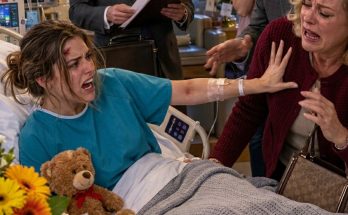
Her room was quiet.
Her daughter left us alone.
Brenda looked small.
No makeup.
Hair thin.
She smiled.
“You came.”
“Yes.”
“I wasn’t sure.”
“Neither was I.”
She laughed weakly.
Still Brenda.
Direct.
For several minutes we talked about ordinary things.
Oakridge.
The sewing program.
She had continued volunteering until she became too tired.
“She’s better than I was,” she said about one student.
“Most people probably are.”
She smiled.
Then:
“I’ve thought about the apron a thousand times.”
“I haven’t.”
Her eyebrows lifted.
“Really?”
“Not a thousand.”
That pleased me.
I think she feared she had remained huge in my life.
I did not want to lie.
“The prom stayed longer.”
She nodded.
“I’m sorry for that too.”
“I know.”
She looked at the window.
“My mother died never admitting anything.”
I did not know what to say.
“So I wanted to.”
“You did.”
“Was it enough?”
There was the question.
Enough for what?
I asked.
She closed her eyes.
“To make it right.”
“No.”
She opened them.
I continued gently.
“You can’t make seventeen-year-old me walk back into that prom and finish the dance. You can’t undo it.”
Tears formed.
“But you did something else. You took responsibility. You changed some behavior. That matters. It’s not the same as making it right.”
She nodded.
“Thank you for not lying.”
“I’m too old.”
We both smiled.
She reached toward the side table.
A small envelope.
“I wrote something for the sewing program.”
I did not take it immediately.
“What is it?”
“A donation. Not huge.”
“Why are you giving it to me?”
“I’m not. The check is to them. I just thought you could make sure it gets there.”
I almost refused.
Then I saw she had already addressed the envelope.
This was not a burden.
I took it.
“I can mail it.”
“Thank you.”
We sat quietly.
Then she said:
“I used to think you made me feel small.”
I waited.
“But really, you made me aware that I was small.”
I shook my head.
“I didn’t make you anything.”
She smiled faintly.
“Still correcting me.”
“Yes.”
“You were always annoying.”
“That’s not how you framed it.”
She laughed and coughed.
For a moment, we were almost friends.
Almost.
Then the moment passed.
I did not need to turn it into more.
Before leaving, she asked:
“Do you forgive me?”
Again.
Years after the coffee.
I gave the same answer, refined.
“I don’t carry you as an enemy.”
She watched me.
“That’s enough.”
Maybe for her.
For me, it was simply true.
I touched her hand.
Not dramatic.
“Goodbye, Brenda.”
“Goodbye, Martha.”
She died twelve days later.
Her daughter sent a note.
No funeral request.
I attended anyway.
Sat toward the back.
The sewing-program coordinator spoke.
One of Brenda’s grandchildren spoke.
A former colleague.
No one told the reunion story.
Good.
People are larger than the worst thing they did to us.
That does not mean we owe them friendship.
It means truth can hold more than one chapter.
After the service, Brenda’s daughter approached.
“She talked about you a lot.”
I smiled carefully.
“I hope not too much.”
“She said you taught her that an apology doesn’t control the person receiving it.”
That surprised me.
“I’m glad.”
Then her daughter asked:
“Were you friends?”
I considered.
“No. But we were no longer enemies.”
She nodded.
That was accurate.
At home, I mailed the envelope.
The donation was $2,500.
Meaningful.
Not enormous.
No condition.
I did not add my own money to amplify it.
This was Brenda’s gesture.
Let it remain hers.
Weeks later, the sewing program sent a thank-you letter addressed to her estate.
I forwarded it to her daughter.
Then I archived the messages.
Not deleted.
Not displayed.
Finished.
I realized that was closure.
Not feeling nothing.
Not a perfect final exchange.
Simply no remaining task.
No sentence I needed Brenda to say.
No proof I needed to show.
No future meeting imagined.
The relationship had ended.
And I was okay.
After Brenda died, I expected some dramatic emotional release.
It did not come.
I woke the next morning.
Made coffee.
Read the paper.
Felt sad.
Not devastated.
Not free.
Just sad.
A person I had known in a strange, painful way for most of my life was gone.
That afternoon, I walked to the company archive.
I stood in front of the dress.
For the first time, Brenda was no longer alive somewhere in the world.
That fact altered the memory slightly.
There would be no future apology.
No future regression.
No surprise call.
The story was closed by mortality whether I felt ready or not.
I whispered:
“Goodbye.”
No one heard.
I did not tell David.
Not because it was secret.
Because every private emotion does not need witness.
Later, Brenda’s daughter sent me one of her mother’s sewing-program photos.
Brenda sat beside a teenager, both laughing over tangled thread.
On the back:
Mom hated threading machines. She refused to quit.
I kept the photograph in a drawer.
Not the archive.
Brenda did not belong in the company history.
She belonged in my personal history.
Different.
Years later, I could look at the photo without tightening.
That was enough.
I never visited her grave.
Never needed to.
I had said goodbye to the living person.
The dead one required nothing more from me.
In the months after Brenda’s death, her daughter and I exchanged two more letters.
She wanted to understand parts of her mother’s youth.
I answered carefully.
Not every detail.
Enough.
I did not want to recruit a daughter into judging her dead mother.
I wrote:
Your mother hurt me when we were young and again at the reunion. She later took responsibility in ways I respected. Both are true.
Her daughter replied:
Thank you for not making me choose which version was real.
That line moved me.
Children often inherit unfinished stories without asking.
Heroes.
Villains.
Silences.
I did not want to hand Brenda’s daughter a simplified mother any more than I wanted my own company archive to hand employees a simplified founder.
Complexity can be a kindness when it is truthful.
After that, our correspondence faded naturally.
No obligation to continue.
One Christmas card.
Then none.
I was fine with that.
Not every meaningful connection must be maintained forever.
Some exist to carry one piece of truth from one person to another.
Then end.
Click here to continue reading: PART 15: Years After the Reunion, a Seventeen-Year-Old Employee Asked Why I Had Served Brenda Instead of Exposing Her Immediately, and My Answer Finally Made the Whole Night Clear to Me
Brenda Handed Me an Apron in Front of Everyone, and I Let Her Believe She Had Put Me Back in My Place
Part 14 of 16