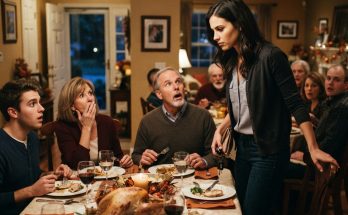
Grant turned fifty-two on a Thursday.
A week earlier, he asked:
“Would you be okay if we had the family here Saturday?”
I looked at him.
“How many?”
“Probably fourteen.”
I laughed.
He laughed too.
The number was almost offensively perfect.
“Food?”
“I want barbecue.”
“Are you making it?”
“No.”
“Good choice.”
“I’m ordering from the place that rescued my thirty-fifth birthday.”
I stared.
“The same restaurant?”
“If they’re still open.”
They were.
Grant called.
Placed the order early.
Paid the deposit.
Confirmed pickup time.
Then he asked:
“Would you want to make a cake?”
There it was.
A question.
Not a promise.
Not:
Laurel’s making her chocolate cake.
Would you want to?
I thought.
“Yes.”
His face lit.
“Really?”
“Yes.”
“Chocolate?”
“Obviously.”
He smiled.
Then:
“If you change your mind, tell me. I’ll order one.”
That part mattered even more.
A yes was not a contract enforced by guilt.
I made the cake Friday afternoon.
Not because it was my job.
Because I wanted to.
Saturday, the family arrived around six.
Denise was older and walked with a cane.
Miles brought his partner.
Tessa’s children were nearly grown.
The house filled with the same kind of noise as that disastrous birthday years before.
But the kitchen felt different.
The barbecue had been picked up at four-thirty and kept warm properly.
Drinks were cold.
Paper goods stacked.
Grant had made a simple salad himself.
I had baked one cake.
That was all.
At six-fifteen, Tessa walked into the kitchen.
“When are we eating?”
Everyone froze for half a second.
Then Miles burst out laughing.
I did too.
Grant pointed at the food.
“Right now.”
Tessa looked confused.
Then remembered.
“Oh my God.”
Denise laughed so hard she had to sit.
The old birthday existed.
But it no longer hurt.
That is how I knew the wound had healed enough.
Not forgotten.
Integrated.
We ate.
The brisket was excellent because professionals had cooked it.
Grant announced:
“I have accepted my limitations.”
Miles said:
“Growth.”
After dinner, people helped clear.
Grant cut the cake.
He gave me the first slice.
No symbolism needed.
Just cake.
Later, after everyone left, we sat at the same kitchen table where years earlier I had spread receipts in front of him.
The table had been refinished since then.
Different chairs.
Same room.
Grant said:
“I was thinking about what Mom asked that night.”
“What did Laurel actually agree to do?”
“Yes.”
He looked at me.
“That question embarrassed me more than anything.”
“I know.”
“At first.”
“What does it do now?”
“Reminds me to ask.”
That was the entire story.
Not brisket.
Not grocery shelves.
Not receipts.
Ask.
Before promising someone’s labor.
Before spending shared money.
Before assuming who will cook.
Before deciding whose job matters more.
Before treating a spouse’s flexibility like ownership.
I said:
“I had my own question I needed to learn.”
“What?”
“Why am I saying yes?”
He looked curious.
I explained.
Sometimes because I wanted.
Sometimes because I feared conflict.
Sometimes because I wanted to prove I was generous.
Sometimes because I wanted people to need me.
Sometimes because I believed earning less meant I had to make up for it.
Those yeses looked identical from outside.
They did not feel identical inside.
Learning to say no had taught me how to recognize a real yes.
That was why baking his cake that day felt good.
It was mine to give.
Grant reached across the table.
“I’m sorry.”
I looked at him.
“For what?”
“The first birthday.”
“We have covered that.”
“I know.”
“Then why again?”
He thought.
“Not to get forgiveness. Just because sitting here reminds me.”
I nodded.
“Okay.”
Then:
“I forgave you years ago.”
His eyes filled.
I had not said it directly before.
Not because I was withholding.
Because I did not think the word was necessary.
But now it felt right.
“Forgiveness does not mean I think it was small.”
“I know.”
“It means I don’t need to keep charging you for it.”
He laughed softly.
“Appropriate metaphor.”
Very.
Money had been the language of the conflict.
Who paid.
Who provided.
Who owed.
Who deserved.
In the end, forgiveness meant closing an emotional account without pretending there had never been a balance.
Grant squeezed my hand.
Then he got up and started loading the dishwasher.
I watched him for a second.
Not because a man doing dishes is a miracle.
Because once, years ago, he had invited fourteen people and assumed all invisible work would somehow pass through me.
Now he had planned his own party.
Paid.
Ordered.
Asked.
Cleaned.
Normal adulthood.
That is the ending people often overlook.
Real change becomes boring.
The spectacular part was the cold stove.
The useful part was everything after.
There was no single dramatic moment when our marriage became equal.
It happened through hundreds of small corrections.
A shared grocery account.
A transferred payment.
A dinner request.
A business loan written down.
A fundraiser promise corrected.
A client dinner ordered instead of assigned.
A mother’s surgery care divided instead of dumped on women.
A layoff that did not turn the lower earner into the lesser spouse.
A retirement that did not turn me into unpaid household staff.
A birthday invitation phrased as a question.
That is how a marriage changes.
Not by winning an argument.
By changing the system that made the argument predictable.
I did not leave Grant after his birthday.
I could have.
Contempt is serious.
If he had doubled down, I might have.
If therapy had become performance, I might have.
If he had continued using income as authority, I would have needed to decide whether the marriage was safe for me emotionally and financially.
But he did not double down.
He became accountable.
Slowly.
Imperfectly.
So did I.
I stopped keeping silent ledgers.
If a bill was unpaid, I said it.
If I wanted help, I asked.
If I did not want to host, I said no before resentment.
If I chose to cook for someone, I let the gift remain a gift.
No secret invoice.
Grant stopped measuring provision only in dollars.
He learned that paying the mortgage did not buy a wife.
He learned that a home is produced by money, time, planning, maintenance, and care.
He learned that a person’s lower income does not make her vote smaller.
Most importantly, he learned that my no still counted when it embarrassed him.
That was the part that saved us.
Years later, Denise asked me privately whether I ever regretted staying.
I told her the truth.
“No.”
Then:
“But I would regret staying if nothing had changed.”
She nodded.
That distinction matters.
Staying is not automatically loyalty.
Leaving is not automatically strength.
The question is what happens after the harm becomes visible.
Does the person deny it?
Minimize?
Blame?
Or change behavior in a sustained way?
Grant changed enough that I chose the marriage again.
Not once.
Repeatedly.
He chose it too.
The children in the extended family grew up seeing different rules than Grant and Miles had.
Men cooked.
Women earned.
Whoever invited people did not automatically assign another person the work.
Family members asked what to bring.
The person with the largest paycheck was not automatically the most important person at the table.
That was a better inheritance than any story about a provider.
My baking business eventually became a memory.
I still baked.
Sometimes for money at the community center.
Mostly for pleasure.
I made chocolate cake for birthdays when I wanted to.
Once, Grant asked if I could make one for a coworker.
I said:
“My price is eighty dollars.”
He laughed.
“For me?”
“For your coworker.”
He paid from his own account.
Perfect.
We kept the shared grocery system for the rest of our marriage.
Not because we needed the reminder forever.
Because it worked.
We adjusted contributions as income changed.
No one used percentages as moral score.
The separate refrigerator shelf never returned.
Sometimes I thought about the handwritten label:
LAUREL.
At the time, it had been a boundary.
Crude.
Necessary.
A strip of tape that said:
If you insist my food is mine, then yours is yours too.
Eventually we did not need labels.
Because the respect that label demanded became part of the household.
That is the best outcome for a boundary.
Not that it stays visible forever.
That the behavior it protects becomes normal enough that the sign can come down.
On Grant’s fifty-second birthday, after the last dish was loaded, he opened the refrigerator.
There were three slices of cake left.
He looked at me.
“Can I have one?”
I stared at him.
He laughed.
“I’m asking.”
I laughed too.
“Yes.”
He put two plates on the counter.
“One for you?”
“Yes.”
We ate cake at almost midnight.
No audience.
No mother asking hard questions.
No folder of receipts.
No cold stove.
Just two people who had once nearly let money and invisible labor define who mattered more, sitting in a kitchen they now understood belonged to both of them.
There was one more reason the final birthday felt peaceful.
I no longer needed Grant’s family to know the whole story in order to feel believed.
Early on, I had replayed the scene in my head.
Miles hearing the insult.
Denise confronting him.
Tessa seeing the cold kitchen.
Their knowledge mattered because I had spent years questioning whether I was overreacting.
Public evidence reassured me.
Later, I did not need an audience.
If Grant and I disagreed, we could settle it privately.
If I said no, the no did not need witnesses.
That was a sign my confidence had changed.
I trusted my own perception more.
Grant respected it more.
The family no longer had to validate every boundary.
That was healthy.
A marriage cannot depend on a jury of relatives.
The relatives mattered during the crisis because Grant’s public promises had pulled them into it.
Afterward, the relationship had to become ours again.
It did.
That is why the final birthday could be funny.
We were not reenacting a courtroom scene.
We were remembering something both of us had already understood.
The laughter belonged to people who no longer needed the old conflict to decide who was right.
We already knew what had been wrong.
More importantly, we knew what we did differently now.
By then, nobody in the family needed a dramatic reminder of the old rules. We had something better: habits that made those rules harder to recreate.
People asked. People answered. People changed plans when someone said no. The work was still there, but it no longer disappeared behind one person’s silence.
That was the real ending. Not the empty stove, not the ruined birthday menu, and not the receipt folder. The ending was a home where nobody had to become smaller so another person could feel like the provider.
We had finally learned that contribution could change without changing anyone’s worth.
THE END
The End
Read more original stories on Feel Every Story.
Grant thought I would rescue his birthday dinner at the last minute, but his mother asked the one question he could not answer without admitting who had really been carrying our home
Part 16 of 16