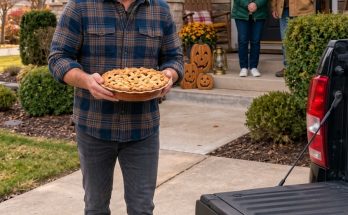
Dad opened the door in socks.
That was the first thing I noticed.
No work boots.
No old jacket.
No smell of oil.
Just gray socks and a plaid shirt tucked into jeans.
He looked at the foil trays in my arms.
Then at my face.
“Rick.”
“Move.”
He stepped aside.
I carried turkey, stuffing, potatoes, beans, rolls, and two pies into his kitchen.
Dad watched me set everything down.
“You robbed your own house?”
“Technically, I bought half the groceries.”
He did not laugh.
“Karen know?”
“Yes.”
That was not entirely true.
She knew I left.
She probably had not realized I took enough food to feed twelve people.
Dad rubbed one hand over his jaw.
“You should take it back.”
“No.”
“Rick.”
“No.”
He sat at the small kitchen table.
The same table where I had eaten cereal as a teenager.
One chair still squeaked.
Nothing in that house had ever been arranged for appearance.
It had been arranged to work.
Dad said:
“Your wife called me. She didn’t threaten me.”
I stared.
“She told you not to come.”
“She said the table was crowded.”
“She told me you smell like a garage.”
His face changed.
There.
He had not heard that part.
Good.
Or terrible.
I regretted saying it immediately.
Dad looked down.
“That sounds like Karen.”
“What does that mean?”
He shrugged.
“She likes things a certain way.”
“Why are you defending her?”
“I’m not.”
“You are.”
He leaned back.
“Son, I’m seventy-four. I don’t need you starting a war because somebody doesn’t like my jacket.”
“It’s not the jacket.”
“I know.”
That was the point.
He knew.
For years, he knew.
I had pretended not to.
Comments.
Little pauses.
Karen’s mother, Elaine, once asking whether Dad wanted to wash up before dinner after he had already showered.
Her father, Charles, telling him:
“You must be glad Rick moved into management.”
As if crawling through mechanical rooms had been shameful.
Karen correcting Dad’s pronunciation of “bruschetta” in front of everyone.
Dad laughing.
Me laughing too.
Keep the peace.
I had participated.
Not in their contempt.
In letting it pass.
Dad said:
“You want to know why I stayed home?”
“Because Karen told you.”
“No.”
He looked at me.
“Because I was tired of making you choose.”
That stopped me.
“I never chose.”
“Exactly.”
He said it gently.
Worse.
I sat.
Dad continued.
“Every holiday, she says something. Her mother says something. You get quiet. Then you help me with my coat and act like everything’s fine.”
My throat tightened.
“I thought you didn’t care.”
“Sometimes I didn’t.”
“Sometimes?”
“Sometimes I did.”
There.
The man who rarely asked twice had been waiting for me to notice without asking once.
I covered my face.
Dad said:
“Don’t make this bigger than it is.”
“It’s already bigger.”
My phone rang.
Karen.
I let it.
Again.
Then a text.
My parents are here. Where is the food?
I laughed.
Dad did too this time.
“What are you going to say?”
I typed:
At Dad’s.
Three dots.
Then:
Are you serious?
Yes.
Rick, bring it back now.
Dad shook his head.
“You are twelve.”
“Maybe.”
Another message.
My parents drove two hours.
I typed:
Dad was supposed to drive twenty minutes.
Then stopped.
I did not send.
This was not going to become a text war.
I called.
Karen answered immediately.
“What are you doing?”
“Having Thanksgiving with Dad.”
“You took everything.”
“Not everything.”
“You took the turkey.”
“Most of it.”
“Rick.”
Her voice sharpened.
“My parents are sitting at our table.”
“Then order something.”
Silence.
“You are humiliating me.”
I looked at Dad.
He heard.
His eyes dropped.
That sentence clarified everything.
Not:
You hurt me.
Not:
We had plans.
Humiliation.
Her parents seeing disorder.
“I’m not coming back tonight.”
“What?”
“I’ll come home tomorrow.”
“Because of one comment?”
“No.”
Important.
“Because of years of comments I kept pretending were harmless.”
Karen exhaled.
“You’re doing this on Thanksgiving?”
“You did.”
Silence.
Then:
“Dad smells, Rick. That’s not classism. It’s hygiene.”
I stood.
Dad looked away.
I said:
“He showered this morning.”
“How do you know?”
“Because I called him.”
“That doesn’t mean—”
“Stop.”
I had almost never said that to Karen.
Not like this.
“No more talking about my father like he’s something dirty.”
Her voice changed.
Now hurt.
“So I’m the villain.”
“No.”
That mattered.
“I’m saying what you did was disrespectful.”
“And taking dinner wasn’t?”
“No. It was childish.”
Dad raised an eyebrow.
I continued:
“I know that.”
Karen went quiet.
I had not expected to admit it.
Packing the entire meal had felt righteous in my kitchen.
Sitting in Dad’s house, it looked different.
The food belonged to the household.
Guests had expected it.
I could set a boundary without making twelve people hungry.
That was on me.
I said:
“I should have taken enough for Dad and me. I took everything because I wanted you to feel what it was like to have a plan changed without your consent.”
Karen said:
“So bring it back.”
“No.”
Because changing course now would make Dad the temporary lesson before the “real” family dinner.
No.
“I’ll pay for replacement food.”
She laughed.
“Money isn’t the point.”
Exactly.
Finally.
I said:
“We’ll talk tomorrow.”
She hung up.
Dad stared at me.
“You apologized and still said no.”
“Yes.”
“Huh.”
“What?”
“Growth.”
I laughed.
We heated the food.
Too much food.
Dad’s neighbor, Mrs. Torres, saw my truck and came over with cranberry sauce.
Then her son joined.
Then a retired guy from down the block.
By six, Dad’s small table held six people.
Not a revenge party.
Just neighbors.
Dad told the dry-turkey joke.
I laughed.
My phone stayed face down.
At eight, Karen sent one message.
My parents left.
No other words.
I felt guilty.
Not enough to undo the boundary.
Enough to know tomorrow would require more than a dramatic exit.
The real conflict was not Thanksgiving food.
It was whether my wife respected the man who raised me.
And whether I respected myself enough to stop participating in the disrespect through silence.
Later that night, Dad and I cleaned the kitchen together.
I washed.
He dried.
Same rhythm from when I was a teenager.
No speeches.
At one point he said:
“You know she’s going to remember the food more than the insult.”
I stopped.
“What?”
“Karen.”
He was right.
My dramatic response had created a second event.
People would tell the story as:
Rick took Thanksgiving dinner.
That could overshadow:
Karen excluded Jack because she was ashamed of him.
Actions compete for narrative attention.
I had given everyone an easier scandal.
That bothered me.
Dad said:
“You wanted to make a point.”
“Yes.”
“Made one.”
“Wrong one?”
“Loud one.”
Exactly.
I had spent years staying quiet.
Then swung to spectacle.
Neither was communication.
That insight mattered the next day when I apologized.
I did not want my apology used to erase Karen’s choice.
I also did not want her apology demanded as price for mine.
Adults can own separate wrongs at same time.
Dad finished drying a plate.
Then said:
“Your mother used to do that.”
“What?”
“Get mad for six months in one night.”
I laughed.
Mom had been quieter than me.
Apparently not always.
Dad continued:
“She’d let things go. Let things go. Then one day I’d leave a sock wrong and suddenly we were discussing 1987.”
That was me.
Thanksgiving included years.
Karen heard one day.
I carried a decade.
No wonder the reaction felt disproportionate to her.
That did not make accumulated hurt unreal.
It meant I had failed to address it early.
I said:
“I should’ve said something the first time.”
“Yes.”
“You could’ve too.”
Dad gave me a look.
“Now we’re blaming the old man?”
“No.”
“Good.”
Then:
“I could’ve.”
There.
Both.
Our family had a tradition of indirect endurance.
Dad showed love through action, not complaint.
I inherited that.
It looks noble until resentment builds.
The next morning, before I went home, Dad handed me a foil tray of leftovers.
“Take this.”
“To Karen?”
“You paid for half.”
I laughed.
Then he became serious.
“Don’t punish her with me.”
That sentence stayed.
“What does that mean?”
“Don’t use me every time you’re mad at your wife.”
Fair.
I had already begun turning Dad into evidence.
Your family disrespected my father.
My father would never.
Dad thinks.
No.
Marriage conflict belonged between us.
Dad’s dignity mattered.
His opinion did not need to become a weapon.
I promised.
I failed sometimes later.
Still, that warning kept me from building a permanent alliance with Dad against Karen.
Triangulation can feel supportive.
It destroys marriages.
I learned to talk to Karen directly.
Talk to Dad about Dad.
Separate relationships.
That may have been the healthiest thing to come from the first night.
Click here to continue reading: PART 2: Karen’s apology collapsed the moment she explained why Jack embarrassed her, and Rick realized the marriage had been built around an invisible social ranking he had never agreed to
Rick did not ruin Thanksgiving to punish Karen — he took the meal to the one man who had spent his whole life being asked to swallow disrespect quietly
Part 1 of 16