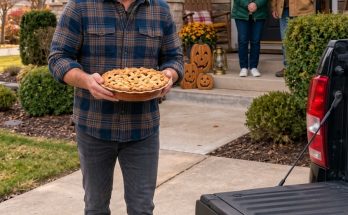
I was eighty-two when I hosted my last Thanksgiving.
Not because I knew it would be last.
Because after that, Karen and I moved into assisted living and the kids took over holidays.
The house smelled like turkey.
Of course.
Karen supervised less than she used to.
Age helped.
So did years.
Emily arrived with her husband and son.
Noah and Priya with their daughter.
Elaine and Charles gone.
Dad gone.
Maya retired.
Our parents’ whole generation absent.
Still, the room was full.
No place cards.
Karen said she no longer believed in them.
I reminded her she used them two years earlier.
She said:
“Growth.”
I laughed.
Noah brought store-bought rolls.
I held them up.
“Grandpa Jack would approve.”
His daughter asked:
“Why?”
There.
Story opportunity.
I looked at Karen.
She nodded.
Not because permission required.
Shared history.
I told the short version.
Years ago, Grandma Karen told Grandpa Jack not to come to Thanksgiving because she worried her parents would judge him for smelling like work.
I got angry.
Packed almost all dinner.
Took it to his house.
The granddaughter’s eyes widened.
“You stole Thanksgiving?”
“Basically.”
Karen said:
“He absolutely did.”
Everyone laughed.
Then I continued.
“It wasn’t my smartest moment.”
That mattered.
Family stories grow sharp edges if heroes are too clean.
I said Karen had been wrong to exclude him.
I had been wrong to punish every guest with missing food.
We learned.
Changed.
Granddaughter asked:
“Was Great-Grandpa Jack mad?”
I thought.
“He was mostly annoyed I brought too much food.”
True.
She laughed.
Then:
“Did Grandma hate him?”
Karen answered.
“No.”
Good.
Then:
“I was embarrassed by things I should not have been embarrassed by.”
Specific.
“I cared too much what my parents thought.”
The girl looked confused.
Children often are when adults describe status anxiety.
Good.
Maybe not inherited.
Karen added:
“Jack forgave me enough to make fun of my turkey for years.”
That was the story.
No saint.
No villain.
No dramatic revenge ending.
Just people.
Dinner continued.
At one point, my grandson came in from garage after helping me check furnace.
He smelled faintly of dust and metal.
Karen looked at him.
Smiled.
Said nothing.
I noticed.
Then let it go.
No scorecard.
That was what changed.
We no longer needed every moment to prove anything.
After dinner, I sat in Dad’s old jacket.
Yes, still.
It barely smelled of oil now.
Mostly cedar from closet.
Memory changes physically too.
Karen sat beside me.
“Cold?”
“A little.”
She touched sleeve.
“That thing is disgusting.”
I looked at her.
She burst out laughing.
So did I.
The joke worked because contempt was gone.
Context changes words.
She said:
“Jack would be happy I finally said it.”
“He would tell you to mind your business.”
“Also true.”
We sat.
No speech.
The next year, Noah hosted.
Then Emily.
We moved into a senior community at eighty-four.
Not because children demanded.
We chose.
One-level.
Healthcare nearby.
Less maintenance.
I understood Dad’s condo decision completely now.
We sold house.
Kids took few things.
Most donated.
No one wanted china.
Elaine would have been horrified.
Karen laughed.
We kept two settings.
Enough.
My vocational scholarship work continued through a local nonprofit.
Not named after me.
Dad’s small scholarship had grown through donations.
We added funds.
No family board seat.
No legacy control.
Help students.
Simple.
One year recipient became commercial HVAC tech.
Another became electrician.
One left program for nursing.
Fine.
Support is not a contract for identity.
Karen’s first-generation scholarship continued too.
Two family histories held side by side.
Manual labor.
Upward mobility.
Both with dignity.
Neither superior.
That balance felt right.
Karen died before me.
Eighty-five.
Stroke.
Short decline.
She could still communicate choices for most of it.
We had directives.
No family chaos.
I sat beside her.
She whispered once:
“Was I awful?”
I knew exactly what she meant.
Not stroke.
Thanksgiving.
Decades later.
I said:
“You did something awful.”
She looked at me.
“And?”
“You changed.”
Tears.
Then:
“So did I.”
That mattered.
She squeezed my hand.
“Did Jack forgive me?”
There it was again.
I smiled.
“He let you drive him to rehab. That’s basically sainthood.”
She laughed weakly.
Then slept.
No grand absolution.
Enough.
After Karen died, I lived two more years.
Grief quieter than expected.
Maybe age.
Maybe preparation.
I missed coffee.
Her bad stories.
Thermostat fights.
I did not miss family conflict.
Funny.
I kept her letter to kids.
Not for public.
Family.
At eighty-seven, heart failure worsened.
I chose hospice after discussions.
No heroism.
No fearlessness.
I was afraid.
Emily and Noah visited.
Grandchildren.
One day Noah asked:
“Dad, do you think taking the food saved your marriage?”
I laughed.
“No.”
“What did?”
“Everything after.”
That was the answer.
The Thanksgiving stunt got attention.
It did not repair anything.
Repair came from:
Apologies.
Counseling.
Boundaries.
Repeated behavior.
Jack speaking for himself.
Karen confronting her parents.
Me admitting my own retaliation.
Years without scorekeeping.
Care during illness.
Ordinary dinners.
People love dramatic first acts.
Life changes through repetition.
I told Noah:
“Do not copy the food part.”
He laughed.
“Noted.”
Then:
“What should I copy?”
I thought.
“Don’t let peace depend on one person swallowing disrespect.”
There.
Maya’s sentence, changed a little.
That was worth passing down.
Also:
“Don’t make a person into a lesson while they’re still sitting at the table.”
Dad’s warning.
People before symbols.
Noah nodded.
He wrote it down? No. That would be too neat.
He forgot exact words probably.
Fine.
Values survive imperfectly.
After I died, estate administration was boring.
Good.
Kids received what plan said.
Charities.
No surprise conditions.
No Thanksgiving clause.
No requirement anyone keep Dad’s jacket.
Emily found it.
Asked Noah.
Neither wanted.
For a moment, they felt guilty.
Then remembered my letter about objects? I had not written. They knew enough.
They donated it to a local theater costume shop? Maybe weird. Better vocational program could use as display? That turns relic. No. They threw it away respectfully after taking photo.
That was fine.
Memory does not require storage.
Dad’s Alaska magnet remained on Emily’s fridge for years.
Accidentally.
Probably better.
No one wrote a book about Thanksgiving.
No family museum.
The story surfaced at holidays occasionally.
Every version changed.
Grandpa took turkey.
Grandma insulted Great-Grandpa.
Chinese food.
Therapy.
Apologies.
Eventually younger children laughed more than they judged.
Good.
The moral did not need to stay dramatic.
What mattered was practice.
At a later Thanksgiving, one great-grandchild brought a boyfriend who worked construction.
He came straight from a job because shift ran late.
Boots dusty.
Apologized.
Emily said:
“Take your shoes off and eat.”
That was all.
No one mentioned Jack.
No one needed to.
A family value had become ordinary enough to stop announcing itself.
That was the ending I wanted.
Not Karen humiliated.
Not Elaine defeated.
Not Charles taught a lesson.
Not Dad vindicated through some secret fortune or heroic revelation.
Jack was exactly what he seemed.
A retired factory worker with rough hands, old jackets, bad jokes, and a habit of showing up.
He did not need hidden wealth to deserve respect.
That was the point.
The mistake had been believing dignity needed some twist to justify it.
It did not.
Karen’s parents did not have to discover he was secretly rich, decorated, brilliant, or famous.
He was a mechanic and factory man.
Enough.
I was an HVAC supervisor who sometimes crawled through dirty spaces.
Enough.
Elaine liked polished tables.
Enough.
Charles wore expensive shoes.
Enough.
Respect was not pretending differences vanished.
It was refusing to convert differences into human rank.
That lesson took our family too long.
But we learned it while enough people were alive to change how they treated one another.
That is more than many families get.
And if someone remembers the Thanksgiving where I carried the turkey out the door, I hope they remember the part after.
I was angry.
Karen was wrong.
I was also wrong in how I retaliated.
Dad told me not to make him a symbol.
We listened eventually.
The meal was dramatic.
The repair was better.
In assisted living, I met a man named Howard who had been a surgeon.
He complained constantly about staff.
Degrees.
Grammar.
Shoes.
The younger me after Thanksgiving would have decided:
There is another Charles.
Then I learned Howard had lost his wife, mobility, and much of his hearing in one year.
Control had become his defense.
Did that excuse insulting aides?
No.
But understanding helped me respond better.
One day he criticized a maintenance worker in front of everyone.
I said:
“Howard, he fixed your heat.”
Howard snapped:
“That’s his job.”
“Yes.”
“Then what?”
“Nothing. Just talk to him like a person.”
He glared.
Later apologized.
Maybe my family lesson kept working in small places.
Not because I became moral teacher.
Because once you spend decades noticing rank, you hear it.
I also had to notice my own.
I became impatient with residents who never worked in trades.
I assumed they were helpless.
One retired professor repaired his own wheelchair brake better than I could.
Humbling.
Stereotypes multiply in every direction.
At eighty-six, I understood respect less as a belief and more as a habit:
Stay curious before ranking.
Ask before assuming.
Correct behavior, not human worth.
Let people surprise you.
Dad surprised Karen.
Karen surprised Dad.
Charles surprised me.
Elaine surprised herself.
I surprised me plenty.
That is why I rejected the easy version of our Thanksgiving story.
In the easy version, rich snobs reject humble mechanic.
Loyal son chooses dad.
Everyone learns lesson.
Reality was messier.
Dad had pride.
I retaliated.
Karen had fear.
Her parents had histories.
Everyone had blind spots.
Everyone had choices.
The point was not that working-class people are morally superior.
The point was no occupation, income, accent, clothing, or table habit settles human rank.
Once our family learned that, the original insult lost power.
Not because forgotten.
Because disproven through years of better behavior.
There was one more thing I wanted the younger people to understand about that first Thanksgiving.
The food was memorable because it was visible.
Turkey leaving a house is easy to picture.
Years of quiet contempt are harder.
So people naturally retold the dramatic part.
I wanted them to remember that the important damage had happened before I touched a foil tray.
A guest list changed privately.
An old man told to stay home.
A wife afraid of her parents’ judgment.
A husband who had ignored too much for too long.
That is how families often reach explosions.
Not from one terrible day.
From small moments nobody addresses because each one seems too minor to justify conflict.
Then the accumulated weight lands on something ordinary.
A dinner.
A phone call.
A comment.
And suddenly everyone asks:
Why did this become so big?
Because it was never only this.
I also wanted them to remember the opposite.
Repair did not happen in one giant moment either.
It happened in small repetitions.
Karen saying “Mom” before a comment went too far.
Me apologizing without surrendering the boundary.
Dad saying what hurt instead of pretending nothing did.
Charles asking questions instead of ranking.
Elaine catching herself.
Emily apologizing at work.
Noah questioning his own status fears.
Grandchildren learning service workers are not scenery.
That is how families change too.
Not by announcing a new value.
By practicing it until nobody needs the announcement.
If someone had told me on that first Thanksgiving that Karen and Dad would one day laugh together in cardiac rehab, I would not have believed them.
If they told me Charles would ask Dad about maintenance like an equal, I would have laughed.
If they told me Elaine would someday correct herself before Karen did, I would have called them optimistic.
But change is often less dramatic than conflict and therefore easier to underestimate.
People improve in inches.
Sometimes inches become miles only when you look back.
That is why I never regretted refusing the dinner as planned.
I do regret taking almost all the food.
Both can be true.
A boundary can be necessary and still be executed badly.
That may be the most useful part of the whole story.
You do not have to choose between:
I was right.
I was wrong.
Sometimes you were right about the problem and wrong about the method.
Own both.
Then repair the method without abandoning the principle.
That is adulthood.
I learned it carrying a turkey through cold Indiana air.
Late.
Still useful.
And one final correction mattered: Dad never needed me to prove his worth by choosing him over everyone else forever. He needed me to treat him like family while he was alive. Once I understood that, loyalty became less dramatic. It looked like invitations, honest conversations, rides to appointments, jokes at dinner, and speaking up before resentment had to explode. That kind of loyalty is quieter than carrying away a turkey. It is also much harder to fake.
In the end, respect became ordinary enough that nobody needed to announce it, defend it, or use Jack’s memory to prove anything anymore.
THE END
The End
Read more original stories on Feel Every Story.
Rick did not ruin Thanksgiving to punish Karen — he took the meal to the one man who had spent his whole life being asked to swallow disrespect quietly
Part 16 of 16