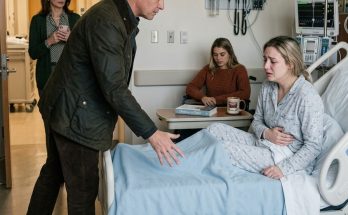
The emergency department smelled of disinfectant and coffee that had been sitting too long.
A nurse guided me toward a chair outside Maggie’s treatment room.
I sat for perhaps ten seconds.
Then I stood again.
A physician came to ask when I had last seen my wife healthy.
I told her about Nashville.
I told her about the phone calls.
I repeated what Earl had witnessed through the kitchen window.
I did not say Kevin had poisoned Maggie.
I did not know what had happened.
I said only what I could describe and what other people had reported.
The doctor thanked me.
She explained that confusion and unusual sleepiness could have many causes.
Dehydration was one.
Infection was another.
Medication effects could also contribute.
The team would test for urgent problems while watching Maggie’s vital signs.
Nobody promised me an answer before the afternoon was over.
Maggie had an intravenous line in her arm when I was allowed inside.
Her hair was tangled against the pillow.
I brushed it away from her face.
“Your truck?” she asked.
“Downstairs.”
“You drove?”
“Of course.”
She closed her eyes.
“Sorry.”
“Please stop apologizing.”
I held a cup with a straw while the nurse checked whether she was safe to drink.
Maggie could manage only a little.
The nurse asked whether anyone had brought medication bottles from the house.
No one had.
I called Kevin.
He did not answer.
I called Brittany.
She answered after several rings.
“Is she okay?”
“She's being examined. Please bring her medications and phone.”
A pause followed.
“Her phone?”
“Yes.”
“I thought she had it.”
“I looked in her purse and beside the bed.”
“Maybe she left it somewhere downstairs.”
“Please check.”
Brittany said they would try.
Then she ended the call.
I asked a nurse to record that Maggie’s phone and medication list had not come with her.
I also asked whether a social worker could speak with us.
The nurse nodded.
An hour later, a hospital social worker named Denise met me in a small room with a round table.
She did not treat me like a detective.
She asked straightforward questions.
Could Maggie ordinarily make her own decisions?
Yes.
Had she been living independently before the visit?
Yes.
Did I know why her son might have discouraged medical attention?
No.
Was there any history of financial pressure or conflict?
I hesitated.
Then I described Kevin’s comments about our retirement savings.
Denise wrote them down.
She told me the hospital would need to hear Maggie’s account when she was medically able.
She explained that a family member’s explanation did not substitute for a patient’s consent or a clinical evaluation.
I felt some relief just hearing somebody say it.
While we waited for the first overnight results, I sat with a plastic cup of coffee in the family lounge.
A television mounted above the vending machine showed a gardening program with the sound turned off.
A man across from me was asleep over a half-finished crossword.
I envied him.
I tried to write down Maggie's usual medications from memory.
One small white tablet in the morning.
Another bottle she kept on the upper shelf.
I knew the routine better than the names.
It embarrassed me.
We had spent forty-one years together, yet I had treated her medication list as something that belonged only to her.
I called our pharmacy after checking that its telephone line was open.
The pharmacist explained what records could be reviewed after identity and authorization were verified.
She did not discuss Brittany's medicine or anyone else's prescription.
I thanked her.
Then I called Claire and explained that her mother was receiving care.
I told her we did not know enough yet to say what had happened.
Claire asked whether she should drive immediately.
I said she could come the next day if Maggie wanted company.
She asked whether Kevin was at the hospital.
“No.”
Another silence.
She knew her brother's habits too.
She did not argue about him while Maggie was ill.
Instead she asked whether I had eaten.
I lied and told her yes.
She said she could hear the vending machine behind me.
I bought a sandwich after hanging up.
It tasted like cardboard.
At seven that evening, the nurse asked a series of orientation questions.
Maggie knew my name and our address.
She got the month wrong.
She frowned and tried again.
The nurse told her it was all right to take a moment.
Maggie looked at me, ashamed.
I wanted to answer every question for her.
I did not.
She needed the staff to understand her actual condition.
When she finally said the month correctly, she looked exhausted.
I squeezed her hand.
Later, I walked to the parking garage to get her sweater.
I found the extra charger and the pair of slippers I had thrown into my truck.
They smelled faintly of home.
On my way back, I saw a family gathered around a wheelchair.
One woman was arguing about who should call their aunt.
Another was trying to find a parking ticket.
The world was filled with crises much like ours.
No dramatic music.
Just people trying to remember the right information at the wrong moment.
I took the stairs instead of the elevator.
By the time I reached Maggie's room, my chest had stopped feeling so tight.
She was asleep.
I placed the sweater at the foot of her bed.
Then I sat down and opened my notebook again.
I wrote one question at the top of a fresh page.
What would Maggie choose if she felt strong enough to choose?
Everything after that would have to begin with her answer.
By late afternoon, I learned that Maggie was significantly dehydrated.
The team was also reviewing blood tests and possible medication exposure.
The first results did not settle everything.
A clinician asked for her regular prescriptions and any over-the-counter sleep aids or pain medication she might have taken.
I knew the names of her usual prescriptions.
I did not know what had been offered to her at Kevin’s house.
I remembered the sweet tea.
Earl had not mentioned it.
Maggie had, during a brief lucid moment in the ambulance.
“Brittany’s tea,” she had said.
I told the doctor exactly that.
The doctor did not leap to conclusions.
Food, drink, illness, medicines, and missed doses could all matter.
They would assess the whole picture.
I went into the hallway and called Earl.
He answered immediately.
“How is she?”
“She’s awake. They’re checking everything.”
“Thank goodness.”
I asked whether he could write down what he had seen.
Not an interpretation.
Just dates, times, and the words Kevin had used.
Earl said he had written some notes already because his own daughter had urged him to keep a record.
He promised to send a copy.
Before we hung up, he added something else.
“The night after she fell, a delivery van came.”
“Delivering what?”
“I don't know. Big office-supply boxes, maybe.”
It could have been ordinary moving supplies.
I thanked him anyway.
Back in the treatment room, Maggie was looking more alert.
She asked me what day it was.
I answered.
She frowned.
“That can't be right.”
“Why?”
“I was supposed to call you Thursday.”
“You tried?”
She nodded slightly.
“My phone went missing.”
“Did somebody take it?”
“I don't remember.”
I watched her struggle.
She looked frightened by what she could not recall.
I took her hand.
“You don't have to sort it out tonight.”
She stared at our wedding ring on my hand.
“Don't let them tell you I was drinking.”
“I won't.”
She pressed my fingers once.
“I asked to leave.”
Then she became tired again.
That evening, Kevin finally called back.
He asked whether I had told hospital staff about his mother’s wine.
I said I had told them she denied drinking.
“Dad, you’re embarrassing us.”
“She is in a hospital, Kevin.”
“We were trying to help.”
“Then bring her medication and phone.”
Silence.
“I'll see what we can find.”
When the call ended, I sat beside Maggie’s bed and wrote down every word while it was fresh.
For years I had kept notebooks in my work as a building safety inspector.
Dates mattered.
Details mattered.
And what people said before they knew there would be questions often mattered most of all.
Click here to continue reading: PART 3: Maggie Remembered the Tea, but Her Medical Records Told a More Complicated Story
The Drive to Knoxville Ended With a Neighbor Begging Me to Call an Ambulance
Part 2 of 16