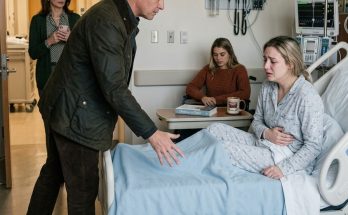
By the third hospital morning, Maggie could walk to the bathroom with assistance.
The nurses were pleased with her progress.
She still tired quickly.
Her memory of Thursday was uneven.
Her doctor wanted follow-up care after discharge and warned us to seek urgent attention if confusion returned.
He did not suggest we solve the mystery ourselves before taking her home.
Neither did I.
I bought a notebook at the hospital gift shop.
We wrote down the medication plan, appointments, and warning signs.
Maggie read each page.
She corrected me when I misspelled a nurse’s name.
Seeing her correct my spelling almost made me cry.
Our daughter-in-law left three voice messages that morning.
One said she had found a charger but no phone.
Another said the missing keys were probably under a moving box.
The third asked us not to tell anyone about the hospital visit because people in their neighborhood liked to gossip.
Maggie listened to the messages herself.
She did not reply.
Kevin called at noon.
He said he needed me to understand the pressure they were under.
Their mortgage payment was higher than expected.
His business had lost a major customer.
Brittany’s hours at work had been reduced.
He insisted they only needed a bridge loan.
“What happened to your mother's phone?” I asked.
“You think I stole it?”
“I asked where it is.”
“You're treating us like criminals.”
“I am treating her missing phone as a missing phone.”
He told me I always assumed the worst of him.
I remembered paying a credit card bill for him at twenty-three.
Then another when he was twenty-seven.
Then helping with a truck payment after his business opened.
Every time, he had promised it would be the last.
I had never asked him for a dollar back.
I had also never allowed myself to add the amounts together.
Maggie watched me hang up.
“Don't do it,” she said.
“Do what?”
“Give him money to make him calm down.”
I sat beside her.
“I wasn't going to.”
She studied my face.
“Frank.”
I looked away.
She knew me too well.
Before discharge, a hospital staff member brought in a plain envelope.
Inside was a photocopy of a form Brittany had left with Maggie’s belongings.
Brittany apparently said it was something Maggie had asked to keep.
The form concerned authorization to discuss financial accounts with a third party.
It was not a completed power of attorney.
There was no signature on Maggie’s line.
Kevin’s name appeared in a space for a designated contact.
Maggie held the copy at arm's length.
The discharge nurse gave us a printed packet thick enough to fill a folder.
There were medication instructions, warning signs, and appointment details.
I tried to fold everything into a pocket.
Maggie stopped me.
“That's how important things get lost,” she said.
She asked for a larger envelope.
The nurse smiled and found one.
Maggie labeled it before we left.
Her handwriting was shaky but recognizable.
That afternoon, a hospital volunteer wheeled her toward the exit.
Maggie looked embarrassed when we reached the lobby.
I reminded her that she had spent days seriously ill.
She was permitted to use a wheelchair when she needed it.
She said she knew.
Then she asked whether I had parked close.
Of course I hadn't.
I had chosen a space in the far corner because I didn't want to block a busy entrance.
The volunteer suggested bringing my truck to the pickup area.
For once I took the sensible advice without arguing.
When I returned, Maggie was sitting with her bag on her lap.
She had her reading glasses on.
The sight of them made her look more like herself than any hospital test could.
I helped her into the passenger seat.
She adjusted the air vent and reached for the seat belt.
I asked if she wanted me to do it.
“No, thank you.”
I held up both hands.
She smiled.
We took the interstate slowly.
Every rest stop felt like a small negotiation with fatigue.
At one station, I bought water and crackers.
Maggie stayed in the truck with the door open while I watched from a few steps away.
A young family parked beside us.
The little girl waved at Maggie through the window.
Maggie waved back.
It had been days since I had seen her smile at a stranger.
When we reached our neighborhood, she began naming the houses along the road.
There was the couple who raised chickens.
There was the man who played saxophone on weekends.
There was the mailbox someone had painted bright blue.
She remembered every little thing.
We pulled into our driveway at dusk.
I carried the bag inside while she stood at the threshold.
She touched the familiar doorframe.
Then she went straight to the kitchen.
The African violets needed water.
She lifted one leaf and showed me the dry soil.
“I told you,” she said.
I got the watering can.
She supervised from a chair.
Afterward we ate leftovers Claire had arranged to have delivered.
Maggie wanted to wash the dishes.
I suggested leaving them until morning.
She agreed without a fight.
As I switched off the kitchen light, I saw her overnight bag sitting by the stairs.
The hospital envelope rested on top.
I carried both into our room.
They looked ordinary in that space.
That evening, ordinary was a gift.
“That was the paper.”
“Are you sure?”
“Yes. I asked why they needed to speak to our bank.”
She looked at me.
“He said we were making everything harder than it had to be.”
I put the paper in our folder.
It was evidence of a conversation.
It did not prove that anyone had taken our money.
We needed account statements before we could know that.
I called our credit union from the hospital lobby using the number on my own card.
I explained that we wanted to review recent activity and secure our accounts.
The representative verified my identity.
She said the institution could explain available safeguards and document our concern.
She could not tell me anything about Kevin’s finances.
I did not ask her to.
We arranged to visit our branch together once Maggie recovered.
That afternoon, Denise reviewed the discharge plan.
Maggie would return to Nashville with me.
We would follow the medication instructions and attend scheduled appointments.
We had information about how to report concerns to the appropriate Tennessee adult-protection authorities.
Maggie wanted to make a report.
She also wanted a few days away from her son before answering his calls.
Nobody argued with either choice.
I loaded her overnight bag into the truck.
Before we left, Earl met us briefly in the hospital parking lot.
He had brought the notes he promised.
He had listed the afternoon when Maggie fell, the approximate arrival of the medical responders, and what he could actually see from his own property.
He did not pretend he had seen everything inside the house.
He gave Maggie a small wave.
“You look better, ma'am.”
She smiled.
“Thank you for paying attention.”
Earl looked embarrassed.
“Anybody would have.”
I thought about the days he had been the only person asking questions.
Not everybody had.
Maggie slept during most of our drive home.
I kept the music off.
At the edge of Nashville, she woke and recognized the turnoff near our favorite diner.
“Could we have soup?” she asked.
“Of course.”
We ate in a booth by the window.
She finished half a bowl.
Then she reached across the table.
“Frank, I was ashamed to call for help.”
“Why?”
“Because I thought you'd say you warned me.”
I took her hand.
“I was worried. I didn't know.”
She nodded.
“I know.”
When we reached our driveway, our porch light was on.
The house was exactly as we had left it.
For the moment, that was enough.
Click here to continue reading: PART 5: At Our Kitchen Table We Found the First Charge We Could Not Explain
The Drive to Knoxville Ended With a Neighbor Begging Me to Call an Ambulance
Part 4 of 16