Two days later, Samuel telephoned.
“The petition has been filed and accepted for processing,” he said.
“There is still work ahead before the estate can be distributed.”
I knew that.
My years at the medical office had taught me to distrust promises that ignored paperwork.
Samuel asked me to come in.
When I arrived, a plain white envelope waited on his desk.
Walter had written my name across it.
The sight of his handwriting made my throat tighten.
Samuel slid over a tissue box without comment.
I opened the envelope carefully.
Inside were a letter and a photocopy of an old recorded document.
My dearest Linda,
I am sorry you have to read this without me there to answer your questions.
I know the land looks like a poor gift.
It wasn't meant to be.
I kept it because I wanted one thing to reach you without becoming another argument over what belonged to my children.
The county records will explain the rest.
Talk to Samuel before you sign anything.
You deserve a home where nobody can tell you you're only visiting.
Love, Walter.
I read it three times.
Then I put it face down.
“Did he know the land was valuable?”
Samuel nodded slowly.
“He knew it might become valuable. He also knew the details weren't final.”
He pointed to the photocopy.
Nearly eleven years earlier, Walter had granted an easement across a narrow strip along the northern edge of the parcel.
It let a local utility cooperative maintain an underground line.
The document was real, recorded at the county clerk's office.
But that wasn't the important part.
Attached to it was a separate, much newer letter from a regional water district.
The district was studying whether to acquire land along the creek for a pumping and treatment project.
Walter's parcel was on its preliminary list.
I looked at Samuel.
“A study?”
“Only a study. Nothing in this letter is a purchase offer.”
“Then why keep it hidden?”
“He didn't hide the ownership. He was private about the possibilities.”
Samuel folded his hands.
“Walter thought Melissa would push for a quick sale if she knew there might be interest.”
I pictured her laugh in his office.
The burned trailer.
Ten acres of weeds.
“I don't want to fight them,” I said.
“You may not have to.”
Samuel paused.
“But you do need to understand what you own.”
He gave me the number of a local surveyor and suggested an independent real estate attorney.
Not because he expected trouble.
Because Samuel represented the estate and had responsibilities to all the beneficiaries.
I liked that he said so plainly.
The next morning, I drove to the property.
The road narrowed past the last row of houses.
A tractor was parked beside a feed store.
Farther along, there were fields, bare trees, and a rusted mailbox missing its door.
Walter's old gate leaned inward.
Someone had tied it shut with orange baling twine.
I parked along the gravel shoulder.
The land smelled of wet leaves and old smoke.
The single-wide trailer sat beyond a patch of briars.
One end was blackened and its metal roof had buckled.
I did not go inside.
Walter had warned me years before that its floor was unsafe.
The shed looked even worse than I remembered.
But the creek was still running.
It moved over pale stones and disappeared behind a stand of sycamores.
I walked as far as my boots allowed.
Along the way, I found a flat patch beneath the trees where Walter and I had once eaten sandwiches on a summer afternoon.
He had brought a dented thermos of iced tea.
I had complained about the mosquitoes.
He had called it our grand wilderness retreat.
I sat on a fallen log.
For the first time since his death, I cried without trying to be quiet.
A pickup slowed at the gate.
An older woman stepped out and asked whether I needed help.
Her name was June Harper.
She lived on the next property and had known Walter for years.
When I told her who I was, she took off her gloves.
“Walter talked about you every time he came out here.”
“He did?”
“He said you could grow tomatoes in gravel and make a stranger feel welcome.”
I laughed through my tears.
“That sounds like him.”
June looked toward the creek.
“People have been measuring around here.”
“Who?”
“Survey crews. Last autumn. They said they were checking drainage and access.”
She didn't know who had hired them.
She was careful about that.
“Ask the county,” she said.
“Don't take a neighbor's guess as a fact.”
I liked her immediately.
Back home, I spread the papers across the kitchen table.
I made three columns on a yellow legal pad.
What I knew.
What I needed to verify.
What I would not agree to yet.
Under the last heading, I wrote one sentence.
No sale without independent advice.
Three days later, I met a surveyor named Daniel Keene.
He explained that the recorded acreage was an approximation and that a boundary survey would identify the exact lines.
He also said the existing easement had to be considered when assessing future use.
“Is it possible the water district wants it?” I asked.
“Possible. I can't tell you more than that.”
Daniel showed me the county parcel map.
Our creek connected to a larger waterway beyond the ridge.
The road provided access without crossing several neighboring properties.
Those facts might matter to a project engineer.
They were not a guarantee of a sale.
He gave me an estimate for the survey.
It was more than I wanted to spend.
I called my former coworker Denise and asked if she knew an attorney who handled rural land.
She gave me the name of a woman named Rachel Moreno.
Rachel's office was above a pharmacy.
There were no impressive marble floors.
She wore reading glasses on a chain and asked practical questions.
Had the deed been recorded?
Were there unpaid property taxes?
Was the trailer insured?
Had I signed anything after Walter's death?
I answered no to the last question.
“Good,” she said.
She explained that the will alone did not mean every ownership detail was finished.
The estate still needed to complete the proper transfer.
She would review the documents and communicate with Samuel.
She would also request public records concerning the district's planning process.
I paid her initial fee from my savings.
It hurt.
So did the cost of renting a small apartment once the occupancy period ended.
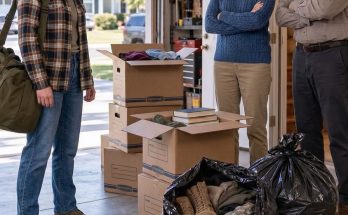
I began sorting my furniture by what would fit.
Walter's kitchen shelves would stay.
My mother's china cabinet would not.
I gave the cabinet to Denise's daughter.
We carried it onto a borrowed truck in the cold.
That evening, Melissa appeared without calling.
She looked past me at the boxes.
“So you're finally moving.”
“I've been moving a little every day.”
She held up a folder.
“A buyer asked about the house.”
“That sounds like something you should discuss with Aaron and Samuel.”
“He wants photographs.”
“Ask me for a time. I'll make sure everything is presentable.”
Melissa glanced at the legal pad on my table.
“What's all that?”
“My paperwork.”
“For the trailer?”
“For my property.”
Her eyes narrowed.
“Don't spend good money trying to turn weeds into a fortune.”
I put the folder down between us.
“I'm paying to find out what I own.”
She stared at me as though I had spoken a new language.
Then she picked up her folder and left.
Two evenings later, Rachel called.
She had obtained the public agenda from a water district meeting held the previous month.
The board had authorized preliminary site assessments for several locations.
Walter's parcel was among them.
The estimated project budget was substantial.
But it was still a planning document, not cash waiting for me.
Rachel explained all of that before saying what I had been afraid to hope.
“The district appears genuinely interested in the location.”
I gripped the phone.
“Does that mean someone will contact me?”
“Probably. And when they do, we'll ask questions before answering theirs.”
As if the conversation had summoned him, my phone buzzed during dinner.
It was Aaron.
“Linda, did you know people are talking about a water project near Dad's creek?”
I set down my fork.
“Yes,” I said.
“I've been looking into it.”
He was quiet.
Then he asked the question I had never heard from him before.
“Can we talk?”
Click here to continue reading: PART 3: The Long Road from an Uncertain Offer to a Home Nobody Could Take from Me
The Funeral Seat, the Burned Trailer, and Walter’s Letter I Could Barely Open
Part 2 of 3