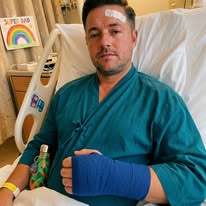
My name is Marcus Thorne.
At two in the morning, a storm reduced the interstate to a ribbon of broken reflections.
I drove overnight freight for Apex Freight Lines, usually between Ohio and Detroit.
The trailer behind me carried sealed electronics.
The receiving warehouse expected the shipment at seven.
I had left early enough to make the appointment under normal conditions.
Nothing about that night was normal.
Rain came sideways across the windshield.
The wipers made a frantic rhythm.
I slowed down because the lane markings disappeared whenever a truck passed in the opposite direction.
My supervisor, Victor Vance, would not like that explanation.
He never liked explanations.
Before I left the terminal, he had tapped the delivery deadline printed on my dispatch sheet.
“Seven sharp, Marcus.”
“I'll get there safely.”
“Get there on time.”
I knew why he was anxious.
A customer had complained about our previous delivery, and Victor wanted the next one to be perfect.
My daughter's orthodontist also wanted a payment by the end of the month.
Chloe was twelve, and she had begun covering her mouth whenever she laughed.
Her mother, Sarah, worked extra shifts at a pharmacy to help us pay for the braces.
Neither of us wanted to tell Chloe she had to wait another year.
That was on my mind when I saw the stranded SUV.
Its hazards flashed close to the right travel lane.
A man stood near the driver's door, signaling toward passing traffic.
The shoulder narrowed against a guardrail.
I could see a woman inside.
Then a child's flashlight illuminated a small face in the rear window.
I drove another quarter mile before I found a wider place to pull over.
My stomach tightened as I set the parking brake.
I was responsible for the trailer, the cargo, and myself.
I was not a roadside rescue crew.
But someone needed to make a phone call.
I put on my reflective jacket and walked back in the rain.
The man started toward me.
“Stay in the car,” I shouted.
He stopped.
“Our engine died. Both phones say no service.”
“I'm calling patrol and a tow.”
He wiped rain from his face.
“Please don't stand out here because of us.”
“I won't stand here longer than necessary.”
Back inside my cab, I found a weak signal near the top of the hill.
I called the state patrol and gave the mile marker.
Then I called a roadside service that had helped me on another run.
The dispatcher found a flatbed with seats for three passengers.
The truck might take an hour because of the weather.
The dispatcher needed a credit card to send it.
I used mine.
The amount was more than I wanted to put on that card.
I stared at the confirmation for a moment before folding the receipt into my logbook.
Then I called Apex's overnight dispatch line.
No one answered.
I left a voicemail and sent Victor a text explaining my location.
His reply arrived almost immediately.
Keep moving. You're behind schedule.
I explained that a little girl was inside a vehicle dangerously close to traffic.
I told him patrol was coming and I would leave when the family was safe.
Miss that delivery window, and you may have cost yourself your job.
I read that message twice.
Then I put the phone facedown.
I stayed in the cab where I could watch the SUV without obstructing the road.
A gust of wind rocked the trailer.
Another truck passed the stranded car close enough to throw water over its roof.
The girl's flashlight blinked.
I opened the door and went back only when traffic cleared.
The father cracked his window.
“State patrol is coming,” I said. “The tow truck will take you to a motel.”
His shoulders dropped.
“Thank you. I'm Julian Hayes.”
“Marcus Thorne.”
He shook my hand through the gap.
His fingers were cold.
The little girl leaned between the seats.
“Can your giant truck carry our car?”
“No, ma'am. It's the wrong kind of giant truck.”
She looked disappointed.
“Is the other truck better?”
“For your car, absolutely.”
Her mother smiled for the first time.
“I'm Allison. That's Lily.”
Julian explained they were returning to Detroit after visiting his sister in Columbus.
The SUV had lost electrical power without warning.
He had barely managed to coast onto the shoulder.
They had started the trip after the first line of storms passed.
None of them expected a second round.
“We thought the worst was behind us,” Allison said.
“I did too.”
I gave them a bottle of water from the spare case in my cab.
Lily asked whether freight drivers always traveled at night.
“Not always.”
“Do you get scared?”
“Sometimes.”
“My dad does too,” she said.
Julian looked down.
I told her being scared could help a person remember to be careful.
She considered that answer with unusual seriousness.
Then she nodded.
I returned to my truck and waited.
Twenty minutes later, a patrol car arrived.
The trooper positioned it behind the SUV with emergency lights flashing.
She checked on the family and told me she could stay until the tow arrived.
I offered to leave then.
But the operator called to say he was ten minutes away, and the trooper asked whether I could provide the dispatch confirmation.
I walked it over during a break in traffic.
The tow operator arrived with a flatbed and a crew cab.
He secured the SUV and checked that the three passengers could ride safely.
Julian tried to pay.
“The dispatch was already authorized,” the operator told him.
Julian stared at me.
“Marcus, that wasn't necessary.”
“I was able to do it.”
“I can reimburse you.”
“Get your family warm first.”
I handed him the carbon receipt.
“My full name's on it if you ever need to reach me.”
I didn't write down his number.
I wanted to return to work before Victor had another reason to be angry.
Julian shook my hand again.
Lily pressed her palm against the tow truck window as they pulled away.
I waved.
Then I checked the trailer seal and climbed into my cab.
By the time I merged onto the interstate, I was over an hour behind my plan.
I sent another dispatch update, noting the patrol unit and the completed tow.
Victor responded with a single word.
Unacceptable.
My delivery paperwork was still dry on the passenger seat.
The electronics were still secure.
The road ahead was clearer.
I drove without rushing.
The warehouse clock read 8:26 when I arrived.
The crew checked the seal and unloaded every pallet.
Nothing was damaged.
The receiving clerk pointed at the rain on my jacket.
“Half the carriers are running late today.”
I asked her to record the actual arrival time.
She signed the paperwork and gave me a copy.
I reached the Apex terminal that afternoon.
Victor waited beside the dispatch office.
He held a printed sheet.
“You stopped for over an hour.”
“I reported it.”
“I told you to keep moving.”
“The family was in danger, and patrol eventually took over.”
He opened the office door.
“Come sign your warning.”
The form accused me of an unauthorized delay.
I read every line.
It did not mention the weather.
It did not mention the patrol.
It did not mention the family.
I signed only to acknowledge receipt and wrote a statement beside my name.
I included the mile marker, the notifications, and the fact that my sealed freight remained in my control.
Victor frowned at the additional writing.
“Are you trying to challenge me?”
“I'm making the record accurate.”
He took the sheet without answering.
For the next two weeks, my assignments became shorter and fewer.
Drivers with less seniority received routes I used to take.
When I asked Victor about it, he said demand was slow.
I had been with Apex long enough to recognize a punishment that wasn't formally called one.
At home, Sarah spread our bills on the kitchen table.
Our rent was paid.
The utilities were covered.
The orthodontist's installment was next.
She looked at the smaller paycheck.
“Does he know what he's doing to us?”
“He knows exactly what he's doing.”
I showed her the texts.
Sarah read them slowly.
“You saved these?”
“Every one.”
“Good.”
Then she held my hand.
“I'd still want you to stop.”
“Even if it meant losing hours?”
“I don't want Chloe to grow up thinking a deadline matters more than a child's safety.”
Later that evening, Chloe asked why we were being quiet.
Sarah told her adults had a difficult problem at work.
Chloe pushed a handwritten list toward us.
It was a list of things she could do to help save money.
At the top she had written: skip movie night.
I folded it and gave it back.
“Movie night stays.”
She looked uncertain.
“Really?”
“Really.”
I did not tell her what the paycheck said.
That was my responsibility, not hers.
On Sunday, Sarah and I took Chloe to the park after breakfast.
I had nearly suggested staying home to save fuel.
But the park was close, and we needed time away from the kitchen table and the bills.
Chloe brought a ball.
She challenged us to see who could throw it farthest.
Sarah won.
I insisted the wind had helped her.
Chloe said that was exactly what a loser would say.
We sat on a bench afterward and watched a dog chase leaves across the grass.
For a while, nobody talked about work.
Then Sarah asked me quietly whether I wanted to look for another employer.
“Maybe,” I said.
“You don't have to decide today.”
“I know.”
I had driven long enough to understand that leaving a bad situation sometimes made sense.
But I also knew new employers couldn't be evaluated from a job advertisement alone.
I wanted to see what the internal review showed before making a choice.
The following Monday, I spoke to the safety coordinator, Denise, about the warning.
She asked me to send the messages and the signed receiving papers.
I did.
I didn't demand that Victor be fired.
I asked for a review of the incident and an accurate record.
Denise said she would look into it.
I began keeping a separate notebook of every shift I was assigned.
Not because I wanted a fight.
Because I was beginning to doubt my own memory.
On Monday I wrote the route, starting time, ending time, and mileage.
On Tuesday I compared that schedule with the same week a month earlier.
The difference was obvious.
It wasn't only the hours.
My regular long runs had been reassigned to drivers who usually covered local deliveries.
One of them asked whether I had requested fewer shifts.
I told him no.
He looked surprised.
“Victor said you wanted to spend more time at home.”
I hadn't said anything like that.
I didn't blame the other driver for believing him.
We all relied on what dispatch told us.
That afternoon, I emailed Victor and asked whether my route availability had been entered incorrectly.
I copied the scheduling desk.
He replied that assignments were made at management discretion.
It was not an answer, but it was a record.
Sarah helped me save a copy beside our household budget.
“Don't send an angry response,” she said.
“I'm not planning to.”
“I know. But I can see your face.”
I stood at the sink a little longer than necessary.
Then I dried my hands and went back to the table.
I had once liked working at Apex.
The trucks were maintained on schedule.
Most dispatchers did their jobs without making life difficult.
The yard mechanic, Frank, knew my daughter by name and asked how she liked middle school.
I didn't want one supervisor to erase all that.
On Friday, Frank found me checking tire pressure before departure.
“You've seemed worried,” he said.
“I'm handling something with dispatch.”
“Anything I can help with?”
“Keep doing those brake checks right.”
He grinned.
“That's the plan.”
I climbed into the cab knowing the road would still demand my full attention.
A driver can carry worry into the cab.
He cannot let it do the driving.
I put the notebook in my bag, checked the mirrors, and started the engine.
Two days later, Victor called me at the end of my shift.
“Office. Now.”
I expected another warning.
Instead, when I opened the door, a familiar man stood beside Victor's desk.
His coat was dry this time.
His handshake was just as firm.
“Marcus,” Julian Hayes said. “I've been trying to find you.”
Click here to continue reading: PART 2: The Man From the Interstate Brought Records That Changed the Conversation in Victor’s Office
The Storm, the Stranded Family, and the Warning My Supervisor Refused to Reconsider
Part 1 of 3