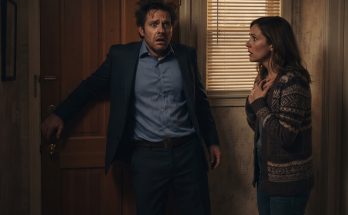
Anna arrived carrying a paper bag from the bakery on our corner.
She had inherited Elaine's habit of bringing food when she sensed bad news.
“I brought cinnamon rolls,” she said.
“Your mother would have approved.”
She hung her raincoat on the peg by the door.
Then she saw Margaret's photograph beside the kettle.
“Dad, what's happened?”
I placed the letter on the kitchen table.
“Please read this before I try to explain.”
Anna sat.
I watched her face as she reached the first sentence.
She stopped reading, looked up, and returned to the paper.
“Benjamin is your son?”
“That's what Margaret wrote.”
“Her son from the funeral?”
“Yes.”
Anna rested her elbows on the table.
“Does he know you're being told?”
“He brought the letter.”
She closed her eyes for a moment.
I could see her arranging the facts as she did with problems at her job as a public librarian.
“What evidence is there?”
I put the blue notebook beside her.
“Margaret kept dates and letters.”
“That's not the same as proof.”
“I know.”
“Are you going to get a test?”
“If Benjamin agrees.”
She nodded.
“And before anything else, Dad, do you know whether your marriage was legally valid? You married Margaret in a hospital while she was dying. That can affect an estate.”
“I hadn't thought about that.”
“I have.”
It was the sort of remark Elaine might have made.
Anna had been looking after me gently since her mother's death.
Some days I found it comforting.
Other days I hated how quickly a competent daughter could become the parent in a room.
“I didn't marry Margaret for her estate,” I said.
“I didn't say you did.”
She put her hand over mine.
“But other people could say it. You need advice before you sign anything.”
I explained what Benjamin had told me about Paul Carter.
I told her he had adopted Benjamin and raised him well.
I described Lucy, the twelve-year-old granddaughter I had not yet met.
Anna listened without interrupting.
Finally, she asked a question that hurt more than suspicion about money.
“If you have a son, where does that leave me?”
I stared at her.
“Anna.”
“I'm not asking because I'm selfish. I'm trying to be brave enough to say it before it turns into resentment.”
Her eyes filled.
“Mom is gone. You were married to Margaret for five days. I tried to be happy for you, because I saw how happy you were. Now suddenly there's a grown man who might be your child, and his daughter, and a whole family I never heard about.”
She wiped her cheek.
“I don't know where I belong in that story.”
I walked around the table and knelt beside her chair.
She gave a startled laugh.
“Dad, your knees.”
“They've survived worse.”
I took her hands.
“You don't have to compete for a place in my life. You're my daughter. That is not a seat somebody can take.”
She nodded, but I could tell she needed time.
I did too.
We ate the rolls after they went cold.
We talked about practical things because the larger questions were too heavy for one evening.
Anna offered to help find a family-law attorney who knew how adoption and parentage records worked in our state.
I asked her to come with me to the first appointment.
She said yes.
Before she left, she picked up Margaret's photograph.
“She looks happy here.”
“She was.”
“Did you love her the whole time?”
I considered the question.
“I loved the girl I remembered. Later, I loved your mother. Those truths don't cancel each other.”
Anna looked at me carefully.
“And at the hospital?”
“At the hospital I loved the woman Margaret had become.”
She set the photograph down.
“I'm glad she wasn't alone.”
Before Anna left, she wandered into the living room where Elaine's piano still stood beneath the window.
She pressed a single key.
The note rang out, slightly flat.
“Mom always said she'd have it tuned before Christmas,” Anna said.
“She did.”
“I used to think she was avoiding the expense.”
“Maybe she enjoyed complaining about it more than she wanted it fixed.”
Anna smiled.
She sat on the bench and opened the music book to a page marked with a faded ribbon.
“When I was little, you two seemed like the whole world,” she said.
“I suppose most children think that.”
“Now I'm finding out there was a whole other story before I was born.”
I stood beside the instrument.
“I didn't know that other story either.”
“I know. But part of me wants Mom here so I can ask her what she would think.”
“Me too.”
She played a few uncertain notes.
Then she stopped.
“Please don't tell me I have to welcome Benjamin because we're related.”
“You don't.”
“Thank you.”
“But I hope you'll make your own decision after meeting him.”
She nodded.
“I can do that.”
I held it carefully.
After Anna left, I stood beside the piano in the living room.
Elaine had taught our daughter her first scales on that instrument.
Sometimes, after a difficult week, the two of them would play duets so badly that all three of us ended up laughing.
I opened the bench and found an old beginner's book with Anna's name written on the cover.
A small photograph slipped from the pages.
It showed Anna at seven, standing beside Elaine with a ribbon around her neck.
On the back, Elaine had written, First recital. She was terrified. She did it anyway.
I set the photograph beside Margaret's letter.
Both women had known fear and chosen how to live with it.
Neither deserved to become a footnote in the other's story.
My phone showed a message from Anna.
I'm home. Thank you for being patient with me.
I answered that she had nothing to apologize for.
Then I changed the message.
Thank you for telling me how you feel. I love you.
She replied with a small heart.
It occurred to me that the ordinary habit of answering a message could mean more than anything I might say in a long speech about family.
I made a list of commitments I already had with Anna's sons.
There was a school concert, a Saturday project, and an upcoming birthday.
I would not let the excitement and anxiety surrounding Benjamin cause me to break promises to the grandchildren who already knew me.
The list stayed on the refrigerator beside Elaine's recipe cards.
It was not a way of measuring love.
It was a reminder that love needed a calendar as well as a heart.
When Anna drove away, I called Benjamin.
We agreed to meet at a cafe outside town the next morning.
I lay awake thinking about how I might recognize a child I had never held.
At nine, Benjamin was waiting by the window.
He wore a gray sweater and carried a canvas messenger bag.
I noticed the way he moved his coffee aside as I approached, making room at the table before I asked.
Elaine had done the same thing for visitors.
“Thanks for coming,” he said.
“I ought to be thanking you.”
He shook his head.
“Please don't make it something I earned. I almost didn't bring the letter.”
“Why?”
He watched a delivery truck pull up outside.
“Mom was sick for a long time. I was angry that she didn't tell me sooner who you were. Then I saw how much you meant to her in the hospital, and I thought I might lose that too if everything got complicated.”
“Were you at the wedding?”
“I was the one who brought the cake.”
I remembered a simple white cake on a tray.
Margaret had only eaten one bite.
Benjamin had laughed when she made me feed it to her.
I had not understood that the quiet man arranging napkins might have been my son.
“Did you want to tell me?” I asked.
“Every minute.”
“Why didn't you?”
“Mom asked me not to. It was one of her last wishes. I thought I could honor it for five days.”
We sat in silence.
Then Benjamin slid a photograph across the table.
He was about seven in it, standing on a small porch beside a man holding a bicycle.
“That was Dad.”
Paul Carter had a broad smile and oil stains on his trousers.
“He repaired farm equipment,” Benjamin said.
“He would leave before sunrise and come home smelling like grease. He told terrible jokes. Mom loved them anyway.”
“I'm glad he loved you.”
“Me too.”
Benjamin tucked the photograph back into his bag.
“He knew about you. Mom told him before they married. He said I could look you up when I was older, but he asked me to remember that nobody had abandoned me on purpose if I didn't have proof.”
“He sounds wise.”
“He had his moments.”
I told Benjamin about Anna.
I admitted she felt frightened by the sudden discovery.
He gave a sympathetic nod.
“I would too.”
“She wants us to verify the relationship.”
“Of course.”
“I do as well.”
He looked relieved.
“I've researched testing. We can use an accredited lab and arrange it through a professional rather than mailing a random kit.”
“Let's do that.”
The waitress brought fresh coffee.
Benjamin asked whether I wanted cream.
I told him I drank it black.
He smiled.
“Me too. Mom hated that.”
“She hated my coffee forty-five years ago.”
For a brief moment, we laughed like two ordinary men who had known each other a long time.
Then his phone vibrated.
A message from Lucy appeared on the screen.
He turned it toward me.
Her photograph showed a girl holding a violin in front of a school curtain.
“She had her recital last night.”
“She looks proud.”
“She made it through the whole piece without stopping.”
I wanted to ask everything at once.
Was she shy?
Did she get scared before performances?
Would she be upset to learn that a stranger had suddenly acquired a place in her family tree?
Instead, I asked whether he had recorded the recital.
Benjamin found a short video.
I watched a child who might be my granddaughter draw a bow across the strings.
Her first note squeaked.
She glanced toward the audience, then steadied herself.
When the music ended, her face opened into a relieved grin.
I had spent decades preaching that love meant being present.
Now I had a life in front of me filled with moments I had missed through no choice of my own.
I could not recover those moments.
But I could decide what I did with the next one.
“Benjamin,” I said, “I won't rush you. I won't tell Lucy anything without your permission.”
“Thank you.”
“But I'd like to learn what matters to you. Not because a letter says I should. Because you're sitting here.”
He looked down at his hands.
“That's a good place to begin.”
When I got home, there was a message from the administrator at my church.
Someone had seen Benjamin and me together after the funeral.
The person wanted to know whether Margaret had left a sizable donation to the congregation.
I stared at the screen.
The rumor had started before we had even scheduled the test.
I called the administrator and asked her not to speculate.
Then I wrote a note to myself on the back of the envelope.
Protect his privacy. Protect Anna's dignity. Tell the truth slowly.
I placed the note beside Margaret's letter.
For the first time since her death, I felt something beyond grief.
It was not certainty.
It was responsibility.
Click here to continue reading: PART 3: The Notebook Revealed a Different Story About the Letters We Never Received
The Letter Margaret Left Behind Made Me Question Forty-Five Years of Silence
Part 2 of 12