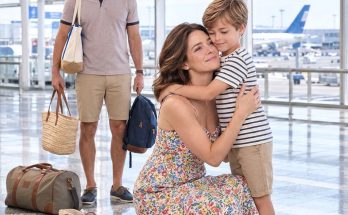
We agreed to meet at a family services center rather than a house full of old memories. Maya would sit with me until I was comfortable. Claire could bring one person, and I could leave whenever I wanted. The arrangements sounded stiff until I realized they existed to prevent two strangers, bound by grief and biology, from being forced into a scene neither could control.
I barely slept. I tried on three shirts and settled on the gray one without a stain near the collar. Luis called to remind me that a clean shirt mattered less than an honest face. Then he told me I had both and hung up before I could argue.
Claire arrived ten minutes early. I knew because I saw her crossing the courtyard through a narrow window. She walked slowly, holding a small handbag with both hands. Her hair was silver now, nothing like the braid in the old photograph. A man followed a few paces behind, carrying a coat.
Nora came to the door. “They're ready whenever you are.”
I stood. My shoulder caught. The little burst of pain grounded me.
When Claire entered, she stopped so suddenly that the man behind her nearly collided with her. Her eyes moved over my face, searching for the toddler she'd lost inside the grown man standing in front of her. I wanted to say something magnificent, something that justified the years. All I managed was, “Hello.”
She covered her mouth with one hand.
“Hello, Daniel,” she whispered. Then she stopped herself. “I'm sorry. What would you like me to call you?”
“Ethan,” I said. “For now.”
She nodded immediately. “Ethan.”
That tiny act of respect nearly broke me. Gary had named me, renamed me, corrected me, and used silence as punishment. Claire received a name she had not chosen without making it a test of love.
The man with her introduced himself as Thomas Rowan. My biological father. He was taller than me, with broad shoulders and a cautious smile. He didn't reach out to shake my hand until I offered mine.
“I don't know what I'm supposed to say,” he admitted.
“Me either.”
“Good,” he said. “At least we're starting in the same place.”
We sat around a low table. There were tissues, water, and a box of crackers nobody touched. Claire said she had imagined this meeting thousands of times. In most versions she ran across a room and held me. She had learned, through years of counseling, that her wishes might not match the needs of a child who became an adult without her.
“I don't expect a hug,” she told me. “I don't expect anything except the chance to listen.”
I asked about the boat song.
She smiled through tears. “My mother sang it to me. I changed the words for you because you were obsessed with boats. You called every puddle an ocean.”
I looked at my hands. In the recording a baby had laughed. I could almost hear it again.
“Did I really have a blue truck?”
Thomas let out a breath that sounded like a laugh. “You carried that miserable thing everywhere. I stepped on it more times than I can count.”
“The yellow wheel was missing.”
“It fell off on the kitchen tile. I tried to repair it with glue, but you pulled it apart again.”
I smiled before I could help myself. Claire saw it and began to cry silently. Ruth, the advocate, moved the tissues closer. Nobody rushed to fill the room with words.
I asked what happened in 1996. Thomas explained they had taken me abroad for a specialist appointment related to recurrent ear infections. On the return journey, a hired caregiver was to accompany me on a separate route while Thomas completed paperwork after a flight was canceled. The caregiver never arrived at the meeting point. A fire at a lodging property led local authorities to believe I had died. In an atmosphere of confusion, the identification of a child's remains was accepted too quickly.
“We buried what we thought was you,” Thomas said. “Then we learned the evidence didn't support the identification. By then the trail was cold.”
“Why didn't you take me yourselves?”
Thomas looked directly at me. “We made arrangements we believed were safe. They weren't. I have asked myself that question every day.”
I recognized the shape of his guilt. I had lived with the belief that hard work could prevent disaster. Sometimes it couldn't.
Claire told me about the years afterward. She visited police stations and consulates, worked with advocates, checked sightings, and traveled whenever somebody claimed to have seen a boy resembling me. She learned to distinguish hope from a reliable lead because failing to do so almost destroyed her health. She and Thomas separated for a time, then found a way to live together without pretending they were unchanged.
I asked whether they had other children.
“A daughter,” Claire said. “Your younger sister, Lily. She's twenty-six.”
A sister. I thought of Emily and the way we'd learned to apologize over diner coffee.
“Does Lily know about me?”
“She grew up knowing your name,” Thomas replied. “We tried not to make you a shadow she had to compete with.”
That answer mattered. I didn't want a stranger resenting me for taking up space in a house I had never seen.
The following week Claire mailed me a small booklet of photographs rather than a loose stack. She had written dates and short descriptions beneath each image, leaving plenty of white space. On the first page, toddler Daniel sat under a table with his blue truck. On the second, he wore an enormous raincoat and looked outraged by the weather. The third showed Claire asleep on a sofa while the boy draped a blanket over her legs.
I was afraid of how much I wanted those photographs to belong to me. Wanting was dangerous in Gary's house. Anything I showed too much interest in could be used as a bargaining chip. I put the booklet away and took it out again an hour later.
Thomas called while I was studying the raincoat picture. He said Claire hoped she hadn't sent too much. I told him the booklet was fine and asked whether I had always disliked rain.
“You liked jumping in puddles,” he said. “You just hated the coat. You called it the yellow prison.”
I laughed. The phrase sounded like something a stubborn little kid would say. It might have been mine. I could enjoy the possibility without claiming a memory I didn't have.
Thomas asked about my shoulder. I told him the physical therapist was pleased with the exercises. He said he had torn a tendon years earlier and understood the aggravation of slow recovery. For twenty minutes we talked about heating pads, work boots, and the strange pride men took in refusing to sit down. He didn't ask me to call him Dad.
Afterward I called Claire and thanked her for the booklet. She said she'd been nervous opening the envelope because she didn't know whether the photographs would seem like invitations or demands.
“They're invitations,” I said. “I can look when I'm ready.”
“Then that's what they should be.”
I kept the booklet on a shelf near my work manuals. There was no ceremonial place for it, no glass case. I wanted the pictures to become part of ordinary life.
Later Lily sent a message asking whether I knew how to fix a wobbly dining chair. I sent instructions and a short video. She responded with a picture of three screws and the caption, *Why are two of these left over?* We laughed about it. Her messages made room for a sibling relationship that wasn't only about loss. I had spent decades being described by the wrong history. It was a relief to be useful for something as small as repairing a chair without feeling that usefulness was the price of belonging.
Claire reached into her handbag and put an envelope on the table. “This is yours if you want it. Not because I need you to look at it today.”
Inside was a birthday card dated many years earlier. It said only, *We love you wherever you are.* The handwriting was careful and uneven.
“Did you write one every year?”
“Yes.”
“Even when you thought I might be dead?”
“Especially then.”
I stared at the card. For fifteen years I'd received nothing from my family except the occasional envelope from Carol. Somewhere else, somebody had been writing to me without knowing whether the messages could ever be delivered.
I asked for a break and walked outside with Maya. My hands were shaking. She didn't tell me I should feel grateful. She asked whether I wanted to go home or return to the room. I said I wanted five more minutes.
“Did they seem real to you?” I asked.
“They seemed like people,” she said. “That may be a more useful beginning.”
When I returned, Thomas was telling Ruth about a stubborn refrigerator they'd spent the morning trying to repair. The detail was reassuring. Their lives had continued through the search. They were not only parents in a tragic photograph. They were people with broken appliances and tired knees.
I asked if Claire wanted to know about my life. She nodded. So I told them about the mill, the small house I rented, my fishing trips with Luis, and the shoulder that had brought me to the benefits office. I told them I had never married. I did not tell them every cruel thing Gary had said. There would be time, or there wouldn't. I was allowed to choose.
Thomas offered to pay my medical bills. My body stiffened before he finished the sentence. He saw it.
“Sorry,” he said. “I don't want money to become another way somebody tells you what to do.”
I thanked him and explained I was working with my lawyer and the clinic. Help might become possible, but I needed to know it came without conditions.
Before we left, Claire asked whether I would mind a photograph. I said not yet. She nodded and returned her phone to her bag.
Then I took a step toward her.
“I can do a hug,” I said. “A short one.”
She opened her arms but waited until I moved first. She felt smaller than I expected. She smelled faintly of lavender soap. For a moment nothing miraculous happened. She was just a woman holding a man who had once been her child.
Then she whispered, “I never stopped looking.”
I couldn't promise to become Daniel again. I couldn't even say I loved her.
But I held on a little longer.
Click here to continue reading: PART 7: The Search for My Real Name Exposed the Business Gary Had Hidden
The Supervisor Recognized a Face That Should Have Vanished Thirty Years Ago
Part 6 of 12