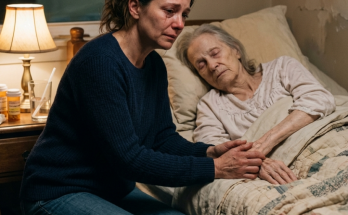
During my two-week hospital stay, I learned how loud silence can be. The days dragged on in slow motion, filled with beeping monitors, distant hallway voices, and the steady rhythm of nurses coming and going. My children lived far away, and even though a few people promised to visit, most days passed without anyone walking through my door.
At night, when the lights dimmed and the building settled into stillness, the loneliness felt heavier—like the room had extra space just to remind me what was missing.
But every evening, one nurse stood out. He always checked on me near the end of his shift, speaking in a calm, reassuring tone that felt different from the usual quick medical routine. He didn’t say anything dramatic—just small, steady encouragement: to keep fighting, to rest, and to believe I would get through it.
In those moments, I felt like more than a patient on a chart. His kindness became the one part of the day I looked forward to, a quiet reminder that I wasn’t as invisible as I felt.
When I was finally discharged, I asked the front desk how I could thank him. The staff looked confused, flipping through schedules and checking assignments.
After a brief conversation, they told me something that left me frozen: no male nurse had been assigned to my room during my entire stay. They gently suggested that stress, medication, or exhaustion might have blurred my memory. I nodded and tried to accept it, even though it didn’t sit right.
Recovery is strange that way—sometimes your body heals while your mind holds onto questions you can’t explain.
Weeks later, while unpacking my hospital bag, I found a small note tucked between my belongings. It read, “Don’t lose hope. You’re stronger than you think.” There was no signature, no clue where it came from.
I stared at it for a long time, feeling that same calm warmth I remembered from those nights. Maybe it was from a staff member I never officially met, or maybe it was something I wrote and forgot. Either way, it became a gift I didn’t know I needed—a reminder that hope can show up quietly, and that sometimes the kindness that saves us doesn’t need an explanation to be real.
A tense, fast-moving incident involving Renee Nicole Good, a 37-year-old mother, has continued to draw national attention after video footage of her final moments circulated online.
The story doesn’t end here — it continues on the next page.
Tap READ MORE to discover the rest 

What began as a law enforcement operation in a Minneapolis neighborhood quickly turned into a tragedy that left a family grieving and a community demanding answers. Federal officials have stated that agents believed they were facing an immediate threat, while local leaders and many viewers of the footage have questioned whether the situation escalated too quickly. As public discussion grows louder, small details in the video have become the focus of intense scrutiny.
In the midst of the debate, a clinical and forensic psychology expert reviewed the footage and highlighted what he described as a key indicator of Good’s state of mind.
Rather than appearing aggressive, her body language and the way the vehicle moved suggested she may have been trying to leave the area in fear. The expert pointed to subtle visual cues—such as how the steering wheel appeared positioned and the way the SUV shifted—arguing that these small movements can reflect instinctive survival behavior under stress. In his view, the moments captured on video looked more like an attempt to escape confusion than an attempt to confront anyone.
The expert also noted that the scene became more chaotic when another person attempted to enter the vehicle as officers approached.
That added movement, he suggested, may have increased Good’s anxiety and made it harder for her to fully understand what was happening in real time. In high-pressure situations, even a split-second reaction can be misread. From the officers’ point of view, a moving vehicle may have appeared threatening, even if Good’s intention was simply to create distance.
That gap between intent and perceived danger has become a central issue in how the incident is being evaluated.
Adding to the emotional impact, public officials and community members have emphasized Good’s life beyond the footage, describing her as a mother with responsibilities waiting for her at home. Some lawmakers noted that items reportedly found in her vehicle reflected everyday family life, not signs of danger—fueling further questions about how quickly ordinary moments can spiral into irreversible outcomes. As investigations continue, many hope the case leads to clearer accountability, improved communication during enforcement actions, and deeper reflection on how tragedies like this can be prevented in the future.
The night before my husband Jason’s birthday party, I asked him to clear the icy porch steps because I had a bad feeling.
He brushed it off like I was overreacting. The next morning, rushing out the door, I stepped outside, slipped, and hit the ground hard enough to break my arm. After the hospital visit, I came home in pain, wrapped in a heavy cast, and told to rest.
I expected at least a little concern. Instead, Jason looked around the house and asked the one question that made my stomach drop: how was his birthday party supposed to happen now that I “couldn’t manage things”?
That single comment cracked open something I’d been ignoring for years. Every holiday, every gathering, every “perfect” moment we hosted had always depended on me doing the work while he enjoyed the compliments.
Even injured, exhausted, and barely functioning, he still seemed focused only on his celebration and how disappointed he would be if it wasn’t flawless. I didn’t argue. I just nodded and said I’d take care of it.
But that night, while he went out with friends, I made a plan that had nothing to do with impressing guests. I booked a professional cleaning service, ordered catering, paid for it myself—and then made a call I’d been considering far longer than I wanted to admit.
By the time the party arrived, everything looked picture-perfect. Jason played the happy host, greeting guests with pride, acting as if the evening was his accomplishment.
When people noticed my cast and asked what happened, he brushed it off casually, barely giving it attention. Then the doorbell rang—and the mood shifted. A legal representative arrived and handed Jason official documents.
Moments later, the cleaning and catering managers confirmed that I had arranged and paid for everything because I was medically unable to do the physical work. The room went uncomfortably quiet as the reality settled in. Jason stared at me, stunned, but I stayed calm.
This wasn’t about embarrassing him—it was about finally making the truth impossible to ignore.
Later that night, I left with a packed bag and a friend waiting outside. My arm still ached, and emotionally I felt drained, but underneath it all was something unexpected: relief. I wasn’t walking away out of anger—I was walking toward a life where my effort, my health, and my voice would matter.
Healing would take time, both physically and emotionally, but I knew I had chosen the right future. That birthday party didn’t just mark another year for Jason—it marked the moment I stopped carrying everything alone.
Onions are one of those everyday ingredients most people don’t think twice about—until they realize how often they show up in the best meals. Whether they’re sizzling in a pan, tossed into a salad, or slowly caramelized into something sweet and rich, onions bring comfort and flavor to nearly every kind of cuisine.
But beyond making food taste better, onions also contain natural nutrients and plant compounds that can support overall wellness. When included regularly as part of a balanced diet, this simple kitchen staple can offer benefits that go far beyond taste.
One reason onions often stand out in nutrition conversations is their antioxidant content. They contain plant-based compounds such as flavonoids, including quercetin, which help protect cells from everyday environmental stress.
Onions are also part of the Allium family—alongside garlic, leeks, and shallots—vegetables that have been widely studied for their potential role in supporting general health. Red and yellow onions are especially known for having higher levels of certain beneficial compounds compared to milder white onions.
Onions can also be helpful for digestion and gut health. They provide fiber and natural prebiotics, which feed beneficial gut bacteria and can support smoother digestion over time.
Along with that, onions contain small amounts of vitamin C, potassium, and other nutrients that support normal immune and circulatory function. Some research suggests that when onions are eaten as part of an overall healthy eating pattern, they may help support stable blood sugar and cholesterol levels that are already within a healthy range. While they aren’t a medicine or a cure, they can be a smart, simple way to add more nutritional value to everyday meals.
That said, onions aren’t equally comfortable for everyone.
Some people experience bloating or stomach irritation, especially with raw onions. Cooking them—especially slowly—can make them easier to digest while still keeping much of their flavor and nutritional value. A moderate amount added to meals is often enough to enjoy the benefits without discomfort.
Like any dietary change, those with health conditions or sensitive digestion may want personalized guidance from a healthcare professional. When enjoyed mindfully, onions remain one of the easiest and most affordable ways to add both flavor and wellness support to your plate.
My father stopped speaking to me the day I adopted my husband’s son. To him, Caleb “wasn’t really mine,” and that one opinion mattered more than my marriage, my happiness, or the child who had already begun calling me Mom.
For four years, we lived without him—no holiday calls, no birthday messages, no family dinners. I told myself I didn’t care anymore, that I’d stopped needing his approval. But one ordinary afternoon at the grocery store, the past showed up in the produce aisle… and my son walked straight toward it like he wasn’t afraid at all.
It wasn’t always this bad.
The first time my dad met Thomas, he acted polite—but cold, like he was evaluating a decision I hadn’t even made yet. When he realized Thomas had a young son, his entire mood shifted. He asked questions like he was building a case: where the boy’s mother was, why she wasn’t around, and why I would “take on” someone else’s child.
Later, in the kitchen, he said the words that made my stomach turn—telling me I should be having my “own” children instead of “raising someone else’s.” I didn’t fight him that night, but something in me quietly started breaking.
After Thomas and I married, I didn’t try to replace Caleb’s mother—I simply showed up. I packed lunches, helped with homework, sat beside his bed when nightmares hit, and stayed steady when life felt big and confusing to him. Then one night, he looked up at me with shaking courage and asked if he could call me “Mom.” A year later, I made it official and adopted him legally.
That should’ve been one of the happiest days of my life, but when I told my father, he exploded. He said Caleb wasn’t mine, that blood had limits, and that I was making a mistake I couldn’t undo. Then he told me not to call him again until I “came to my senses.” So I didn’t.
Four years passed before I saw him again.
Caleb and I were shopping after school when I looked up and spotted my father—older, thinner, his hair completely white, but his expression still sharp. I froze, but Caleb noticed immediately and asked if that was my dad. I only managed to say, “We don’t talk,” and I gave him the simplest truth I could: my father didn’t accept my choice to be his mom.
Caleb nodded, thought about it for one quiet second, then walked up to my father and said, calm and steady, “Julia is my family. She’s my mom.” My father tried to argue, insisting blood mattered—but Caleb didn’t flinch. He told him, “She chose me,” then looked him straight in the eye and said the words that changed everything: “If you’re her dad, you’re supposed to choose her too… and you didn’t.” My father didn’t have a comeback.
His shoulders dropped, his voice cracked, and to my shock, he started crying right there in the store. And for the first time in years, I realized something: my son didn’t just become my family… he protected it too.