I grew up in foster care. Fourteen homes in twelve years. That’s not a metaphor—it’s the actual number. I learned early how to pack my life into a trash bag, how not to get attached, how to read adults’ moods the way other kids read comic books.
Some homes were kind but overwhelmed. Some were strict. Some barely noticed I was there. A few were places I learned to stay quiet just to survive. I never stayed long enough anywhere to feel like I belonged. Just long enough to learn the rules. Then I’d be moved again.

By the time I was ten, I stopped asking questions. I stopped hoping. Hope hurts when it keeps getting taken away.
When I turned eighteen, there was no party. No cake. No family gathering. Just paperwork, signatures, and a social worker walking me through what “aging out” meant—housing lists, job programs, a thin pamphlet about independence.
As we finished, she hesitated. Then she reached under her desk and pulled out a small cardboard box. It was taped shut, the corners worn soft with time.
“This was dropped off years ago,” she said. “A woman asked that you receive it when you turned eighteen.”
I asked who the woman was.
She shook her head. “She didn’t leave a return address. Just this.”
I took the box to my tiny studio apartment that night. I didn’t open it right away. Something about it felt heavy, like whatever was inside might ask something of me that I wasn’t sure I could give.
Eventually, I did.
Inside were letters.
Not one or two. A stack. Neatly bundled with a ribbon that had faded from red to something closer to pink. On each envelope was my name, written in the same careful handwriting. Underneath, a year.
Age 8.
Age 9.
Age 10.

My hands started to shake when I realized what I was holding.
There was a letter for every birthday—from eight to eighteen.
They were from my third foster mom.
I’d only lived with her for four months. Four months out of twelve years. Long enough for me to remember the smell of her kitchen in the mornings, the way she hummed while folding laundry, the fact that she always knocked before entering my room—even though it was her house.
I’d been moved suddenly. No warning. No goodbye. One day she was packing my lunch, the next day I was sitting in the back of another car, watching her shrink in the side mirror.
I assumed she forgot me. Everyone else did.
But she hadn’t.
I opened the first letter. She wrote about how old I must be now, how she hoped school was going okay, how she still thought about the way I used to line my shoes perfectly by the door.
Every letter followed me forward in time, guessing who I might be becoming. She never knew where I was. Never knew if I was safe. Never knew if I’d ever read a single word.
And still—she wrote.
She wrote when I turned twelve and said she hoped I had someone to light candles for me.
She wrote when I turned fifteen and said she hoped I was learning to be kind to myself.
She wrote when I turned seventeen and said, “The world may not have been gentle with you, but I believe you’re strong in ways that matter.”
The last letter was for eighteen.
It was shorter than the others.
“I don’t know where life has taken you,” it said. “But I want you to know this: I never stopped thinking about you. I hope you know you were always loved.”

I cried harder than I ever had before. Not because I was sad—but because for the first time, I realized something had been true all along without me knowing it.
Someone had loved me. Even when I was gone.
I searched for her for months. Old records. Community boards. Libraries. Eventually, I found her name connected to a small senior apartment complex.
She’s seventy-eight now.
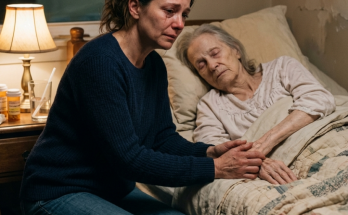
When I knocked on her door and said my name, she stared at me for a long moment—then she started crying. She said she’d wondered for years if I was okay. She said writing those letters was the only way she knew how to keep me close.
Now I visit her twice a month. Sometimes we drink tea. Sometimes I help her carry groceries. Sometimes we just sit quietly, comfortable in a way that doesn’t need words.
I spent twelve years thinking nobody wanted to keep me.
But it turns out—I was never forgotten.
And love doesn’t always disappear just because you’re moved away.