Vernon’s jaw tightened. “For Bradley. He’s in trouble, Macy. Real trouble. He made some investments that didn’t pan out. And there are people who want their money back, and if we don’t come up with something fast…”
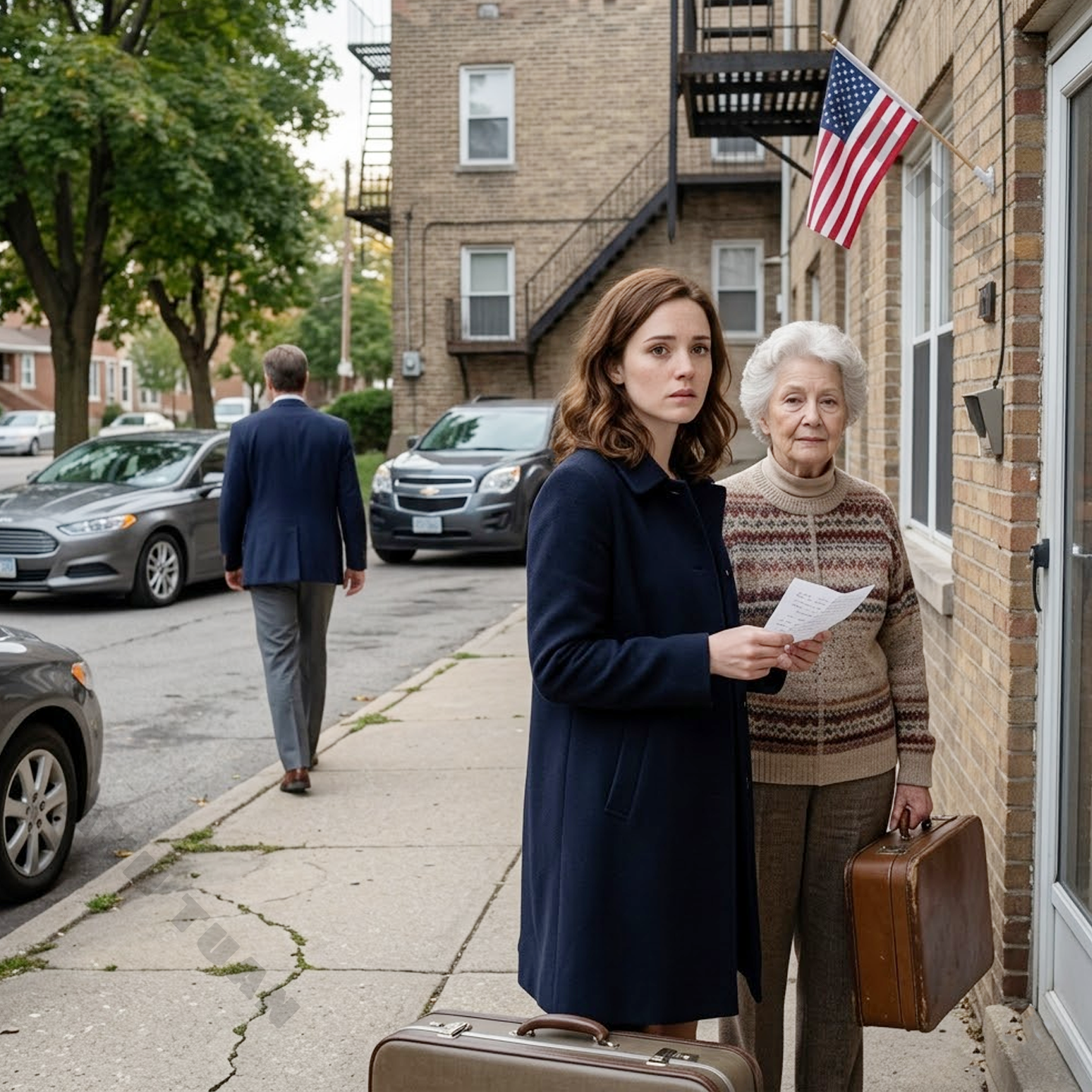
“So Bradley gambled with money he didn’t have. And now you want to raid whatever grandma has left after you already took her house.”
“That was… that was different. That was a legitimate opportunity.”
“You lost everything she had, Vernon. Her house, her savings, everything. And now you’re back for more.”
Marcus’s voice came from behind me. “Everything okay in here?”
I turned. He was standing in the doorway and his eyes were moving between me and Vernon.
Vernon straightened his jacket. “This is a family matter.”
“She asked you to leave.” Marcus stepped inside, not aggressive, but solid. “So leave.”
Vernon looked at Marcus, then at me. “You don’t understand what’s at stake. Bradley could go to prison. Your brother, your family.”
“Then he should have thought about that before he committed fraud.”
“This isn’t over.” Vernon grabbed his briefcase, shoving the papers back inside. “That money belongs to the family. You can’t keep it locked away forever.”
“Watch me.”
He pushed past Marcus and into the hallway, stopped at the door, looked back at us, at me, at Marcus, at grandma sitting silent in her chair.
“You’ll regret this?” he said. “Both of you.”
Then he was gone.
Marcus closed the door, locked it. “You okay?” he asked.
I was shaking. I didn’t realize until I tried to pick up my bag for work and couldn’t get my fingers to close around the strap.
“Yeah,” I said. “I’m fine.”
I wasn’t fine, but I had a shift to get to.
Bradley came to the restaurant 3 days later. I didn’t see him at first. I was carrying a tray of drinks to a table near the back, focused on not spilling anything, when I heard my name.
“Macy.”
He was sitting alone in a booth by the window. Nice shirt, no tie. He looked tired, actually tired. Not the kind of tired people fake to get sympathy. There were circles under his eyes, and he’d lost weight since the last time I’d seen him.
“Bradley.” I kept my voice neutral. “I’m working.”
“I know. I won’t keep you.” He gestured at the seat across from him. “Just give me 5 minutes, please.”
The restaurant was busy. My manager was watching from the bar. I couldn’t make a scene without consequences.
I slid into the booth. “5 minutes.”
Bradley didn’t speak right away. He was looking at me like he was trying to figure something out. How to start, maybe, or what approach would work best.
“You look tired,” he said finally.
“I work two jobs and take care of an elderly woman. What’s your excuse?”
He almost smiled. Almost. “Fair enough.”
“Is this about Vernon? Because if you’re here to pressure me…”
“I’m not.” He held up his hands. “I swear. I actually came to apologize.”
I waited.
“What Vernon did, showing up like that, trying to get Grandma to sign things… that was wrong. I told him that. I told him before he went that it was a bad idea, that he was going to make things worse.”
Bradley shook his head. “He doesn’t listen. He never has.”
“And you’re here to tell me you’re different.”
“I’m here to tell you I’m sorry for all of it.” He leaned forward, elbows on the table. “You got stuck with grandma because nobody else stepped up. That wasn’t fair. I should have helped. I should have visited. I should have done a lot of things.”
“Okay.”
“I mean it, Macy.”
I said, “Okay.”
He sat back. Something flickered across his face, frustration maybe, at not getting the reaction he wanted, but he smoothed it over quickly.
“Look,” he said. “I’m not going to pretend things are good with me right now. They’re not. I made some bad decisions. Trusted the wrong people. And now I’m in a situation where…” He stopped, took a breath. “It doesn’t matter. That’s not your problem.”
“No, it’s not.”
“I just wanted you to know that I’m not here to take anything from you or from grandma.” He met my eyes. “I’m just trying to fix things, make things right. If there’s a way to do that, a way that works for everyone, I want to find it.”
I watched him. He was good at this. The earnest eye contact, the careful pauses, the way he made everything sound reasonable. He’d always been good at it. It was part of why our parents loved him so much.
Bradley never demanded things. He just made you feel like giving them to him was your idea.
“What do you want, Bradley?”
“I want to help.”
“Help with what?”
“With grandma, with everything.” He spread his hands. “You’re exhausted. You’re working yourself to death. And I know, I know I haven’t been there, but I’m trying to change that if you’d let me.”
“How exactly would you help?”
“I’ve been looking into care options, real ones, not whatever Vernon was pushing. There are programs, grants, things that could take some of the pressure off you.” He paused. “And if there is money somewhere from grandpa’s estate, wherever it should go to grandma’s care, not to bail out Vernon’s mistakes or mine…”
To her. It sounded good. It sounded almost reasonable.
“You don’t know anything about grants or programs?”
“I’ve been researching.”
“Since when?”
“Since I realized how badly I’d let things slide.” He looked down at the table. “I’m not proud of who I’ve been, Macy. I’m trying to be better.”
My manager was looking at me again. Two of my tables were waiting for refills.
“I have to get back to work,” I said.
“Sure, of course.” Bradley reached into his pocket, pulled out a business card, slid it across the table. “That’s my cell. If you want to talk, no pressure.”
I didn’t pick up the card.
“Bradley.”
“Yeah.”
“If there was money, if grandpa left something and grandma had access to it, what would you want her to do with it?”
He didn’t answer right away. And in that pause, something shifted in his face just for a second. The mask slipped and underneath there was something cold, calculating. Then it was gone.
“I’d want her to be comfortable,” he said. “That’s all. Whatever that looks like.”
I stood up. “I have to go.”
“Macy, thanks for stopping by.”
I walked away before he could say anything else. When I glanced back from the kitchen, he was still sitting in the booth, staring at the business card I’d left on the table. He left a $20 tip on a coffee he never ordered. The bus boy found it when he cleared the table.
That night, after my shift, I sat in my car in the parking lot for 20 minutes before driving home. Bradley’s visit kept replaying in my head. The apology, the concern, the careful way he’d said everything like he was reading from a script he’d rehearsed. And that moment when his face had changed when I’d asked about the money. He hadn’t been lying exactly, but he hadn’t been telling the truth either.
He’d been performing something, a version of Bradley that was humble and apologetic and only wanted to help.
I thought about calling Marcus, but I didn’t know how to explain what I’d seen. It wasn’t anything he’d said. It was the thing underneath it. The way he’d looked at me when he thought I might have something he wanted, like I was a problem to be solved.
The legal letters started arriving the next week. My mother sent them. Or rather, a lawyer my mother hired sent them, requesting documentation about grandma’s care, questioning my fitness as a caregiver, suggesting that a more appropriate living situation might be necessary for someone of her complex medical needs.
I showed the letters to Marcus, who showed them to his cousin Nadia, who worked as a parallegal.
“They’re fishing,” Nadia said, flipping through the pages. “This isn’t a real case. There’s no accusation of abuse, no evidence of neglect. They’re trying to scare you into compliance.”
“So I can ignore it.”
“You can respond professionally. Document everything. Her medication schedule, her doctor’s visits, her physical therapy. Show that you’re competent.” Nadia handed the papers back. “But be careful. They’re clearly building towards something.”
“What, control?”
“If they can establish that she needs a different kind of guardian, someone who’d be more cooperative, they can petition the court.”
I thought about Vernon’s sweating face. Bradley’s careful performance at the restaurant. The way they’d both talked about the money like it was already theirs, like grandma was just an obstacle to get around.
“They can’t just take her.”
“No, but they can make your life very difficult while they try.”
I spent the next month preparing. Every doctor’s visit was documented, every medication refill photographed. I kept a log of grandma’s daily routine, when she woke up, what she ate, her energy levels, her mood. I got statements from her physical therapist and her social worker, both of whom said she was thriving under my care.
Marcus helped where he could. He fixed the leaky faucet that had been driving me crazy, installed a handrail in the bathroom, made the apartment look less like a survival situation and more like a home. Grandma watched him work with something that might have been amusement.
One evening, while Marcus was measuring the window for new curtains, Grandma reached out and tugged the back of his shirt. He turned, surprised.
“Yeah?”
She pointed at me, then at him, then she pressed her hand to her chest again, that gesture I still didn’t understand, and nodded firmly.
Marcus looked at me.
I shrugged. “I think she’s saying she approves.”
“Of what?”
“The curtains.”
“Of you.”
He went red in a way I’d never seen before. “Oh.”
Grandma made a sound. Not quite a laugh, but close. A small huff of air that sounded intentional.
We both stared. She closed her eyes and went back to her quiet breathing.
The second letter came two weeks later. This one was different, not from a lawyer, but from Bradley directly, handwritten, which surprised me. He’d mailed it to the apartment.
I read it standing in the hallway, my back against the wall. It was two pages. The first page was more of the same apologies, explanations, assurances that he wanted to help. But the second page was different. He wrote about his situation, the people he owed money to, the timeline he was working with. He didn’t ask for anything directly, but the implication was clear. If he didn’t come up with a significant amount of money soon, bad things would happen.
The last paragraph said, “I know I don’t deserve your help. I know I haven’t earned it, but you’re the only person in this family who ever did the right thing just because it was right. If there’s any way, any way at all, that you could talk to grandma, help her understand what’s at stake, I would be grateful. Not for me, for all of us.”
I crumpled the letter and threw it in the trash.
Vernon came back 3 days after that. Not to my apartment. He’d learned that lesson. He arranged to meet at a branch of Grandma’s Bank downtown, claiming he needed to verify account information. My mother had passed along the request like she was just the messenger.
“He says there’s paperwork the bank needs to process. Something about updating the account after, you know, her condition.”
I didn’t believe it, but I also couldn’t ignore it. If there was legitimate bank business, ignoring it could cause problems. So I took Grandma, and Marcus came along because I wasn’t going anywhere near Vernon alone.
The bank was one of those old downtown buildings with marble floors and too much brass. Vernon was waiting in a small conference room with a bank manager and another man in a suit who didn’t introduce himself.
“Macy, Mother.” Vernon stood all fake warmth. “Thank you for coming.”
“What’s this about, Vernon?”
The bank manager, a woman named Patricia, according to her name plate, cleared her throat. “We need to verify account holder identity for a transfer request. Standard procedure when there’s been a change in circumstances.”
“What transfer request?”
Vernon jumped in. “I filed paperwork to become a signatory on the account. Given mother’s condition, the family agreed someone should have access in case of emergency.”
“The family agreed. I didn’t agree to anything.”
“You’re not a direct beneficiary, Macy. This is between me and mother.”
Grandma was sitting beside me watching everything. The man in the suit was watching her.
“Mrs. Harmon,” he said, not Vernon’s lawyer then, but someone from the bank. “We need to confirm that you understand the request being made. If you’re unable to communicate consent, we cannot process.”
“She can’t consent,” I said. “She hasn’t spoken since…”
“I understand what he’s asking.”
Everyone went still.
Grandma’s voice was rusty, unused, but clear. “I understand exactly what my son is asking.”
She turned to look at Vernon, and there was nothing vague in her expression now. “The answer is no.”
Vernon’s face went white. “You… You can’t…”
“I can talk, Vernon. I’ve been able to talk for months.”
She turned to the bank manager. “I’m competent. I’ve been evaluated by my own physicians. My attorney has documentation, and I’m telling you directly my son is not authorized on any of my accounts. He never has been. He never will be.”
The room had that particular silence of people recalculating everything they thought they knew.
Vernon found his voice. “This is… she’s been manipulated, coached. Macy has been…”
“Macy has been taking care of me for over a year while you haven’t visited once.”
Grandma’s voice was getting stronger. “She didn’t know I could speak. I didn’t tell her. I wanted to see who she really was when there was nothing to gain from being kind.”
She looked at me. “She was kind anyway.”
The bank manager was looking between us. “I’d like to see this documentation, the medical evaluations.”
“Call Leonard Roth.” Grandma recited a phone number from memory. “He’s been my attorney for 30 years. He has everything.”
Vernon grabbed the edge of the table. “Mother, you don’t understand what you’re doing. Bradley needs that money. He’s going to prison without it. The family…”
“Bradley made his choices. You made yours.” Grandma’s voice didn’t waver. “I’ve already made mine.”
She reached into her purse slowly, her hands still not what they used to be, and pulled out a folded document. She handed it to the bank manager.
“This is a certified copy of the trust transfer I executed 2 months ago. The original is with my attorney. Everything I have, the accounts your father hid from you, the investments you never knew about, has been transferred to my granddaughter.”
She looked at me. “Macy.”
I couldn’t speak.
“$2 million. Your father hid it from you and Richard because he knew exactly what you’d do with it.”
A ghost of a smile crossed her face. “Turns out he was right.”
Vernon was on his feet. “That’s not… You can’t… I’ll challenge this. Mental incapacity, undue influence…”
“I was evaluated by three independent physicians before I signed anything. Two of them are on the hospital’s ethics board.”
Grandma’s voice was iron. “I had capacity. I had counsel. And I made my choice.”
She turned to the bank manager. “Are we done here?”
Patricia was still reading the document. “This appears to be in order. Mr. Harmon, I’m afraid without Mrs. Harmon’s consent, we can’t process your request.”
“This is fraud, Mr. Harmon.”
The other suit finally spoke. “I’d suggest you consult with your own attorney before making accusations you can’t support.”
Vernon looked around the room like he was searching for an ally. He found none. His eyes landed on me last.
“You planned this,” he said. “You took her in so you could steal.”
“I took her in because you dumped her on my doorstep and drove away.”
I stood up. “We’re leaving.”
Marcus helped Grandma to her feet. She moved slowly, but she was walking on her own.
In the elevator, she leaned against the wall. “I’m sorry I didn’t tell you sooner,” she said quietly.
“Why didn’t you?”
“I needed to know.” She met my eyes. “I needed to know if you were like them.”
The elevator doors opened. We walked out into the afternoon sun.
We got home around 3:00. Grandma was exhausted, more talking in 1 hour than she’d done in over a year, and I helped her to bed. She was asleep within minutes.
Marcus was in the kitchen making tea out of habit.
“$2 million,” he said without turning around.
“Yeah.”
“You okay?”
“I don’t know.”
I sat at the small table. “I didn’t do any of this for money.”
“I know.” He brought two cups to the table. “She knows too. That’s why she did it.”
“The money every month. The 800.”
“That was her.”
“I figured.”
He wrapped his hands around his cup. “She was watching, making sure.”
From the other room, I heard grandma shift in her sleep.
“What happens now?” I said. “They’ll fight it.”
“Vernon and your parents. They won’t give up easy.”
“No, they won’t.”
Marcus reached across the table, took my hand. “Then we deal with it together.”
The family meeting happened two weeks later. Vernon demanded it. My mother arranged it. We met at a restaurant downtown. Vernon, my mother, my father, Bradley. No Cynthia. I’d heard the engagement was off, that she’d moved out when Bradley’s legal troubles became public.
They were already at the table when we arrived. Grandma walked in on her own.
“Mother.” Vernon’s voice was strained. “You look well.”
“I am well.” Grandma’s voice was steady. “No thanks to you.”
My mother leaned forward. “We just want to understand what happened. This transfer, it came as a shock to everyone.”
“You didn’t ask.” Grandma folded her hands on the table. “You were too busy fighting over the scraps to wonder if there was anything else.”
“That’s not fair…”
“Isn’t it?” Grandma looked at Vernon. “You told me the investment was safe. Guaranteed returns. I sold my house because you said it was the smart thing to do. And then you lost everything.”
Vernon’s face was red. “The market…”
“You gambled it. I found out later from people who actually tell me the truth.”
The table went silent.
“And you…” Grandma turned to my mother. “You visited every week when you thought I had something to give. When the house was gone, you stopped coming. When I had the stroke, you waited 3 days to call your own daughter.”
“We were trying to figure out…”
“You were figuring out how to avoid responsibility.”
Grandma’s voice was flat. “All of you.”
Bradley hadn’t said a word. He was staring at his hands.
“Bradley,” Grandma said.
He looked up. His face was gray.
“You came to her restaurant. You wrote her a letter. You tried to be the good one, the reasonable one.” Grandma tilted her head. “Did you think I wouldn’t find out?”
“I was trying to help.”
“You were trying to use her the same way you’ve used everyone.” Grandma’s voice was quiet now. “You’re just better at hiding it than Vernon.”
Bradley’s jaw tightened. For a second, something ugly flickered across his face. Then it was gone.
“The money is hers,” Grandma said. “The transfer is final. You can waste your time fighting it, or you can accept it and move on.”
Vernon started to speak. But Grandma held up her hand.
“I’m done. I’ve been done for years. I just didn’t have anywhere else to go.”
She looked at me. “Now I do.”
I helped her stand. Marcus was already there with her coat.
My mother’s voice followed us toward the door. “Macy, wait.”
I turned. She looked older than I remembered, tired.
“I know we haven’t… Things got complicated. Family is complicated.”
“Family isn’t complicated, Mom. You just made choices.”
I looked at her for a long moment. “And so did I.”
We walked out.
Bradley’s trial started 4 months later. The charges were securities fraud, multiple counts. He’d been running a Ponzi scheme with his investment firm, using new investors money to pay old investors, skimming off the top for himself. When it collapsed, dozens of people lost their savings.
I testified once about Vernon’s visit, about the pressure to get Grandma to sign papers. The prosecutor was interested in establishing a pattern, a family that viewed other people’s money as theirs to take.
Bradley’s lawyer tried to paint me as biased, as someone who’d manipulated a vulnerable old woman for personal gain. The three independent medical evaluations made that difficult.
Vernon was named as a co-conspirator. He took a deal, testified against Bradley in exchange for reduced charges.
Bradley got 4 years federal prison. I didn’t visit. Neither did my parents.
6 months after the trial, I signed the lease on a two-bedroom apartment across town. Real bedrooms, not a mattress on the floor, a kitchen with actual counter space, a window seat where grandma could watch the street below.
Marcus helped us move. He’d been doing that a lot, helping, showing up without being asked.
“This one goes in the bedroom.” He was holding a box labeled photos. “Her bedroom, the one with the window seat.”
He carried it down the hall. I heard him talking to grandma, heard her laugh.
I stood in the living room, looking at the boxes stacked everywhere. The afternoon light coming through windows that didn’t smell like cigarettes.
The money was still there, most of it. I’d paid off my debts, put some aside for Grandma’s care, but $2 million was more than I knew what to do with.
“You’ll figure it out,” Grandma had said when I told her that. “You always do.”
Marcus came back down the hall. “She wants tea, two sugars.”
“I know,” he grinned, “just checking.”
I went into the kitchen and put the kettle on. Through the window, I could see the street below, people walking by, a kid on a bicycle wobbling along the sidewalk.
From the bedroom, I heard grandma say something, and Marcus’ low laugh in response. The kettle started to whistle. I made three cups.
The brother Brettley, he leaves a $20 tip on the coffee he never even ordered. I mean, he must be a very nice guy. So, that’s it for today. If you like this, please like, comment, and subscribe. Thanks so much for watching.