Her grandma, who hadn’t spoken a single word in over a year, suddenly opens her mouth at a bunk. Enjoy today’s story.
The first thing I remember my mother ever said about Grandma Edith was that she smelled like old newspapers and disappointment. I was seven. We were leaving her apartment after one of those obligatory Sunday visits. And I remember looking back at the building, wondering what disappointment smelled like and why my grandmother had so much of it.
My mother caught me looking. “Don’t feel too sorry for her,” she said, pulling me toward the car. “She made her own bed.”
I never found out what bed Grandma Edith had made. My mother wasn’t the explaining type. She was the type who expected you to absorb knowledge through proximity. Like how I was supposed to know that we didn’t talk about Uncle Vernon’s first marriage, or that my father’s promotion being passed over was actually a blessing in disguise, or that my brother Bradley was destined for great things while I was destined for… Well, she never quite finished that sentence.
Bradley got the bedroom with the window seat. I got the one next to the water heater that clanked every 40 minutes. Bradley got piano lessons. I got told I didn’t have the fingers for it. When Bradley got into state on a partial scholarship, my parents threw him a party. When I got a full ride to community college for nursing, my mother said, “Well, that’s practical.” Like practical was a disease she hoped I’d recover from.
I didn’t finish nursing school. I know that’s the part that sounds bad when I tell people. They hear dropped out and they fill in the rest. Lazy, uncommitted, couldn’t hack it.
What they don’t hear is that I dropped out because my father had his first heart surgery and someone needed to cover the deductible. And Bradley had just gotten engaged to Cynthia, whose parents were paying for a destination wedding in Cabo. And my mother looked at me across the dinner table and said, “Macy, you understand, don’t you? Bradley’s at a critical point in his career.”
I understood. I’d always understood. So I got a job waitressing at a steakhouse off the interstate and then a second job doing data entry for a chiropractor who paid in cash, and I moved into a studio apartment in a building where the elevator smelled like cigarettes and ambition.
And for 4 years, I basically didn’t exist to my family except as a Christmas card signature and an extra place setting at Thanksgiving when someone else had canled.
The thing about Grandma Edith’s house is that I didn’t know it was gone until it was. She’d lived in that brownstone for 40 years. Three bedrooms, a garden out back where she grew tomatoes, a front porch where she used to sit and watch the neighborhood kids ride bikes. My grandfather bought it before I was born, paid it off before he died. It was the one solid thing grandma had.
I found out she’d sold it the same way I found out most family news: by accident. I was 23, home for Thanksgiving because my mother had guilted me into coming, and I overheard Vernon talking to my father in the kitchen. They didn’t know I was in the hallway.
“She signed everything over last month,” Vernon was saying. “Took some convincing, but she understood it was the right thing to do.”
“And you’re sure the investment is solid?” My father sounded skeptical, which was unusual for him around Vernon.
“Real estate development in Arizona. Can’t miss. I’ve got partners lined up. Permits in process. Two years, maybe three, and we’ll triple her money. Then she can buy an even nicer place somewhere warmer.”
“And if it doesn’t work out?”
“It’ll work out.” Vernon’s voice had that confidence that always made me uneasy, too smooth. “Trust me, Richard, have I ever steered this family wrong?”
I didn’t hear my father’s answer because my mother came around the corner and caught me standing there.
“Macy, why are you lurking?”
“I wasn’t.”
“Help me with the table settings, honestly.”
I helped with the table settings. I didn’t ask about the house. I’d learned by then that asking questions in my family just got you looked at like you’d broken something.
Six months later, I heard Vernon had lost everything. Not just grandma’s money, his partner’s money, investors money, all of it. Something about the permits falling through, the market shifting, legal fees that ate up what remained. The details were vague because no one talked about it directly. They just stopped mentioning Vernon’s projects at family dinners.
And grandma moved into a rental apartment across town. One bedroom, no garden. Nobody talked about that either.
I visited her once about a year before her stroke. I didn’t tell my parents I was going. I just showed up on a Saturday afternoon with a box of pastries from the bakery she used to like. She looked smaller than I remembered. Thinner. The apartment was clean but bare. None of the photographs from the old house. None of the furniture I remembered. Just a couch, a TV, a small table by the window.
“Macy.” She seemed surprised to see me. “Your mother didn’t mention…”
“She doesn’t know I’m here.”
Something flickered across her face. “Ah.”
We sat at the small table and ate pastries and talked about nothing. The weather, my job, a show she’d been watching. She didn’t mention the house. She didn’t mention Vernon. Neither did I. But when I was leaving, she grabbed my hand at the door. Her fingers were thin and cold.
“You’re a good girl, Macy,” she said. “You always were.”
I didn’t know what to say to that, so I just nodded and left.
That was the last time I saw her before the stroke.
I was 25 when it happened. I wasn’t there. None of us were. She was found by the woman who delivered her meals on wheels, Mrs. Akono, who I only know about because she was the one who called the hospital, who was listed as the emergency contact because apparently my grandmother had stopped listing family members years ago.
By the time my mother called me, it was 3 days later.
“The situation is complicated,” she said in that tone she used when something was very simple and she just didn’t want to deal with it.
Grandma Edith had survived, but there was damage. The doctors talked about language difficulties, possible long-term effects on communication. They couldn’t say for certain how much she’d recover. She was responding to some things, gestures, facial expressions, touch, but she hadn’t spoken since they found her.
“The important thing,” my mother said on the phone, “is figuring out the practical matters. Long-term care isn’t cheap.”
I drove to the hospital the next day. My parents were in the hallway outside her room, talking with Vernon and Bradley. Cynthia was there, too, standing slightly behind Bradley like she always did, looking at her phone.
“She can’t live alone,” my father was saying as I walked up. “That’s obvious.”
“Then we find her a facility,” my mother said. “A nice one.”
“With what money?” Vernon’s voice was sharp. “She’s got nothing, Linda. Social security and a pension that barely covers her medications. There’s nothing to pay for anything nice.”
I stood at the edge of the group, still holding my coat because no one had offered to take it.
“So someone takes her in,” I said, “temporarily, until we figure out something else.”
Everyone looked at me like they’d forgotten I was there. My mother’s face did something complicated. Annoyance and relief fighting for space.
“Macy,” she said. “That’s very generous, but you work full-time and you live in that little studio.”
I said, “I live in a studio and I work, yeah, but I could adjust my schedule. Get a night shift instead, maybe.”
The silence that followed wasn’t thoughtful. It was calculating.
Vernon recovered first. “That could work. Just until the Medicaid paperwork goes through. These things take time, but once she’s in the system…”
“I haven’t agreed to anything permanent,” I said.
“Of course not.” Vernon’s smile didn’t reach his eyes. “Just temporary. The family appreciates it, Macy.”
Really? My mother was nodding like everything had been decided. Maybe it had.
I went into Grandma’s room while they kept talking. She was lying in the hospital bed, eyes open, staring at the ceiling. Monitors beeped softly around her.
“Hey, Grandma.” I pulled a chair close to the bed, sat down. “It’s Macy.”
She turned her head slowly, looked at me. Her eyes were clear, more present than I’d expected, but she didn’t say anything.
“I’m going to take care of you,” I said, “for a while, until we figure things out.”
She kept looking at me. Then she reached out and took my hand. Her grip was weak, but it was there.
Three weeks later, Vernon pulled up to my building in a rental car with my grandmother in the passenger seat and two suitcases in the trunk.
“She’s got everything she needs in those,” he said, not getting out of the car. “Mworks in the side pocket. Her prescriptions are listed. Pharmacy should have everything on file.”
I stood on the curb, still in my work uniform, smelling like steak and disbelief. “Wait, you’re just…”
“We talked about this, Macy.” He was already helping her out of the car, moving quickly like he wanted to be somewhere else. “The family agreed. Temporary arrangement.”
“I thought there’d be more preparation, a transition period…”
“She likes tea in the morning. Two sugars. And she doesn’t like the TV on too loud.” Vernon set the suitcases on the sidewalk. He didn’t look at grandma. Didn’t say goodbye to her. “You need anything else? Call your mother.”
“Vernon…”
“I’ve got a flight.” He was already walking back to the driver’s side. “You’re doing a good thing here, Macy. The family appreciates it.”
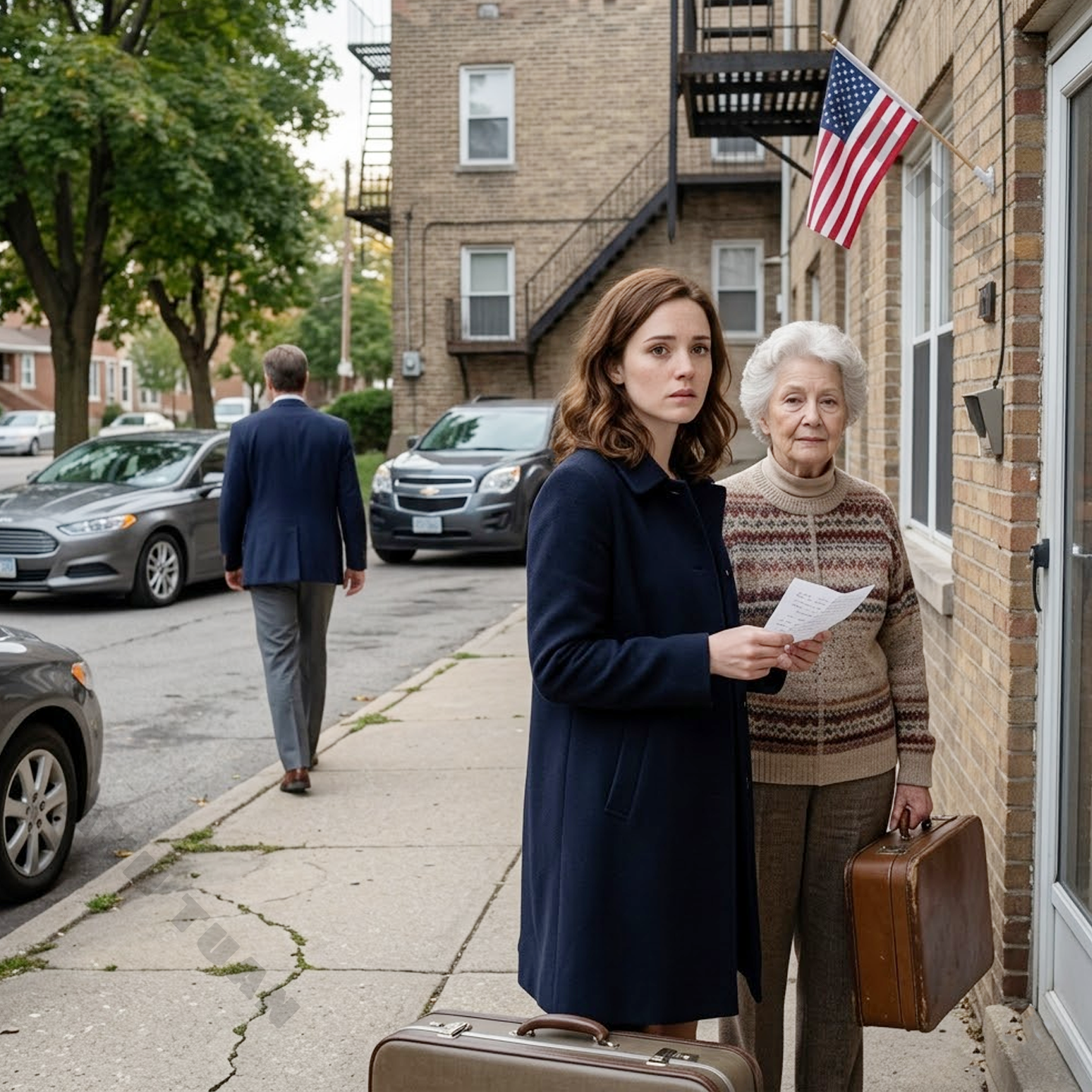
And then he drove away, and I was standing on the sidewalk with a 72year-old woman who hadn’t spoken a word since her stroke, two suitcases, and no idea what to do next.
Grandma Edith looked at me. Then she looked at the building. Then she looked back at me and something happened with her face that might have been a smile.
I picked up the suitcases. “Let me show you the elevator. It smells terrible, but it works.”
The first month was survival. I don’t know how else to describe it. I moved my bed against the wall and bought an inflatable mattress for grandma, which I put near the window because she seemed to like watching the street below. I rearranged my work schedule, mornings at the chiropractor, nights at the steakhouse, and I learned how to set up medication reminders on my phone, how to help her to the bathroom without either of us falling, how to recognize the difference between frustrated silence and content silence.
She didn’t speak. Not once. The doctors had said her speech might be affected, might take time to recover, might never fully come back. My family heard might never and stopped paying attention.
But I watched her, and the thing was, she wasn’t confused. She followed conversations on TV. She reacted to things I said, to jokes, to news. When I told her the steakhouse manager was being a jerk, she rolled her eyes in a way that was so perfectly dismissive I almost laughed.
She just didn’t talk.
We developed our own language instead. She tap her fingers on surfaces when she wanted my attention. Three taps meant bathroom. Two meant water. One long press meant she was tired. It wasn’t complicated, but it was ours.
My mother called twice that first month. Both times to ask about logistical things. Did I need copies of medical records? Had I contacted social services about the Medicaid application? Never to ask how we were. Never to offer help.
“She’s settling in,” I said the second time. “We’re figuring it out.”
“Good.” My mother’s voice was distracted. “Vernon’s been asking about some paperwork. Something from years ago, your grandfather’s estate. He thinks mother might have documents we need.”
“What kind of documents?”
“I don’t know the details. Just if you find anything in her things, let us know.”
I didn’t find anything. I wasn’t looking.
The money started in the third month. I was checking my bank account on my phone during a slow Tuesday at the chiropractor when I saw it. An $800 deposit I didn’t recognize. The description just said transfer and a string of numbers.
I called my bank. After 20 minutes on hold, I got a customer service representative who told me the transfer had come from an account with a different bank and that I’d need to contact them for details.
I spent an hour that night trying to trace the routing number and got nowhere. Eventually, I gave up and figured it was a mistake. Some accountant somewhere had fat fingered a number and eventually they’d notice and the money would vanish back to wherever it came from.
It didn’t vanish.
The next month, 800 more. Same description, same untraceable routing number. And the month after that.
I told myself to stop spending it. I put it in a separate savings account just in case someone came looking. But when grandma’s medication costs went up and the steakhouse cut my hours because the new manager didn’t like me, I dipped into it just a little, just to cover the gap.
The money kept coming. I kept using it.
I was 6 months in when I started dating Marcus. We met standing in line at the pharmacy waiting for prescriptions. He was there for his mother’s cholesterol medication. I was there for the third time that week because the insurance kept rejecting something.
“They always do this,” I said to no one in particular, staring at the ceiling.
“The rejection thing?” He had a voice like gravel smoothed by water. “My mom’s been fighting them for 3 months on her blood thinners.”
“I’ve been fighting them for 6 months on blood pressure pills. They keep saying the dosage isn’t standard protocol. What does that even mean?”
“It means someone in an office building somewhere decided my grandmother doesn’t deserve the medication that actually works for her.”
He was quiet for a second and I thought I’d made things awkward, but then he said, “That’s messed up.”
“Yeah.”
“I’m Marcus.”
“Macy.”
“You want to get coffee after this? Macy, you look like you could use some coffee.”
I almost said no. I was tired and I had to get home to grandma and I didn’t have time for whatever this was, but something in his face, not pity exactly, but recognition, made me say yes.
We got coffee. Then we got dinner a week later. Then he started showing up at the steakhouse near the end of my shifts, nursing a beer at the bar until I clocked out. He never pushed for anything. He never asked why I couldn’t stay out late, why I always had to get home.
When I finally explained about Grandma, about the whole situation, he just nodded. “She sounds tough,” he said. “Surviving a stroke like that.”
“She is.”
“You, too.”
I didn’t know what to say to that, so I kissed him instead.
Marcus started coming over. He learned the tap codes. He started bringing groceries without being asked, just showing up with milk and bread and the specific brand of tea grandma liked, even though I’d never told him the brand. He must have checked the cabinet.
One night, about 8 months in, I was watching him wash dishes in my tiny kitchen while grandma dozed on the mattress by the window. He’d cooked dinner, pasta with vegetables, nothing fancy, but better than anything I had energy to make.
“You’re good with her,” I said.
He shrugged, hands still in the soapy water. “She’s good with me. Yesterday, she patted my face when I came in three times. I think that means she approves.”
“It means she wants water.”
He turned, eyes wide with mock horror, and I laughed for the first time in longer than I could remember.
That night, after he left, grandma caught my eye. She lifted her hand and pressed it to her chest, not a tap code we’d established. Something else, something older. She looked peaceful when she closed her eyes.
The money question started gnawing at me around month 10. $800 a month, steady, never late, never less. No explanation, no trace.
I’d eliminated the obvious possibilities. It wasn’t the bank correcting some old error. I’d verified that multiple times. It wasn’t a government payment. I’d gotten a social worker to check every program grandma could possibly qualify for, and none of them matched.
The only answer that made sense was Marcus. He was the kind of guy who would do something like that without telling anyone. Proud, quiet about money, and he’d been working extra shifts at the garage, I’d noticed. Coming home later, grease stained and tired, brushing off my questions.
“Just busy season,” he’d say. “Lot of people getting their cars fixed before winter.”
But winter had passed. He was still working overtime.
One Saturday, I couldn’t take it anymore.
“Marcus…” We were in my apartment. Grandma was napping. He was on the couch reading something on his phone.
“Yeah?”
“I need to ask you something and I need you to be honest.”
The smile faded. He put the phone down. “Okay.”
“The money, the 800 that shows up every month…” I watched his face carefully. “Is that you?”
His expression went through confusion, then alarm, then hurt. “What?”
“I know you’ve been working extra, and you’re the only person who knows how tight things have been, so I need to know. Are you selling stuff, taking on debt…”
“Macy.” He held up both hands. “Stop. I’m not sending you money, Marcus. I swear I would tell you.”
“You’re getting mystery deposits?”
“800 every month since the third month she’s been here.”
“And you don’t know where it’s coming from.”
“I’ve tried everything. The bank can’t tell me. The routing number leads nowhere.”
“Then who?”
He said, “I have no idea.” He looked toward the window where grandma was sleeping. “Whoever it is, they want to help and they don’t want credit for it.”
“That doesn’t narrow it down.”
“Sure it does.” He turned back to me. “How many people in your life actually help without wanting something back?”
My family resurfaced around month 11. It started with a text from my mother.
Call me when you have a moment. Family matter.
I didn’t call. I’d learned that family matter usually meant we need something from you. So I waited.
And 3 days later, my phone rang while I was in the middle of helping grandma with her physical therapy exercises.
“Macy, I’ve been trying to reach you.”
“I’ve been busy, Mom. I work two jobs and I’m caring for an elderly woman around the clock.”
“Yes, well…” a pause. “That’s actually what I wanted to talk about.”
I waited.
“The family’s been discussing options, long-term options for mother.”
“What kind of options?”
“Vernon has been looking into facilities. Nice ones, private pay. There’s one in Phoenix that has an excellent reputation.”
“Phoenix.”
“It’s only 3 hours from Vernon. He could visit regularly.”
“Vernon hasn’t visited once in 11 months.”
“Macy, that’s not…” My mother’s voice was sharp. “There’s a financial matter. Vernon needs to discuss something with mother directly, but given her condition, communication is difficult.”
“Discuss what?”
“I don’t have all the details. It’s something about an old account. Your grandfather set something up years ago, and there’s paperwork that requires her authorization.”
I looked at grandma. She was sitting in the chair by the window doing her hand exercises. Her eyes were closed, but I could tell she was listening.
“If Vernon needs something, he can come here and ask her himself.”
“That’s not…”
My mother’s voice was sharp. “Fine, I’ll tell him.”
I hung up before she could say anything else.
Vernon showed up 2 weeks later. No warning, no call, just a knock on my door at 7:00 in the evening, right when I was about to leave for my shift.
I opened it expecting Marcus and found my uncle filling the doorway. He looked older than I remembered, thinner in the face with a nervous energy I didn’t recognize. The Vernon I knew was all confidence and bluster. This version was sweating through his collar.
“Macy.”
He didn’t wait for an invitation, just stepped past me into the apartment. His eyes swept the room, the small kitchen, the mattress by the window, Grandma sitting in her chair.
“I see you’ve made do with the space.”
“Vernon, I’m about to leave for work.”
“This won’t take long.” He was already moving toward Grandma, pulling something from his briefcase. A folder thick with papers. “Mother, I need you to help me with something.”
Grandma looked at him. She didn’t move.
“There’s an account,” Vernon said, speaking too loud. “Father set it up years ago. It’s come to our attention that it requires your signature to access. Just a signature. That’s all we need.”
He spread papers across her lap, pushed a pen into her hand.
“Vernon, what is this?” I said.
“Family business, Macy. Nothing you need to concern yourself with.”
“She’s in my care. Everything concerning her concerns me.”
He finally looked at me. Really looked, and something shifted in his face, the fake pleasantness sliding away, revealing something harder underneath.
“The account contains family funds, money that was meant for all of us. Mother has been uncooperative about releasing it in the past. But given her current condition, she can’t exactly object anymore, can she?”
“Are you serious right now?”
“This is happening with or without your approval.”
He turned back to Grandma, trying to close her fingers around the pen. “It’s simple, mother, just sign.”
“Don’t touch her.”
I stepped between them, grabbed the papers off her lap.
Vernon’s face went red. “Macy…”
“She can’t consent. You’re trying to get authorization from a woman who hasn’t spoken in almost a year without any legal oversight. That’s fraud.”
“She’s my mother.”
“She’s my grandmother and she’s under my care and you’re not getting anything from her.”
“You have no idea what you’re talking about.” His voice was rising. “That money is sitting there untouched because she was too stubborn to set up proper access before, and now we need it. The family needs it.”
“For what? To cover another one of your investments.”