She had spent years building that story. I said, “I want every person in that room to hear the real one, not because I want to embarrass her. Because I’m tired of being asked why I never appreciate my parents.” Gerald considered this. I can prepare a formal demand letter, summary of findings, notice of legal action, restitution terms in a certified envelope. You could deliver it at the event. Hand-delivered, I said, to her face. Evelyn looked at Gerald. Gerald looked at me. I’ll have it ready by Friday, he said. Evelyn reached across the table and squeezed my hand. I’ll make sure we’re both invited. Before anything else, I had to remove the chain my mother had wrapped around my throat.
Gerald filed a motion to terminate the supplemental guardianship on Monday morning. The grounds were clean. I had stable employment. I had a verified residence pending. 1847 Birchwood Lane documented in the trust. I had a support network including Evelyn, and the current supplemental guardian, Diane, had an active fraud investigation creating a disqualifying conflict of interest. Priya’s affidavit went in with the filing. So did a letter from Lily’s school counselor confirming regular attendance and normal development. So did my pay stubs. So did the shelter’s case file showing consistent cooperation and responsible parenting. The hearing was Thursday. Diane wasn’t notified in advance.
Gerald filed under expedited procedure, citing the conflict of interest. Without opposition, the judge reviewed the packet in chambers. I was grading spelling tests in the staff room during my lunch break when the email came through. Order terminating supplemental guardianship. Case number 24-fg1127. Sole legal and physical custody of the minor child L.M. is hereby restored to the petitioner Serena E. Mitchell effective immediately. I read it once, twice, three times. Then I put my head down on the table between a stack of second grade worksheets and a cold cup of coffee, and I cried silently. There were teachers in the next room, but the tears ran down my wrists and onto the formica.
For over a year, I had walked on glass around my mother because she held that guardianship like a grenade. You know how courts feel about unstable mothers. Every time I thought about pushing back, I heard that voice. Not anymore. I wiped my face before the bell rang, washed my hands in the staff bathroom, went back to my classroom, and taught long division to 22 7-year-olds. That evening, Gerald sent me the final version of the certified letter, four pages. Summary of fraud, demand for restitution, notice of legal proceedings. Printed on firm letterhead, sealed in a white envelope stamped in red. Certified mail. I held it in my hands. It weighed almost nothing.
It was going to weigh a great deal more on Saturday. Evelyn came to the shelter on Friday. She signed the visitor log the same way Diane had. Only this time, the visit was real. Lily was shy at first. She hid behind my leg and peeked out the way she did with strangers, which in a way Evelyn was. The last time they’d been in the same room, Lily was barely four. Evelyn didn’t push. She sat down at the common room table, set her handbag on the floor, and pulled out a box, wooden, polished with a brass latch. She opened it. 48 colored pencils. Not crayons. Pencils. The kind with soft, rich pigment that didn’t break when you press too hard. Each one sharpened to a perfect point.
“I heard you like to draw,” Evelyn said, setting the box on the table between them. “Can you show me?” Lily’s eyes went wide. She slid out from behind me, sat down across from Evelyn, and ran her fingers over the pencils the way you’d touch something you weren’t sure was allowed to be yours. “I can use these?”
“They’re yours.” Lily picked a violet, then a green. Then she began to draw the way she always drew, fast, sure tongue poking out of the corner of her mouth. She drew a house. Of course she did. It had a big window, a front path, a tree in the yard, and in the back, a circle hanging from a branch, a swing. Evelyn looked at me. Her eyes were wet, but she didn’t let the tears fall.
Not in front of Lily. “This is the house I want to live in,” Lily said, holding up the drawing. Evelyn studied it for a long time. Then she said very gently, “Can I tell you something, Lily? You already have a house.” And we’re going to bring you there. I promise. Lily glanced at me. I nodded. Grandma keeps her promises, I said. Evelyn leaned close to me while Lily returned to her drawing. Her voice was barely above a whisper. I lost two years with her. I won’t lose another day. I folded Lily’s drawing carefully and put it in the blue binder behind the last tab.
It didn’t fit with the rest of the documents, the deeds, the statements, the forged signatures, but it belonged there more than any of them. It was the reason for all of it. Saturday morning, the day of the party. Lily slept in. I’d been awake since 4. I sat on the edge of my bunk in the blue gray dark and went through the binder one more time, tab by tab. Court order check. Certified letter check. Trust deed check. Screenshots printed at the library. Four to a page. Check. Phone recording transferred to a USB drive Priya had lent me in case anyone asked to hear it. Check. Reverse image search printout. Check. Everything in order, everything documented.
Everything numbered and dated the way I numbered and dated lesson plans. Because if I’d learned one thing from teaching second grade, it was this. If it isn’t written down, it didn’t happen. Priya stopped by the room at 7. She was off duty, but had volunteered to watch Lily tonight. She’d take her to Evelyn’s house before the party started. Lily would not be at that anniversary dinner. I’d made sure of it. “You okay?” Priya asked from the doorway. “I’m terrified.”
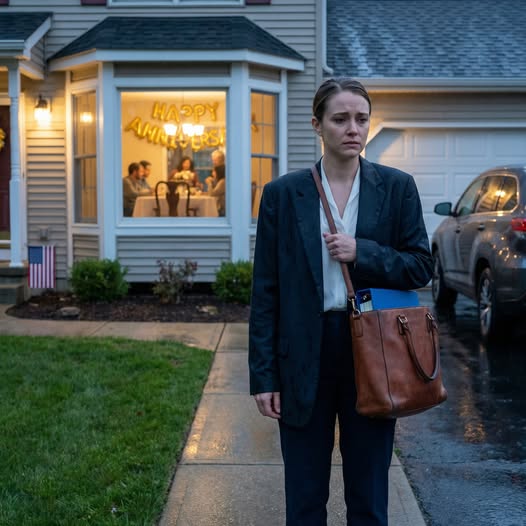
She leaned against the frame. “Good. That means you care enough to do it right. I tried on my outfit in the communal bathroom. White blouse, the one I wore for parent teacher conferences.
Black slacks, a dark blazer Priya had lent me, slightly too big in the shoulders. No jewelry, no makeup except the lipstick I found at the bottom of my purse, half-used. I looked at myself in the mirror above the sink. A woman in borrowed clothes standing in a shelter bathroom. The fluorescent light hummed overhead, the same hum that had followed me every night for two months. Tomorrow, I told myself, I wouldn’t hear that sound tomorrow or the day after or the week after. Lily and I would be somewhere else, somewhere with walls that belonged to us and a door that locked from the inside. But first, there was tonight. I put the binder in my bag, zipped it shut, walked back to my room.
Lily was awake, sitting up on the top bunk, captain in her lap. Where are you going, Mommy? To see some family, baby. Priya’s going to take you to Grandma Xi’s house tonight. You’ll have a sleepover. Her face lit up. “Can I bring my pencils?” Of course. I kissed her forehead. She smelled like the coconut shampoo I bought at the drugstore because it was the one thing I refused to compromise on. My daughter was always going to smell like something good. I picked up my bag. The binder shifted inside, heavy, ready. My hands were shaking, but my head was clear. The text from my cousin Rachel came at 2:00 in the afternoon while I was braiding Lily’s hair for the sleepover. Hey, heads up.
Your mom’s been telling everyone at church that you’re struggling with mental health issues and she’s been supporting you financially for months, but you keep pushing her away. People are eating it up. Uncle Tom gave a whole speech about it at Bible study. Just thought you should know. I read it twice. Then I put my phone down and finished the braid. I wasn’t surprised. This was Diane’s playbook, the preemptive strike. By the time I walked into that party, 30 people would already believe I was ungrateful, unstable, and probably on something. Diane would hug me in front of them, and they’d think she was a saint for even inviting me. I’d watched her do this my whole life.
The only difference was that this time I knew the script in advance. I texted Rachel back. I don’t believe her by the way, she’d added. Something always felt off. Are you okay? I’m fine, I wrote. Are you coming to the party tonight? Yeah, good. Keep your phone charged. I called Gerald. He confirmed. Letter ready. Originals in his office safe. Copies in the binder I was carrying. He’d be on standby by phone in case Diane’s attorney tried anything on the spot. I called Evelyn. She’d arrived separately. Her driver would bring her at 6:30. She hadn’t told Diane she was coming.
The invitation had been routed through Kyle, who Evelyn had called and said, “I’d like to surprise your mother for the anniversary. Don’t spoil it.” Kyle apparently had said, “That’s so sweet, Grandma.” and Priya. Priya was already at the shelter, overnight bag in hand, coloring books under one arm, ready to take Lily to Lake Oswiggo as soon as I left. I knelt down and held Lily’s face in my hands. Have fun tonight. Okay, draw something for Grandma Xi. I’ll draw her house, Lily said. That sounds perfect. I let go. I picked up my bag.
I walked out of the Maplewood family shelter into the late afternoon rain and I got in my car and I drove toward my parents house with a blue binder and a certified letter and absolutely nothing left to lose. My parents house was lit up like a stage set. Every window glowed. The driveway was lined with cars. Through the front bay window, I could see people milling with plates and glasses. Aunts, uncles, cousins, church friends. The anniversary banner hung across the living room wall in gold cursive. Happy 35th, Diane and Robert. I sat in my car for 90 seconds, counted my breaths, felt the weight of the bag on the passenger seat. Then I got out. The front door was open.
I stepped inside and the smell hit me first. catered lasagna, garlic bread, Diane’s signature lemon cake that she always made for events where she wanted people to say she was wonderful. 30some faces turned. I felt the shift, the way a room recalibrates when the person they’ve been discussing walks in. I saw it in the micro expressions. Pity from Aunt Mary. Discomfort from Uncle Tom. A tight smile from Kyle’s wife, Brena, who immediately looked at her shoes. These people had been briefed. They knew I was struggling. They knew Diane was doing her best. They’d already chosen a side, and they’d chosen it on a lie.
Kyle stood in the far corner near the buffet table holding a beer, not meeting my eyes. And then Diane came out of the kitchen. She wore a cream blouse, pearls, fresh blowout, the full anniversary armor. When she saw me, her smile froze for exactly one half second. Then it reconfigured into something warm and generous, performance grade. Serena, honey, I’m so glad you came. She crossed the room, arms wide, and pulled me into a hug that smelled like Chanel number five and hairspray. I did not hug her back. My arms stayed at my sides. Hi, Mom. She held me by the shoulders, smiled for the room, and leaned in close. Behave yourself tonight, Serena.
Don’t you dare make a scene in front of our guests. Her whisper was warm on my ear. Her grip was tight on my shoulders. I looked her in the eye. I wouldn’t dream of it. She released me, smoothed her blouse, turned back to her guests, and then the doorbell rang. Robert opened it. And there, framed in the porch light, stood Evelyn Hargrove, 5 foot three, white hair, cashmere coat, 78 years old, and absolutely not in California. Diane’s face went white, not pale. White, the color of paper, the color of surrender. Mother, she whispered. Surprise, Evelyn said. The room came alive the way rooms do when the matriarch enters. Evelyn Hargrove was not a woman people forgot.
She’d built a real estate business with her late husband from nothing, funded college scholarships for two nephews, and still sent handwritten Christmas cards every year to 46 people. When she walked in, people straightened. Evelyn, oh my god, we haven’t seen you in years. Aunt Mary was first, then Uncle Tom, then cousins I couldn’t name. They circled her. Hugs, handshakes, genuine warmth. Evelyn received each one graciously, the way a woman accustomed to being respected moves through a room. I stood near the hallway and watched my mother. Diane hadn’t moved from the kitchen doorway. Her hand was on the frame. Her knuckles were pale.
Evelyn made her way through the well-wishers and finally reached Diane. She embraced her lightly. One arm a polite pat on the back. Diane, you look well. How’s everything? Diane’s voice came out too bright. Mom, what a surprise. I thought you were—I mean, I didn’t know you were in California, Evelyn said. She smiled. No. I moved back to Lake Oswego last year. She turned to the room, still smiling. Didn’t Diane tell you? Several people glanced at Diane. Diane laughed, a short clipped sound. I must have forgotten to mention it. Evelyn accepted a glass of water from Robert, who looked like he’d rather be holding a shovel to dig himself underground.
She settled into an armchair near the buffet table, and the room settled around her. Then, with the tone of someone making pleasant conversation, Evelyn said, “So, have any of you been to Serena’s house on Birchwood Lane?” The one I gave her. The room went quiet. Not dramatic. Quiet. Confused quiet. The kind of quiet where people look at each other to confirm they heard what they just heard. Diane crossed the room fast. Mom, let’s not talk about real estate right now. It’s a party. Evelyn took a sip of her water. Of course, I just assumed everyone knew. I bought it for Serena and Lily 2 years ago. A three-bedroom, lovely street. She looked at me across the room.
Serena, have you been enjoying it? Every pair of eyes in the room swiveled to me and then to Diane and then back to me. I said nothing. I didn’t need to. The silence was doing my work for me. Diane’s neck flushed red from the collar of her cream blouse, spreading upward like a stain. The murmuring started. Low, uncertain. People looked at Diane for an explanation. Diane opened her mouth, but
I stood up before she could fill the space with another lie. Since grandma brought it up, I said, I think everyone in this room deserves the truth. My voice was steady. I don’t know how because my pulse was hammering so hard I could feel it in my fingertips. But I’d spent two months swallowing silence in a shelter, and I was done. I have never been inside that house. I didn’t know it existed until one week ago. The murmuring stopped. Diane stepped forward. Serena, stop. You’re confused. You’ve been under a lot of stress. I’m not confused, Mom. I kept my eyes on the room, not on her.
I found out about the house because grandma walked into the family shelter where Lily and I have been living for the past 2 months. 30 faces, 30 frozen expressions. Aunt Mary’s hand went to her mouth. Uncle Tom’s jaw actually dropped. I’d thought that was a figure of speech until I saw it happen. A woman from Diane’s church group said, “A shelter?” “The Maplewood Family Shelter,” I said, “On Powell Boulevard, Lily and I have been there since January 17th. Bunk beds, communal bathroom, canned soup for dinner.” I let that sit while the house grandma bought for us, the one she gave to mom to hand over, has been rented out by mom for 2 years. Robert stood up from the couch.
That is enough, Serena. I looked at him. He was red-faced, pointing at me with one thick finger. It was the universal gesture of a man who had no argument, only volume. Sit down, Dad, I said. Quiet, level. I’m not done. He didn’t sit, but he didn’t speak again. Mom rented the house using a forged lease. My name, my signature, neither of which I gave. She collected $52,000 in rent. She took out a $35,000 home equity line of credit on the property. Also in my name, also without my knowledge. Total $87,800. I said the number clearly. I wanted it in the air. I wanted every person in that room to feel the weight of it.
All of it deposited into mom and dad’s joint account while my daughter drew pictures of houses she didn’t have on the floor of a homeless shelter. Nobody moved. Nobody breathed. The anniversary banner hung behind Diane’s head like a prop in a play that had gone terribly wrong. Diane’s voice came out high and fractured. That is a lie. Mother. Mother, tell them she’s lying. Evelyn set down her water glass. I wish she were. I reached into my bag. The room went so quiet I could hear the catered lasagna bubbling in its tray on the sideboard. Somewhere behind me, a phone buzzed once and stopped. Rachel, I’d learn later, already texting her sister. You need to call me right now.
I pulled out the envelope, white, legal. The red CERTIFIED MAIL stamp across the front was bright under the overhead light. “This,” I said, “is a formal demand letter prepared by Gerald Whitfield, attorney at law, on behalf of me and the Hargrove Family Trust.” I set it on the table between the lemon cake and a vase of grocery store tulips. It contains a certified copy of the trust deed naming me as sole beneficiary of 1847 Birchwood Lane. A copy of the lease agreement you signed using a forgery of my signature. Bank records showing $52,800 in rent deposited into your checking account over 24 months. HELOC statements showing $35,000 drawn against my property using fraudulent documents.
I ticked them off the way I read a rubric to my second graders. Calm, clear, no emotion wasted. And a notice that a fraud complaint has been filed with the Multnomah County District Attorney’s Office. Diane stared at the envelope. She didn’t touch it. Her hands were at her sides, fingers curled, trembling. Robert’s mouth was open, but nothing was coming out. I reached into the bag one more time and pulled out a single sheet of paper. There’s also this. I held it up. “A court order issued last Thursday terminating your supplemental guardianship of Lily.” Effective immediately, sole custody has been restored to me.” That was the one that broke her.
Not the money, not the fraud charges, the guardianship, the leash she’d held over me for a year. You can’t do this, Diane whispered. Her voice was stripped now, raw. I am your mother. I looked at her. My mother in her cream blouse and pearls, standing in front of a banner, celebrating 35 years of a marriage built in part on money stolen from her own granddaughter. “And I’m Lily’s mother,” I said. That’s the only title that matters to me right now. I set the court order on top of the envelope, stepped back. You had two years to do the right thing. You had two years to hand me that key. Instead, you watched your granddaughter sleep in a shelter.
So, no, you don’t get to call yourself my mother tonight. The room didn’t gasp. It was worse than that. It just absorbed. 30 people standing in a living room decorated for celebration, absorbing the fact that the woman who baked the lemon cake had stolen a house from her own daughter. Diane cried, “Not the quiet kind. Not the kind you feel sorry for, the theatrical kind, the kind that turns outward, that reaches for an audience, that says, “Look what she’s doing to me without using those exact words.” She pressed both hands to her chest and turned toward the room. You see? You see what she’s doing on our anniversary? After everything I’ve done for her, I raised her. I sacrificed everything.
She looked at Aunt Mary. Mary didn’t move. She looked at Uncle Tom. Tom looked at the floor. Robert stepped in front of Diane like a shield. This family is falling apart because of you, Serena. You always had to make everything about yourself. I didn’t respond to him. I turned to Rachel who was standing near the bookshelf with her phone in her hand and said, “Ra, do you mind reading these out loud? I handed her my phone open to the screenshot album.” Rachel looked down. Her eyes moved across the screen. Then she read clearly, steadily, the way someone reads testimony. Text from Diane Mitchell, January 24th, 9:47 p.m. Stop being dramatic. Lots of people go through hard times.
The room flinched. Text from Diane Mitchell, February 1st, 11:12 a.m. The answer is no. And frankly, maybe this is God’s way of telling you to be more responsible. Diane lunged forward. Those are out of context. Text from Kyle Mitchell. January 28th, 8:03 a.m. Sorry, sis. We’re tight right now. Mom said you should apply for section 8. Rachel lowered the phone and looked at her aunt. Were you tight, Aunt Diane? Because those helock records say there was $35,000 sitting in your account when you told Serena you couldn’t spare 2,000. Diane turned to Evelyn. The tears were real now, but they weren’t the right kind. Not remorse, not shame.
The tears of someone watching their story fall apart in real time. Mother, please. I can explain everything. It was a misunderstanding. Evelyn didn’t raise her voice. She didn’t need to. A misunderstanding does not come with a forged signature. Diane, the lemon cake sat untouched on the table. The tulips leaned sideways in their vase, and my mother stood in the middle of her own anniversary party, surrounded by 30 people who could no longer look her in the eye. Rachel didn’t let it go. She turned to the corner of the room where Kyle had been standing all evening, silent, nursing the same beer. Kyle, she said, did you know about this? Every head turned. Kyle’s face was red. Not angry red.
Caught red. He shifted his weight and said in a voice that tried very hard to sound casual. I didn’t know the details. I just thought mom was managing some property for grandma. The HELOC records, I said, show a $10,000 transfer to your personal account dated June 14th for the down payment on your Tahoe. The SUV, the # blessed one, the one he posted on Instagram the same month he told me he was too tight to help with a deposit. Kyle opened his mouth, closed it, opened it again. I thought that was mom’s money. She said it was a loan from her 1:01:001 giờ, 1 phútsavings. It wasn’t her money, Evelyn said from her chair. Her voice was even, factual, like a woman reading a balance sheet.
It was drawn from a line of credit taken out fraudulently on your sister’s property. A property I purchased so that your niece would have a home. The six-year-old who has been sleeping in a shelter. Kyle put his beer down on the mantle. He didn’t pick it up again. Uncle Tom spoke for the first time since the beginning. His voice was thick. Diane, I vouched for you. I told people in this room, in this family, that Serena was the problem. That she was ungrateful. That you were doing your best. He paused. You made me a liar. Aunt Mary, I cannot believe this. You stole from your own grandchild. Diane’s composure finally cracked. Not into sorrow, into defiance. It’s not stealing, she shouted.
Her voice bounced off the walls. It’s family money. Mother gave it to me, and I managed it the way I saw fit. I gave it to Serena, Evelyn said. Quiet. Absolute. I have never in 78 years been more ashamed of my own child. The room held that sentence like a held breath. Diane looked at the 30 faces that had smiled at her when she cut the cake, that had toasted her marriage, that had believed her for years, and found nothing. No sympathy, no rescue, no one to perform for. She turned and walked down the hallway to the bathroom. Robert followed, the door shut. The anniversary banner hung crooked above the empty buffet table, one corner drooping where the tape had given up. Nobody fixed it.
I left the party before anyone started cleaning up. I drove to Evelyn’s house, picked up a sleeping lily from the guest room, carried her to the car, and buckled her in with captain wedged between her and the seat belt. She didn’t wake up. On the drive back to the shelter, the last drive, I told myself, the very last one. My phone buzzed twice. Gerald confirming the letter had been hand-delivered with Rachel and Tom as witnesses and Priya texting a photo of a drawing Lily had made at Evelyn’s. A house with a yellow door and three stick figures out front. I saved both. The following week, Gerald did what Gerald does. He moved paper. Monday, civil suit filed in Multnomah County Circuit Court.
Diane and Robert Mitchell, defendants. Claims fraud, forgery, conversion, breach of fiduciary duty, relief sought, full restitution of $87,800, plus attorneys fees and costs. Tuesday, fraud complaint formally received by the Multnomah County DA’s office. Case number assigned, forgery in the first degree, an OS 100 turn 65.013 013 violation class C felony. Wednesday, Gerald’s office notified the bank that issued the HELOC forged application unauthorized signatures. The bank froze the credit line within 48 hours and opened its own internal investigation. Diane and Robert were now on the hook for the $35,000 outstanding balance.
And if they didn’t pay, the bank would pursue its own criminal referral. Thursday, the 60-day notice to vacate reached its second week. The tenants at Birchwood Lane, decent people caught in Diane’s lie, had already begun apartment hunting. No hard feelings. They’d gotten their deposit back from Gerald’s office, funded by Evelyn, as a gesture of good faith. Gerald called me Friday evening. Their attorney reached out today, he said, used the word untenable. That’s lawyer for we’re going to lose. I sat on my shelter bunk for what I hoped would be one of the last times and felt something I hadn’t felt in months. Not happiness, not yet. Something quieter. Traction.
After two months of sinking, the ground under my feet was finally solid. Serena Gerald said you’ll have your house by April. April, two months away. Lily’s crayons. Lily’s swing. Lily’s room with the built-in shelves. Two months. I could do two months. The call came two weeks after the party. Diane used Kyle’s number. Mine was blocked and she knew it. I almost didn’t pick up, but something in me needed to hear her try. Serena. Her voice was different, smaller, stripped of its polish, its performance. Please, can we talk? You have 2 minutes. Drop the charges, please. We’ll pay you back. All of it. I swear your father’s blood pressure is through the roof. I can’t sleep.
The whole family won’t speak to us. Pastor Reynolds asked us not to come to service until the situation is resolved. She drew a ragged breath. I’m begging you. I stood in the shelter hallway. The fluorescent light buzzed above me. Down the corridor, someone’s toddler was laughing. the pure helpless kind of laugh that doesn’t know anything about fraud or forgery or $35,000 credit lines. Mom, I said, you had 2 years, 730 days. Every single one of those days, you could have called me and said, Serena, there’s a house. It’s yours. Here’s the key. And every single one of those days, you chose not to. I know. I know. But you watched me beg you for $2,000 while you sat on $87,000.
You told me God was teaching me responsibility. You told grandma I was living in that house. You told the family I was mentally ill. You used my daughter’s guardianship to keep me quiet. Silence. So no, I said I won’t drop the charges. I’m your mother, Serena. Doesn’t that mean anything? It meant everything to me. I said, “That’s why this hurts. But I have a daughter, too, and she is never going to wonder whether her mother protected her. I heard Diane inhale to speak. I didn’t wait. You didn’t ruin this family, Mom. You just built it on a lie. I’m not destroying anything. I’m just turning on the lights.” I hung up. I blocked Kyle’s number. I walked to the common room.
Lily was sitting at the table drawing with her colored pencils, the ones Evelyn had given her. She looked up. “What are we drawing today?” I asked, sitting down beside her. “Our new house,” she said. “With the swing.” I picked up a green pencil and started on the tree. “Sometimes I wonder if my mother ever really saw me. Not the version she described to relatives, the struggling one, the dramatic one, the one who never appreciates anything. Not the scapegoat, just me. The woman who packed lunches at 5:30 in the morning, graded spelling tests on her lunch break, and never once asked for a single thing she wasn’t owed.
Four weeks after the anniversary party, Diane and Robert’s attorney called Gerald and said the word settle. Gerald walked me through the terms over the phone while I sat in the school parking lot during my planning period. Engine off, heater fading. Restitution, $52,800 in misappropriated rent to be repaid over 36 months. $1,467 per month deposited directly into a trust-managed account. First payment due in 30 days. HELOC. Diane and Robert would pay the $35,000 outstanding balance to the bank in full within 90 days. Failure to do so would trigger the bank’s own criminal referral separate from the DA’s case. Kyle, $10,000 returned over 12 months, $833 per month. No exceptions, no deferrals.
Criminal. The DA agreed to reduce the forgery charge from a class C felony to a misdemeanor contingent on full compliance with restitution and three years of supervised probation. Any missed payment would reactivate the felony charge. No contact order. Diane and Robert were prohibited from contacting me or Lily by any means. Phone, text, email, social media, third party without prior written consent. violation would result in arrest. Gerald read the final clause. Respondents acknowledge full responsibility for the actions described herein and waive any future claim to the property at 1847 Birchwood Lane. Do you accept? He asked. I looked through the windshield at the school building.
Through the second floor window, I could see my classroom. The one with the alphabet border and the drawer of granola bars and the reading corner where I sat with 22 7-year-olds every afternoon. Yes, I said. I accept. Robert sold the F-150 the following week. Got 28,000 for it. Diane was let go from the dental office. The practice manager cited conduct inconsistent with our values after the misdemeanor charge hit the public record. The tenant at Birchwood Lane moved out on March 29th, one day ahead of the 60-day deadline. They left the tire swing. Gerald called me that evening. The house is empty. It’s yours. I signed the papers the next morning.
A trust distribution confirmation, a new deed, and a key. One key. Silver. Warm in my hand. Justice didn’t feel good. It wasn’t supposed to. It felt right. And for the first time in over two years, something in my life felt exactly right. April 1st, not a joke, not a dream. Portland rain, the soft kind, the kind that sounds like someone shushing a baby. Birch trees along the street had filled in since the last time I’d stood on this sidewalk. Their pale trunks wrapped in the palest green. I turned the key. The door opened into a small foyer with hardwood floors and a coat hook by the door. Beyond it, a living room with built-in bookshelves and a window that faced the street.
The kitchen was to the right, smaller than Diane’s stock photo, but real. My kitchen, my counter, my window above the sink, looking out at the oak tree in the backyard. Lily pushed past me and stopped in the middle of the living room. She turned in a slow circle, taking it all in. The high ceilings, the fireplace, the light coming through the front window. Then she saw the backyard through the sliding door. “Mom, there’s a swing.” She ran. I let her. Priya arrived 20 minutes later with the boxes from the shelter. There weren’t many. Three suitcases, a bag of Lily’s art supplies, Captain the bear, the blue binder, which I sat on the kitchen counter and decided to keep forever.
Evelyn came after that, her driver carrying a box of kitchen essentials, pots, plates, dish towels, a kettle. She said a small vase of fresh daffodils on the counter and didn’t say anything. She didn’t need to. Lily’s room was the small one on the left, built-in shelves under the window, just as I’d seen from the sidewalk. We set up the twin bed Evelyn had ordered, pushed it against the wall, arranged the colored pencils on the shelf. I took Lily’s drawing, the one from the shelter, the house with the big window and the swing, and taped it to the wall above her bed. That night, for the first time in 74 days, I put my daughter to bed in her own room.
I read her the fox story I’d made up on our first night at the shelter. She fell asleep before the end. I stood in the doorway and listened. No fluorescent hum, no stranger crying down the hall, no vinyl mattress crinkling, just rain on the roof, and Lily’s slow, steady breathing, and the house settling around us like it had been waiting. I walked to my room, my bed, my door that locked from the inside. I lay down in the dark and I cried. But these weren’t the shelter tears, the ones I swallowed so Lily wouldn’t hear. These were different. These were the tears of a woman who had finally after 2 years stopped drowning.
And the quiet was not the quiet of a shelter where silence means someone is trying not to cry. It was the quiet of a home where silence means everyone is safe. Six months later, in October, the birch trees on our street turned gold and Lily said they looked like candles. She started second grade at Fernwood Elementary. Five minutes on foot. I walked her every morning and picked her up every afternoon. On Fridays, she brought home a folder of drawings, and we taped the best ones to the refrigerator until the refrigerator disappeared behind layers of color. Evelyn came every Saturday. She and Lily sat at the kitchen table with the colored pencils and drew together.
Evelyn was terrible at drawing, which made Lily laugh so hard she slid off her chair. Lily called her Xi. Evelyn called Lily, my artist. Sometimes I’d hear them whispering to each other and I’d stand in the kitchen doorway with a cup of coffee and just breathe. I started seeing a therapist in May. Priya recommended her, a woman named Dr. Kesler who specialized in family of origin trauma. I went not because I was broken, but because I wanted to understand why I’d said “Okay, Mom” for 29 years. That understanding came slowly, the way spring comes to Portland. gray for a long time and then suddenly everything blooming at once. Diane and Robert made their payments on time.
I checked the trust account once a month and then closed the screen. They’d sold their house and moved into a one-bedroom apartment on the east side. I heard this from Rachel. I didn’t feel satisfied. I didn’t feel sorry. I felt okay. Kyle sent a text in August. Three lines. I’m sorry. I should have known. I should have done more. I read it. I didn’t reply. Maybe someday I would. Maybe I wouldn’t. That was my choice now. One evening in October, Lily was drawing at the table while I graded papers. She put down her pencil and looked up. “Mom, why didn’t we always live here?” I set my pen down. I thought about it. Really thought.
The way you do when a child asks you a question that deserves more than a reflex.
“Because sometimes it takes a while to find your way home, baby. But we’re here now, and we’re staying.” She nodded, satisfied. Went back to her drawing. I looked over her shoulder. It was the house again. Our house, but this time there were three figures standing in front of it. A tall one, a small one, and behind them, a shorter one with white hair and a big smile. I looked at that drawing for a long time. Then I smiled, the kind of smile that doesn’t weigh anything. I used to think protecting my daughter meant keeping the peace.
Swallowing the word no, saying, “Okay, mom.” And hanging up and folding my hands and waiting for someone to notice I was drowning. Now I know. Protecting her means making sure she never has to question whether she deserves a home. She does. She always did. And now she has one. And that’s where my story ends and where our new life begins.