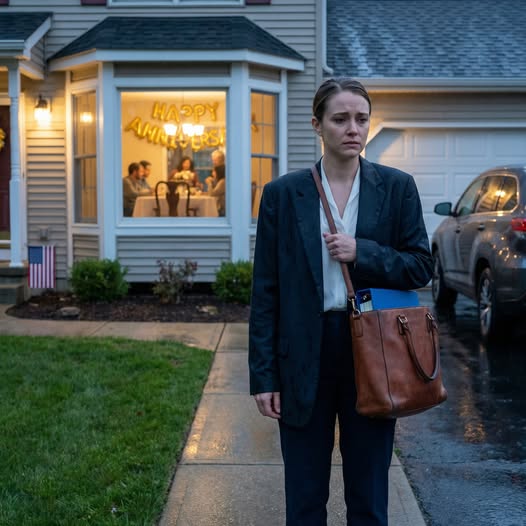
My six-year-old daughter and I were eating dinner at a family shelter when a black sedan pulled into the parking lot. An elderly woman stepped out, looked through the window, and froze. She walked in and said, “Why aren’t you living in your house on Birchwood Lane?” I blinked. “What house?” I didn’t raise my voice. I made a phone call. 3 days later, I walked into my parents’ anniversary party and my mother’s face went white. My name is Serena Mitchell. I’m 29. I’m a second grade teacher and a single mom. And this is the story of how my own parents stole a house from under me and cashed rent checks for 2 years while my daughter and I slept on a shelter cot.
Now, let me take you back to last January. The week I lost my apartment and everything I thought I knew about my family started to unravel. The letter came on a Tuesday. I remember because Tuesdays were Lily’s library days, and she’d come home with her backpack stuffed with picture books she couldn’t wait to show me. That afternoon, while she was spreading them across the kitchen table of our one-bedroom apartment on Division Street, I stood at the counter reading a 30-day notice to vacate. The building had been sold. New ownership, all tenants out by February 15th. I read it three times.
Then I folded it, slid it into the clear plastic folder I kept our important documents in, and sat down next to Lily. Which one first tonight? I said. She held up a book about a bear building a house in the woods. Of course she did. That night, after she fell asleep, I did the math on the back of a grocery receipt. First month, last month, security deposit, $4,200 minimum for anything in Portland that wouldn’t put me further from Lily’s school. I had 1,100 in savings. My last child support check from Marcus had bounced in October and the one before that never came at all. I called my mother. Mom, I need help. Just temporary. A few weeks until I find a new place. Lily and I can share a room.
My mother, Diane Mitchell, paused the way she always paused before delivering a no. Long enough that you’d start hoping. Honey, we don’t have the room. Kyle and Brena are staying with us right now. You know how it is. Kyle, my older brother, 33 years old, employed full-time at a logistics company with a wife who sold real estate, staying in my parents’ four-bedroom house. Can Lily at least stay with you while I figure things out? That wouldn’t be fair to Kyle’s kids. I didn’t argue. I never argued. I said, “Okay, Mom,” the way I’d been saying it my whole life. And I hung up.
Three days later, Lily and I checked into the Maplewood family shelter on Powell Boulevard with two suitcases and a stuffed bear named Captain. The intake worker handed me a sheet of rules and a room number. The hallway smelled like industrial bleach and someone else’s spaghetti sauce. The fluorescent light above our door buzzed at a frequency I’d hear in my sleep for the next 2 months. Lily looked up at me. Is this a hotel, Mom? It’s temporary, baby. I believed that. I had to. The beds were metal framed bunks with mattresses wrapped in vinyl. Lily took the top because she said it was like a treehouse.
I lay below her, staring at the underside of the slats, listening to her shift and sigh and shift again. Mommy, the light makes a noise. She meant the fluorescent tube in the hall. It hummed through the gap under our door, a thin electric whine that never stopped. Close your eyes, Lily. I’ll tell you a story. I made one up about a girl who could talk to foxes. I don’t remember the plot. I just remember that by the time I ran out of words, Lily’s breathing had gone slow and even, and the hallway was quiet, except for that hum, and somewhere down the corridor, a woman crying softly behind a closed door. I did not sleep. I lay there and thought the thing I could never say out loud.
She’s going to remember this. Not the story about the foxes. This, the bunk, the buzzing light, the smell. Someday she’ll be old enough to understand what a family shelter is, and she’ll know that her mother couldn’t provide a home. That thought sat on my chest like a stone. The next morning, a woman with warm brown eyes and a lanyard that read Priya Okafor, Case Manager, knocked on our door at 8:15.
“Serena, I’ve been assigned to your case. Can we talk?”
Priya was professional, but not cold. She walked me through housing wait lists, emergency assistance programs, section 8 timelines. She didn’t sugarcoat anything.
When I asked, “How long do most families stay here?” she paused just a beat and said, “It varies, but I’ll make sure you have everything you need to get out as fast as possible.”
That night, I texted my mother a photo of Lily’s artwork from school. A rainbow over a house. Diane replied 3 hours later at 9:47 p.m. Stop being dramatic. Lots of people go through hard times. I stared at the screen. Then I screenshot the message, saved it to my phone, and put it in a new album I labeled records. I didn’t know why yet. I just knew I should keep it. Here’s what a day looked like. 5:30. Alarm on my phone. Volume low so I wouldn’t wake the family in the next room. Shower in the communal bathroom. Lukewarm water. No lock on the stall. Flip flops I bought at the dollar store because the tile had a film on it I didn’t want to think about. Dress Lily.
Braid her hair with a comb I kept in my purse because I’d learned fast that anything left in the bathroom disappeared. Drop her at the before-school program by 7:15. Drive 12 minutes to Maplewood Elementary, a Title One school where I taught second graders who sometimes came in hungry, which meant I kept a drawer of granola bars in my desk. Teach all day, pick Lily up by 4:00, back at the shelter by 5. Every evening, Lily drew. She drew constantly. The shelter had a donated bin of crayons, half of them broken, most of them some shade of brown. And Lily used every single one. She drew flowers, dogs, rainbows, but mostly she drew houses.
Houses with big windows, houses with yards, houses with trees and a path to the door and smoke coming out of the chimney, even though it was January in Portland, and our last apartment didn’t have a fireplace. I watched her draw those houses, and I felt something crack behind my ribs every time. One night, after she was asleep, I sat on the bottom bunk with a notepad and did the math again. deposit plus first and last 4,200. Current savings $1,100. GAP $3,100 I did not have. I texted Kyle. Can you help me with the deposit? I’ll pay you back within 6 months. He replied the next morning. Sorry, sis. We’re tight right now. Mom said you should apply for section 8.
I put my phone down, opened Instagram. Kyle’s most recent post. a photo of a brand-new silver Chevy Tahoe captioned upgraded #blessed. I didn’t reply to his text. I screenshot the post, added it to the records album, and went to read Lily her bedtime story. My mother came to the shelter 3 weeks after Lily and I moved in. She brought a plastic bag of Kyle’s kids hand-me-downs, shirts with stains on the collars, jeans with frayed knees, and a smile wide enough for the front desk staff to see. I’m Lily’s grandmother, she told the intake coordinator, signing the visitor log with her looping cursive. I just wanted to drop off some things for my grandbaby. She found us in the common room.
Lily was drawing. Diane swept in, arms open, voice pitched high. There’s my girl. Grandma’s here. Lily hugged her. The intake coordinator smiled from the doorway. I watched Diane perform warmth like a woman who’d rehearsed it in the car. When the coordinator left, Diane’s smile thinned. Serena, we need to talk. She sat across from me, handbag in her lap, and lowered her voice to the register she used when she wanted me to know she was serious. I’ve been thinking if this situation keeps up, the shelter, the instability. I might need to talk to the court about Lily’s living arrangement. My blood went cold. She was talking about the supplemental guardianship.
When Marcus and I divorced, the family court had appointed Diane as a temporary supplemental guardian for Lily. A formality, they said, while I stabilized my housing. It gave Diane no custody, but it gave her standing. Standing to file motions, standing to request evaluations, standing to say, “Your honor, my daughter is living in a shelter. That’s no place for a child. I’m not threatening you, she said, adjusting her collar. I’m just worried as her legal guardian, supplemental guardian, I said. Same thing. It wasn’t the same thing, but I didn’t have a lawyer to explain why. Diane stood, kissed Lily on the forehead, and said loud enough for the hallway. Be good for mommy, okay?
Grandma loves you so much. She signed the visitor log on her way out. Date, February 3rd. Time 4:20 p.m. That night, I started a handwritten journal. Date, event, what was said, who was present. I didn’t have a name for what my mother was doing. I just knew it needed to be written down. I found a studio apartment on Stark Street, 600 square ft, one block from a bus line. The landlord said he’d hold it for 72 hours if I could put down 2,000. $2,000. That was the gap between my daughter drawing houses on a shelter floor and my daughter sleeping in a real bed in a room I could lock behind us. I called my mother one last time. Mom, I found a place. I just need 2,000 for the deposit.
I’ll pay you back from my tax refund in March. That’s 6 weeks. Diane sighed the long theatrical sigh she’d been perfecting since I was 12. Serena, your father and I are on a fixed income. We simply don’t have it. Two weeks earlier, she’d accidentally sent a photo to the family group chat before deleting it. I caught it before it disappeared. Robert leaning against a new Ford F-150 in the driveway, grinning, holding up the keys. Fixed income. Mom, I’m asking for a loan, not a gift. The answer is no. And frankly, maybe this is God’s way of telling you to be more responsible. I held the phone away from my face and pressed my knuckles to my mouth. I counted to five, then I put it back.
Okay, Mom. I let the apartment go. That night, Lily tugged my sleeve while I was writing in my journal. Mom, when are we going home? Soon, baby. I didn’t know what soon meant anymore. The word had gone soft and shapeless, like something left in the rain too long. After Lily fell asleep, I opened the clear plastic folder. It was thick now. The 30-day notice from Division Street, screenshots of Diane’s texts, screenshots of Kyle’s, the visitor log entry, my handwritten journal, receipts from my pay stubs, all of it organized with sticky tabs I’d taken from the supply closet at school. I didn’t have a plan for any of it. I just had an instinct I couldn’t name. Keep everything.
I closed the folder and slid it under my mattress. I thought I was out of options. I thought this was my life now. The hum of the hallway light, the vinyl mattress, the word temporary turning to cement in my mouth. I was wrong because 3 days later, a black sedan pulled into the shelter parking lot and everything I believed about my family shattered like a plate on a tile floor. It was a Saturday, late afternoon. The common room smelled like canned tomato soup and the wet wool of someone’s coat drying on a chair. Lily and I were at our usual table. She was drawing.
I was pretending to grade papers while actually staring at my bank balance on my phone when I heard a car door close in the parking lot. Through the window, I saw a black Lincoln Town car. Not the kind of car that pulled into the Maplewood family shelter. An elderly woman stepped out. White hair cut short. camel-colored cashmere coat. She moved slowly but with purpose, the way people move when they’ve decided something. She reached the front entrance and looked through the glass. Her eyes swept the common room, past the bulletin board with its flyers for food pantries and legal aid, past the row of high chairs, past the woman folding laundry in the corner, and landed on me. She stopped.
I stopped. I hadn’t seen my grandmother in almost 2 years. She was thinner than I remembered. Her hair was shorter, but those eyes, sharp gray blue, the kind that didn’t miss anything. Those hadn’t changed. She walked in. Crossed the room. Looked at Lily, then at me, then at the cot visible through our open door, then back at me. Serena. Her voice cracked on the second syllable. “”What are you doing here, Grandma?””
She sat down. She took my hands. Hers were trembling. Why aren’t you living in your house on Birchwood Lane? The room tilted, and I felt the fluorescent light buzzing above us like it had crawled inside my skull. What house? Evelyn Hargrove stared at me. I stared back.
Lily looked up from her drawing and said, “Hi.” The way six-year-olds say hi. Easy. unbothered, like the world hadn’t just cracked open. My grandmother reached into her handbag and pulled out her phone. She opened a PDF and turned the screen toward me. I saw my name. I saw an address. I saw the words irrevocable trust and beneficiary, Serena Elaine Mitchell, and a date from two years ago. A trust deed for a house in my name that I had never seen, never signed for, never been told about. “I don’t understand,” I said. Evelyn’s jaw tightened. Neither do I, but I intend to. Priya brought us coffee in paper cups and left the small meeting room without being asked.
She read the situation the way good case workers do. One glance at my face, one at my grandmother’s, and she closed the door behind her. Evelyn held the cup but didn’t drink. After your grandfather passed, she said, I sold most of the properties. Kept a few. One of them was a three-bedroom on Birchwood Lane. I bought it with the idea that you and Lily would live there. She’d set up an irrevocable trust. I was the beneficiary. The house was mine, free and clear, no mortgage. She’d given the trust documents to Diane because Diane was her daughter and she’d trusted her. Your mother told me you moved in last April. She sent me photographs of the kitchen. Said you’d hung new curtains.
My mother had never given me curtains. My mother had never given me an address. She told me you were happy that Lily loved the backyard. I felt my pulse in my teeth. Grandma, I’ve never set foot in that house. I didn’t know it existed until 60 seconds ago. Evelyn set her coffee down. Her hand was steady now. When she spoke again, her voice was different, quiet, precise. the voice of a woman who’d run a real estate business for 40 years and recognized fraud when she smelled it. “And what did Diane tell you about me?”
I felt the floor tilt again. “She said… she said you wanted space. That after grandpa died, you cut off contact. That you didn’t want to hear from us.”
I changed my phone number when I moved to Lake Oswego. I gave your mother the new one.” Evelyn paused. “Only your mother.” The room was very quiet. She told me you were in California, I whispered. Assisted living.”
Evelyn almost smiled, but it was the kind of smile that had glass in it. I’m 78 years old, Serena. I live 12 miles from here, and I have been sending birthday cards to this shelter zip code for 2 years, believing they were reaching a house.” She pulled up a text on her phone. Messages from Diane, dated months apart. Serena loves the house. Mom, thank you so much. Lily’s room is painted yellow, her favorite color, and then a photograph.
A sunny kitchen with blue curtains and a fruit bowl on the counter. Evelyn turned the phone toward me. “Do you recognize this kitchen?”
I didn’t, because it wasn’t mine. I’d later learn when Gerald ran a reverse image search that it was a stock photo from a homestaging website downloaded and cropped to look personal. My mother had built a fake life for me complete with curtains and fruit bowls and fed it to my grandmother piece by piece while my real life played out on a vinyl mattress under a buzzing fluorescent light. Evelyn looked at me. Then who has been living in that house for 2 years? I didn’t need to answer. We both knew. I called my mother that night from the shelter parking lot.
Lily was inside with Priya. Coloring safe. The February air cut through my coat. I turned on my phone’s voice recorder before I dialed. Oregon is a one party consent state. I’d looked it up during my lunch break. Diane picked up on the fourth ring. Serena, it’s late. Mom, I saw grandma today. Silence. Not the normal kind—the kind that has weight. That’s impossible. She’s an assisted living in California. She was here at the shelter. She showed me a trust deed for a house on Birchwood Lane in my name. I could hear her breathing change faster, shallower, but when she spoke, her voice was smooth, rehearsed. I don’t know what you’re talking about. Your grandmother is confused, Serena.
She has memory issues. You know that. I didn’t know that because it wasn’t true. Evelyn Harrove had recited dates, dollar amounts, and lease terms from memory less than 3 hours ago without hesitating once. Mom, who is living in that house? Serena, I think you need to calm down. You’re stressed from the shelter situation. You’re not thinking clearly. I’m thinking clearly enough to read a trust deed. I’m going to call your grandmother and straighten this out. Don’t do anything rash. Her voice dropped half a register. You know how courts feel about unstable mothers. There it was, the weapon. Loaded and aimed in under two minutes. I let the silence stretch.
Then I said, “Good night, Mom.” I hung up, stopped the recording, saved the file, added it to the records album on my phone. I stood in the parking lot for a long time. My breath made clouds in the cold air. A bus passed on Powell, its headlights sweeping across the wet asphalt. She’d called me unstable. She’d called my grandmother, confused. She had an answer for everything, a smooth, practiced, immediate answer, except the address on that deed, and that told me everything I needed to know. I walked back inside, checked on Lily, asleep already. Captain tucked under her chin, and opened my journal. I wrote one line. She knows. She’s not confused. She’s not sorry. She’s scared.
And for the first time since I’d checked into this shelter, I wasn’t the one who was afraid. I lay in the dark that night, listening to Lily breathe above me, replaying that phone call in my head. My mother didn’t stammer. She didn’t hesitate. She didn’t even ask if Lily was okay. She just denied smoothly like she’d been practicing for it. And I kept thinking, how many times has she done this? How many times did I believe her without question? I couldn’t sleep, so I did what I always do when my brain won’t quiet. I went backward. I thought about summer camp. Kyle went every year. Camp Tamuk, the one with the ropes course and the lake.
I stayed home and helped Diane clean the house because someone has to, Serena, and Kyle needs the experience. I was nine. I thought about the car. Kyle got a used Honda on his 18th birthday. When I turned 18, Diane said, “Get a job, honey. That’s the real gift.” I laughed because I thought she was joking. She wasn’t. I thought about college. I got accepted to Oregon State with a partial scholarship. Diane said, “Are you sure you can afford the rest?” Kyle dropped out of community college halfway through his second semester. Diane said, “He’s finding himself.” I thought about my wedding. a small backyard wedding paid for by Marcus and me.
Diane didn’t contribute because they were saving for Kyle’s wedding. Kyle wasn’t engaged. He wasn’t even dating anyone. Seriously. I thought about my divorce. I called Diane 3 days after Marcus left, asking if she could help with the attorney retainer. You need to handle this yourself, Serena. We can’t keep rescuing you. She had never rescued me, not once. When Kyle divorced his first wife two years earlier, Diane paid his lawyer in full. $2,400. I know because she told the entire family at Thanksgiving, framing it as a sacrifice. Lying on that shelter bunk, I finally saw the pattern for what it was. It was never about money. It was never about room. There was always money for Kyle.
There was always room for Kyle. The answer was only no when I was the one asking. And it had been that way for as long as I could remember. I wasn’t the black sheep. I was the invisible one. The daughter they kept around so the family portrait looked complete. The next morning, Evelyn called and asked me to come to her house in Lake Oswego. Priya offered to stay with Lily at the shelter. She had a half day and said she didn’t mind. I think she could see something shifting behind my eyes and wanted to make sure I had room for it. Evelyn’s house was a modest craftsman on a treelined street. Not flashy, that was her way.
She met me at the door with tea already poured and a man sitting at her dining table. Serena, this is Gerald Whitfield. He was your grandfather’s attorney for 23 years. I called him last night. Gerald was 62, gray-bearded, calm in the way that people who read contracts for a living tend to be calm. He shook my hand and opened a leather folder. I ran a search on the Multnomah County Recorders Office database this morning. He said, “Your property at 1847 Birchwood Lane currently has a tenant. The lease was filed by Diane Mitchell, signing as.” He turned a printed page toward me. Authorized agent for S. Mitchell. I looked at the signature line. It said S.
Mitchell in handwriting that was close to mine, but not mine. The loops were wrong. The capital S leaned too far right. She forged my signature. It appears so. Gerald slid another page across the table. A spreadsheet he’d put together from county and bank records. Monthly rent collected, $2,200. Duration, 24 months. I did the math before he said it. $52,800, Gerald said, deposited into an account held jointly by Diane and Robert Mitchell. None of it transferred to you. None of it reported to the trust. Evelyn set her teacup down. She did not cry. She did not raise her voice. But her eyes, those sharp gray blue eyes, went hard in a way I’d never seen. my own daughter,” she said quietly.
“Sealing from a six-year-old.” I stared at the number. $52,800. That was the deposit for the apartment I lost. That was 2 years of stability I never had. That was clothes for Lily that weren’t hand-me-downs with stains on the collars. That was every night I lay awake on a vinyl mattress doing math on the back of a receipt, coming up short. All of it in Diane’s account. Every cent. Gerald closed the folder. There’s more, he said. I looked up. She also took out a home equity line of credit on the property in your name. The room went very still. Gerald explained it the way you explain a wound. Carefully, but without pretending it didn’t bleed.
A home equity line of credit, $35,000, opened 14 months ago using forged documents. my name, my social security number, my supposed signature. The application listed my occupation as property manager, which I was not, and my address is 1847 Birchwood Lane, where I had never lived. Where did the money go? I asked. Gerald turned to the next page. Bank statements, not mine. Diane and Robert’s joint checking account. He’d highlighted the withdrawals in yellow. 12,000 to a home renovation contractor. Diane and Robert’s kitchen remodel, the one she’d posted photos of on Facebook last summer, captioning it, “Finally got my dream kitchen. Blessed. 8,000 to Visa.
Credit card debt, 5,000 to a Ford dealership. Down payment on Robert’s F-150 and 10,000, a single transfer dated June 14th to an account belonging to Kyle Mitchell.” The same month Kyle posted the new Tahoe on Instagram. The same month, Kyle texted me. Sorry, sis. We’re tight right now. That’s $87,800 total, Gerald said. Rent plus the HELOC draw taken from your property without your knowledge or consent. I gripped the edge of Evelyn’s dining table. The wood was smooth and cool under my fingers. $87,800. While Lily drew pictures of houses she didn’t have. While I ate canned soup at a folding table under fluorescent lights.
While my mother told me this was God’s way of telling you to be more responsible. Gerald looked at me over his reading glasses. This is fraud, Serena. Forgery, theft by deception. We can go to the police. We can file a civil suit or both. Evelyn reached across the table and put her hand over mine. What do you want to do? I didn’t answer immediately. I sat with it. The number, the forged signatures, Kyle’s Tahoe, Diane’s dream kitchen, Robert’s truck, all of it built on a house my grandmother gave me so my daughter would have a home. Then I said, “I want my daughter to have her house. I want every dollar back.
And I want them to know in front of everyone exactly what they did.” Evelyn nodded once. Gerald picked up his pen. I went back to the shelter that night and pulled the clear plastic folder out from under my mattress. It was already thick. Now it needed to become a case. I bought a three- ring binder from the dollar store, blue, the only color they had, and a pack of tabbed dividers. I sat on my bunk after Lily fell asleep and built it section by section. Tab one, the trusted. Evelyn had given me a certified copy from Gerald’s office. Embossed seal, notarized. Every page initialed, my name in black ink. The date, April 23rd, two years ago. Tab two, property records.
County recorder search showing 1847 Birchwood Lane. The lien record. The HELOC filing. Tab three, the forged lease. S. Mitchell in handwriting that wasn’t mine. Authorizing a rental agreement I’d never seen. Tab four, screenshots. Diane’s texts. Stop being dramatic. Lots of people go through hard times. Kyle’s text. Sorry, sis. We’re tight right now. Kyle’s Instagram. The Tahoe. Blessed. The photo Diane accidentally sent to the group chat. Robert with the F-150 keys. All timestamped. All saved. Tab five. The phone recording. Diane’s voice smooth and steady. calling my grandmother confused, calling me unstable, invoking the court. Tab six, my shelter journal.
Every entry dated, timed, and detailed. Diane’s visit, her words about the guardianship, the visitor log she’d signed. Gerald added two more items. The next day, the reverse image search results. Diane’s “Serena’s kitchen” photo was a stock image from a staging company’s website used in 11 other listings. and Priya’s affidavit notarized confirming that Serena Mitchell and her minor daughter Lily had resided at the Maplewood Family Shelter since January 17th, that Ms. Mitchell was a cooperative and responsible parent, and that the child was safe, healthy, and well cared for. I held the binder in my lap. It was heavy. This wasn’t revenge. Revenge was messy and loud and emotional.
This was documentation, and I was a teacher. I graded papers for a living. I knew how to organize evidence. Gerald drove me to Birchwood Lane on a Wednesday morning. I’d taken a personal day. Told the front office I had an appointment, which was technically true. The street was quiet, residential. Birch trees lined both sides, still bare from winter, but already beginning to show the faintest green at the tips. The houses were older Craftsman-style homes, covered porches, steep roofs, the kind of neighborhood where people left strollers on the front steps because they felt safe enough.
Number 1847 had a white picket fence, a small front yard with winter jasmine starting to bloom along the walkway, blue shutters, a porch light that was still on even though it was 10:00 in the morning. Gerald knocked. A young woman opened the door. Late twenties, holding a coffee mug, surprised to find a silver-haired man in a suit on her porch. “Good morning. My name is Gerald Whitfield. I’m an attorney representing the legal owner of this property. May I speak with you for a moment?” She called her husband. They stood in the doorway, confused, but polite. They’d been renting for 22 months. They paid 2,200 a month to a woman named Diane, who said she owned the house.
She told us it was her investment property. The husband said she seemed normal, nice even. Gerald took notes. They showed him their lease. The same forged signature, the same S. Mitchell. Gerald photographed every page. I stayed on the sidewalk. I couldn’t bring myself to go inside. Not yet. But I looked through the front window and saw a small room to the left. A bedroom. empty except for built-in shelves under the window. That room was the right size for a twin bed, a drawing table, and a bookshelf. It was the room I’d imagined for Lily every night for 2 years without knowing it existed. In the backyard, visible through the fence, there was a tire swing hanging from an oak tree.
The tenant said it was there when they moved in. Lily would have loved it. She would have loved all of it. I turned away before I started to cry. Gerald was already on the phone with his office. The tenants are cooperating, he said to me as we walked back to the car. They’re victims in this, too. They paid rent in good faith to someone who had no authority to collect it. We’ll give them proper notice. 60 days. We’ll handle this by the book. By the book? I held on to those words like a railing on a staircase I wasn’t sure I could climb. Gerald laid it out at Evelyn’s dining table the next afternoon. a legal pad, a numbered list, a pen that probably cost more than my weekly groceries.
Step one, notice to vacate to the current tenants, 60 days per Oregon statute. They’ve been cooperative. I don’t anticipate a problem. Step two, Evelyn, as granter of the irrevocable trust, executes a trust amendment revoking Diane’s informal access and designating a new successor trustee. I recommend myself on an interim basis. Step three, we file a fraud complaint with the Multnomah County District Attorney’s Office. Forgery in the first degree, theft by deception, identity theft related to the HELOC application. Step four, civil suit for restitution. Full recovery of $87,800 in misappropriated funds plus costs. He looked up questions. Yes, I said. all of that, but there’s one more thing.
Evelyn, who had been listening with her hands folded in her lap, looked at me and said, “The party.” Next Saturday was Diane and Robert’s 35th wedding anniversary. The invitations had gone out weeks ago. Printed card stock, gold lettering. Diane had booked the catering herself. The entire extended family would be there. cousins, aunts, uncles, church friends, neighbors. Thirty people, maybe more. Thirty people who had spent years hearing Diane’s version of me, the struggling daughter, the drama queen, the one who never appreciated her parents. Thirty people who had nodded sympathetically when Diane said, “I’ve done everything for that girl.”