On the drive back, we passed the familiar sprawl of Naperville at night lit medians, chain stores glowing in neat rows, taillights threading past dark retention ponds and carefully landscaped entrances to subdivisions with names like Ashbury and White Eagle. A place built on the promise that everything can be contained if the fences are decorative enough. Ethan sat in the front this time and finally spoke.
“Are you helping them after what they did?”
I kept my eyes on the road. “I’m helping Grandpa get out of a financial mess. That’s different from pretending what they did was okay.”
That answer mattered to me as much as to him.
From the back seat Lily asked the more honest question, the one adults always try to braid into something gentler before they say it.
“Are they going to say sorry?”
The red light at the intersection near the restaurant turned, and I eased forward. “I don’t know,” I said. “But they should.”
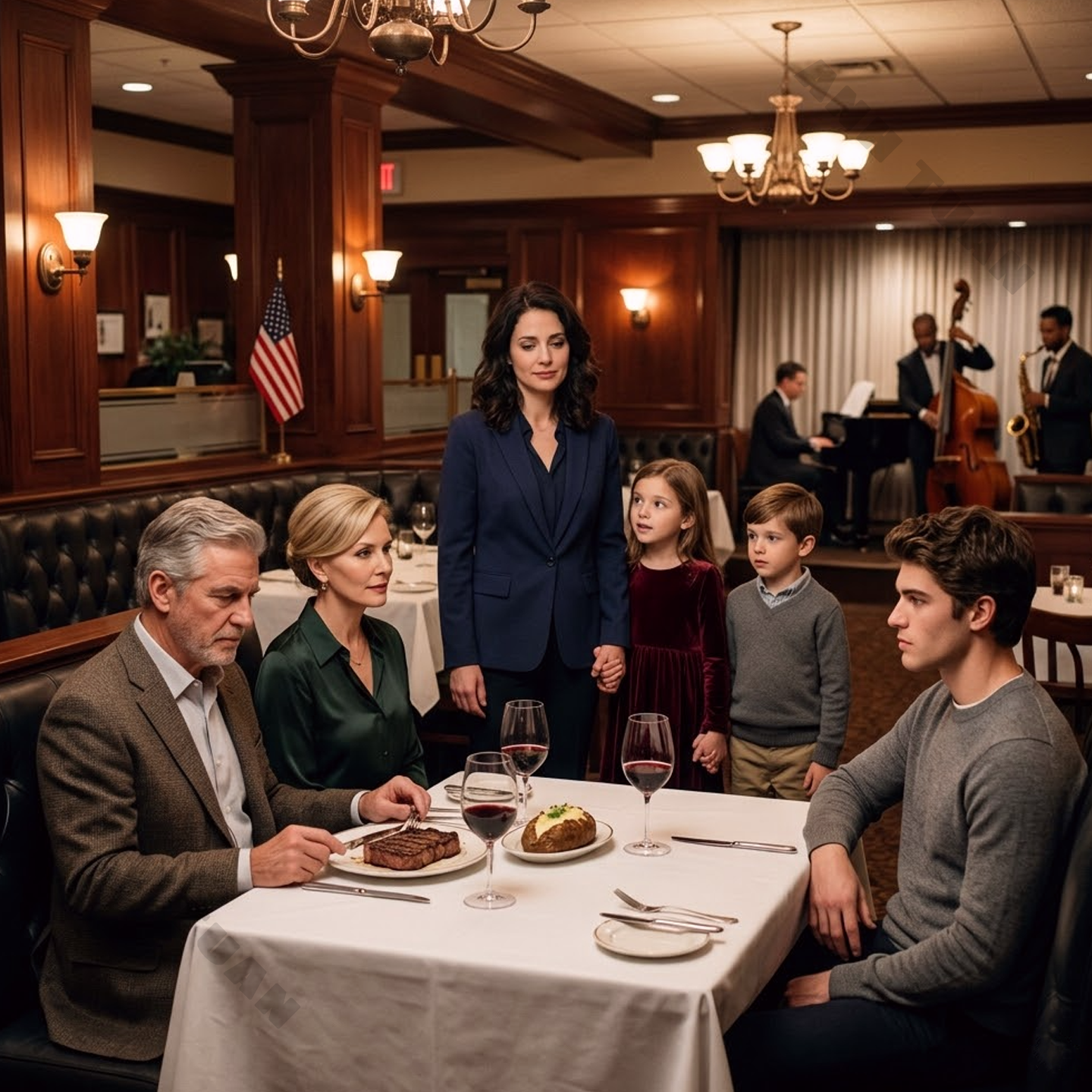
When we walked back into the steakhouse, the energy around the table had changed so completely it almost felt like entering a different event. The earlier smugness had evaporated. So had the faint performance of ease. The expensive wine was still there, half-finished in broad-bowled glasses. Dessert menus had been removed. My father sat rigid, tie loosened, staring at the white tablecloth as if it had personally betrayed him. Linda looked furious and humiliated in equal proportion, which on her face made for a tight, unnatural stillness around the mouth. Grant had shed the last of his swagger. He looked like the sort of man who had just discovered that confidence is not legal tender.
The restaurant manager stepped toward me almost immediately.
She was a composed woman in her forties with dark hair pinned back and the kind of measured expression you only acquire after years of handling weddings, anniversaries, and family implosions in public without ever allowing your own face to become part of the scene. Her name tag said Teresa. She glanced at the children, then at me, and there was something in her eyes not pity, exactly, but recognition. As though she had seen this movie before and knew the worst lines by heart.
“Ms. Bennett?” she asked.
I nodded.
She drew me slightly aside, just enough to preserve the illusion of privacy. Her explanation came in careful, professional language. Multiple cards had been declined. One was attached to the frozen account. Another had exceeded its limit. Grant had attempted to authorize a transfer from a business line he did not have access to. My father had insisted there must be some mistake. Linda had suggested the restaurant “run it again.” Teresa had done all the things restaurants do when they want to preserve dignity while protecting themselves. At that point, she said gently, they needed a valid payment method before the party could leave.
“I can settle it,” I told her, “but only under two conditions.”
Her brows lifted slightly. “All right.”
“First, I want the bill itemized and emailed tonight to my father, Grant, and me.”
“That can be done.”
“Second, I’m paying the restaurant directly. I’m not handing a card to anyone at that table.”
Teresa gave one quick nod, the tiniest flicker of approval passing through her face. “That’s fine.”
I paid. Directly. Quietly. No dramatics at the register. No whispered huddles over wallets. No chance for Grant to reclaim a scrap of control by touching the solution after causing the problem. I paid because the restaurant had done nothing wrong. I paid because service workers should not become hostages to family dysfunction. I paid because some messes should not be allowed to spill farther than they already have.
Then I walked back to the table.
I did not sit down.
2/2
My father looked up first.
“Thank you,” he said.
His voice was rough around the edges now, but gratitude was not enough, and part of me wondered whether he knew that before I opened my mouth or only after.
“No,” I said calmly. “We’re not doing that.”
Grant shifted in his chair, indignation rising reflexively to cover fear. “Claire ”
I cut him off with a look so sharp he stopped speaking before the rest of the sentence ever arrived. For once, he recognized that any attempt to seize control of the moment would go badly for him.
“You don’t get to talk first,” I said.
The table fell silent again, but this silence belonged to me. There is a difference between the silence of humiliation and the silence of truth arriving. The first one isolates. The second one clarifies.
I stood at the end of the table with Ethan beside me and Lily a little behind my left shoulder, close enough that I could feel the warmth of her there. I could see every face in that low amber light. Melissa looking down at her folded napkin. Hal pretending to be fascinated by his water glass. Linda with both arms crossed now, chin tipped upward the way women do when they have decided composure will save them from consequence. Grant with anger rising in ugly little pulses because he hated not being in command of the room and did not know what to do when command had to be earned instead of assumed. And my father, sitting at the center of it all, looking older than he had an hour earlier.
“You threw my children out of a family dinner they were invited to,” I said. “You insulted them in public. You told us to leave like we were freeloaders. Then, when your plan collapsed, you called me to clean up the damage. That ends tonight.”
Linda’s mouth tightened. “You’re being dramatic.”
I turned to her.
I did not raise my voice. I did not need to. Sometimes the clearest thing you can do is refuse to perform anger for people who would happily use that performance to discredit what you are saying.
“My nine-year-old cried in the car because she thought her grandfather didn’t want her there,” I said. “My thirteen-year-old asked me what he had done wrong. If that feels dramatic to you, that says more about you than it does about me.”
For the first time since I had met her, Linda had no response ready.
Maybe it was because the room no longer belonged to her. Maybe it was because other people were finally looking directly at what she had done instead of skimming past it under the banner of keeping the peace. Maybe it was because there are moments when even the most polished cruelty loses its language. Whatever the reason, she stood there in her green silk blouse and perfect makeup and said nothing.
Then Ethan stepped forward.
I had almost forgotten the gift still tucked under his arm, wrapped in plain brown paper with the twine Lily had insisted made it “look more special.” He moved carefully, not timidly exactly, but with the caution of a child who has been forced too quickly into an adult scene and is trying to find the least dangerous place to stand. He placed the framed collage in front of my father.
“We made this for you anyway,” he said.
The word anyway nearly undid me.
My father looked down.
And what he saw there, I think, was not just paper and glass and photographs. It was evidence. A record. A whole quiet history of children loving him without calculation. Fishing trips from summers when Ethan still wore a life jacket too big for him and thought Grandpa knew everything worth knowing. Christmas mornings when Lily still believed all adults were basically good unless proven otherwise. School plays, birthdays, backyard barbecues, little slices of ordinary family life preserved with more generosity than perhaps we had received. There was a picture of my father kneeling in the grass to help Ethan with a model rocket. One of Lily in pigtails asleep on his shoulder in a lawn chair after a Fourth of July cookout. A snapshot of all three of us in his kitchen after he taught the kids how to make pancakes too large for the skillet. The sort of moments that, lined up together, form an argument stronger than any speech.
His face changed.
Not theatrically. Not all at once. But I watched something in him give way. The stubbornness first. Then the defensive pride. Then the fragile shell of self-justification older men often mistake for dignity. He stood slowly and looked at Lily, then Ethan, then finally at me.
“I was wrong,” he said.
I waited.
That was deliberate. Not cruel. Just honest. Too many adults say the first sentence of an apology and expect everyone else to supply the rest out of habit.
He swallowed. “No excuses. I was wrong to let that happen. I’m sorry.”
It was not eloquent. It was late. It did not magically restore what had been damaged. But it was real enough that even before I answered, I could feel the difference between that moment and all the ones before it. Real apologies have weight. They land differently in the room.
I nodded once. “You can apologize to them directly.”
My father turned to Ethan first.
“I’m sorry,” he said, and his voice shook a little now. “You did nothing wrong.”
Ethan looked at him without speaking.
Then he turned to Lily and crouched slightly not enough to make a show of lowering himself, just enough that he was speaking to her instead of over her. “And I’m sorry to you too, sweetheart. You should have been here. Both of you should have.”
Lily studied him with the grave seriousness children bring to adult failures. “Why didn’t you say that before?”
No one at the table moved.
My father opened his mouth, then closed it. When he spoke again, his voice had lost whatever last traces of defensiveness it was holding.
“Because I should have,” he said. “And I didn’t.”
That, more than anything else, may have been why I believed him.
We left right after that.
I did not stay to smooth the edges for anyone. I did not linger for coffee, or dessert, or the soft-focus family reconciliation Linda would almost certainly have preferred once the immediate disaster had passed. I did not tell everyone it was okay. It was not okay. It might someday become survivable, workable, recoverable but at that moment, it was still not okay, and I was done translating other people’s failures into something socially edible.
Outside, the air had turned colder. A thin wind pushed through the parking lot and rattled the bare branches along the curb islands. Ethan climbed into the front seat without being told. Lily strapped herself in back and stared at the window, tracing a finger through the faint fog her breath had made on the glass. For the first several minutes none of us spoke. The silence was not heavy in the same way the restaurant silence had been. This one felt like aftermath. The kind that comes after a storm has moved through but before you have assessed the damage.
Then Ethan said, “I’m glad you said something.”
I kept both hands on the wheel. “I’m glad I did too.”
Lily was quiet for another mile before she asked, “Do you think Grandpa was really sorry?”
The traffic light at Washington Street changed, washing the car interior briefly red, then green. “I think he was,” I said. “I also think being sorry and making something right aren’t always the same thing.”
She considered that. “So what happens now?”
That was the question, wasn’t it. Not just for a nine-year-old in the back seat, but for me. For all of us.
What happens now after a family tells the truth in public? After someone who has counted on your silence discovers you no longer consider it a duty? After the old structure cracks enough that everyone can see the beams underneath?
“I don’t know yet,” I said. “But it won’t be the same.”
At home, I got the kids settled first. Pajamas. Teeth brushed. The framed collage gone now, left behind where it belonged. Lily wanted me to sit on the edge of her bed longer than usual. Ethan, who had spent years trying not to ask directly for comfort once he felt old enough to be embarrassed by wanting it, hovered in my doorway before finally saying, “Can you just leave the hall light on?”
I did.
Then I went downstairs, made tea I never drank, and sat at my kitchen table under the yellow pendant light with my phone faceup in front of me. Houses in my neighborhood had gone dark one by one. Somewhere down the block a garage door rumbled shut. The refrigerator clicked on and off. It was nearly midnight when the text came in.
From my father.
I’m removing Grant from the business accounts.
A second text followed almost immediately.
I’d like to take Ethan and Lily to dinner. Just the three of us, if they’re willing. No Linda. No Grant. No spectacle. Just dinner.
I stared at the screen longer than the words themselves required.
My father was not a man given to impulsive clarity. He preferred delay. He preferred the kind of family arrangements where difficult things softened on their own because nobody pushed them into daylight. For him to say something that direct, that fast, meant the shame of the evening had landed in a place his usual defenses could not easily reach.
I did not answer right away.
Part of adulthood, one I had learned late and at some cost, is understanding that not every message must be answered on the emotional timeline of the person who sent it. Need makes people impatient. Guilt does too. But immediacy is not always what a moment deserves.
So I left the phone on the table and let myself remember.
I remembered my father before Linda. Before Grant. Before the years of appeasement and quiet rearrangements and the slow erosion of the easy certainty I’d once had about him. I remembered being seven and waiting at the curb in front of our little split-level house in Lisle for the sound of his truck at the end of the day. I remembered the smell of sawdust and cold air when he came in from work in winter. I remembered how enormous his hands looked to me when he taught me to bait a fishing hook. I remembered him showing up to my high-school debate tournament in a blazer he clearly hated, sitting through three rounds and clapping like he understood every argument. I remembered him dancing with me at my wedding, one big hand at the center of my back, whispering, “You always were stubborn,” in a tone that meant proud. I remembered calling him two years later from my parked car outside a grocery store because I had just learned my husband had been lying about more than one thing, and hearing him say, “Come home for dinner. We’ll figure it out.”
People are rarely one thing across a whole life. That is what makes them hard to leave and hard to forgive. If my father had been monstrous, I might have cut him off a decade earlier and slept better for it. If he had been consistently good, that night at the steakhouse could never have happened. Instead he was what many parents are: strongest where it cost him least, weakest exactly where courage was required.
Linda entered the picture three years after my mother died.
My mother had not been saintly; I am old enough to distrust the kind of grief that polishes the dead into impossible virtue. But she had been steady, funny in a dry Midwestern way, intolerant of pretension, and incapable of making children feel ornamental. She knew how to set a table without using it as a weapon. She knew how to look at a room and notice who had gone quiet. After she died, my father became lonely in a way that made him vulnerable to admiration. Linda admired him fluently. She laughed in the right places. She admired his “old-fashioned values.” She told him he had held the family together for years. A widower with money and a preference for smooth surfaces is not hard prey for someone who knows exactly where to stroke his ego.
By the time they married, Grant was already a fixture in the outer orbit of my father’s life adult enough that no one expected my father to raise him, young enough to understand immediately the advantages of attaching himself to a man with assets. Grant had always had a salesman’s reflex for power. He could smell it, flatter it, and, when needed, speak on its behalf before being invited. He referred to my father as “Rick” until the engagement, then switched to “Dad” with the speed and confidence of a man stepping onto property he believed he could eventually claim.
At first I tried.
I tried because that is what decent women are trained to do when a family restructures itself around inconvenience. I had them over for Thanksgiving. I bought birthday gifts for Linda when I barely knew what she liked. I smiled through Grant’s stories, through his way of speaking over me in business conversations despite never having read a spreadsheet carefully in his life. I told myself he was insecure. I told myself Linda was trying too hard. I told myself grief had made my father cling to order and admiration in ways that would settle down with time.
Time did not settle it. Time calcified it.
The first crack came small. Linda “forgot” to include Ethan in a cousins’ photo at Christmas. Grant made some crack about Lily being “a little too loud” when she was six and singing in the backyard. My father noticed none of it or pretended not to. Then there were dinners where invitations reached me late enough that declining would make me look difficult. Casual remarks about how “busy” I always was, as if being a divorced mother managing work and two children should have made me grateful for their tolerance. Decisions about my father’s medical appointments, investments, and social calendar made in conversations from which I was excluded until cleanup was needed.
By then I knew the pattern.
When optics mattered, Grant was the son.
When details mattered, I was the daughter.
You do not notice how demeaning that arrangement is at first if you were raised on a certain kind of family loyalty. You call it helping. You call it being mature. You call it not making waves after your father has “been through enough.” Years go by that way. You become the person who knows which insurance forms must be signed, which lease renewals are pending, which tenant in Aurora pays late every other month and needs a reminder on the twenty-sixth instead of the first. You become the quiet machinery underneath someone else’s public authority. And because you know the machinery, they begin to assume it will keep running no matter how they speak to you.
Until one day it doesn’t.
Monday morning I met my father at the bank in downtown Naperville.
The sky was that brittle early-spring blue Illinois gets when the wind is still cold enough to sting but the sun has started pretending otherwise. Men in quarter-zips hurried out of coffee shops with paper cups. A woman in running shoes pushed a stroller past the parking meters. Everything looked offensively normal. My father was already there when I arrived, sitting in his car for a moment before getting out, both hands on the steering wheel as if bracing himself.
He looked tired.
Not physically alone though that too but morally, in a way that is harder to fake your way out of. He had not shaved well. There was a small nick along his jaw. He wore the same navy overcoat he had probably owned for fifteen years and somehow looked less substantial inside it.
“Morning,” he said when I approached.
I nodded. “Morning.”
We went inside.
If you have ever dealt with a bank after a fraud freeze, you know it is ninety percent waiting, paperwork, verification, and hearing the same rules repeated by people who did not make them and do not care about your inconvenience. My father disliked all of it. He disliked waiting. He disliked needing assistance. He disliked being explained to by younger professionals who used phrases like account security protocol. Most of all, he disliked that I understood the system better than he did. That had always irritated him in small ways. Now it embarrassed him.
Still, he listened. That was new.
The wires from Florida had been blocked before completion. Good. The freeze had worked exactly as designed. Less good for his ego, but good for the account. We updated passwords. Verified signatories. Limited card permissions. Shifted certain operational payments to a separate account insulated from the primary line. The branch manager, a woman younger than me with excellent posture and zero patience for bluster, asked gently whether all authorized users should remain on the account. My father looked at the desk for a long second.
“No,” he said finally. “I want Grant removed.”
Even hearing it, I felt something tighten and release in me at the same time.
The manager nodded and began the paperwork.
When we were done, my father asked if I had time for coffee.
There was a day when I would have said yes immediately out of reflex, out of hope, out of the ancient daughter instinct that still wanted one calm conversation to restore what years had damaged. But I had work that afternoon. And more importantly, I no longer wanted to make myself immediately available every time he was ready to process something after the consequences landed on him.
“I have about twenty minutes,” I said.
We walked to a coffee shop two blocks over. Not one of the polished places Linda preferred. Just an ordinary downtown spot with mismatched mugs, indie music too soft to be annoying, and a chalkboard menu written by someone who clearly took latte foam personally. We sat by the window. My father wrapped both hands around his coffee but did not drink it right away.
“I should have said something sooner,” he said.
It was not a dramatic opening. Again, that helped me believe it.
“Yes,” I said.
He looked up. There was no anger in the look, only a kind of tired acceptance. “I know.”
Outside, a school bus hissed to a stop at the light. A woman in a red coat hurried past with a bakery box. Inside, somebody behind the counter laughed at something I could not hear. The world kept moving as if all our private reckonings were no larger than steam off a coffee cup.
My father stared out the window for a while before he spoke again. “Your mother never let me get away with this sort of thing.”
That surprised a laugh out of me. Small, but real. “No,” I said. “She didn’t.”
He nodded once. “I keep thinking about Lily asking me why I didn’t say it before.”
I watched his face as he said it. People talk a lot about children being resilient, and they are, often inconveniently so. But what people mean most of the time is that children have no choice except to keep going. The truth is that a child’s simple question can do what no adult confrontation manages. It cuts past strategy. Past pride. Past the excuses everyone has spent years arranging like furniture.
“I don’t know what to tell you,” he said. “I think I got used to not pushing back. With Linda. With Grant. I let things slide because I didn’t want every gathering to become a fight. And then one day I looked up and…” He exhaled. “I was letting the wrong people pay for my peace.”
That landed.
Because that, in one sentence, was the shape of the whole family problem. My father had been buying ease with borrowed dignity, and the people supplying that dignity had usually been me and the children.
I stirred my coffee even though it no longer needed stirring. “You can’t ask them to trust you because you feel bad,” I said. “You have to show them they’re safe with you.”
He nodded again. “I know.”
A month earlier, I might have heard those two words as deflection. That day they sounded like recognition.
He did take Ethan and Lily to dinner the following week.
A diner, of all places. Their choice. Not a steakhouse. Not anything with linen napkins or layered humiliations hiding under candlelight. They picked a place in Wheaton with booths, milkshakes, and a pie case up front. I drove them there and stayed in the parking lot for fifteen minutes longer than necessary because some part of me still did not fully trust the world not to bruise them again when I was out of arm’s reach. But when they came back out afterward, Lily was carrying a little paper bag with a slice of banana cream pie for me because “Grandpa said you like that kind,” and Ethan was telling me, in the carefully casual way thirteen-year-old boys use when something mattered more than they want to admit, that Grandpa had asked about school and actually listened to the answer.
That did not fix everything.
Nothing fixes everything.
Linda, when she realized Grant had indeed been removed from the accounts and was no longer being consulted on “operations,” went from icy to aggrieved in under forty-eight hours. She called me once and left a voicemail so full of polished indignation it might have qualified as performance art. She said I had “taken advantage of an emotionally difficult evening” to “drive a wedge through the family.” She accused me of humiliating Grant, which would have been funny if it had not been so revealing. People who confuse accountability with humiliation are almost always telling on themselves. I did not call her back.
Grant texted me three times.
The first message was angry.
You blindsided Dad and made me look incompetent.
The second was self-pitying.
After everything I’ve done for this family, this is unbelievable.
The third attempted magnanimity.
I’m willing to move forward if you are.
I deleted all three without answering.
A younger version of me would have drafted and redrafted a response for an hour, trying to sound fair without sounding weak, firm without sounding “emotional,” detailed enough to be undeniable but still civilized enough that no one could accuse me of escalating. Women like me lose years that way. We exhaust ourselves proving our own perceptions to people invested in misreading them.
I was done with that.
Instead, I changed the pattern in quieter places.
I stopped being the unofficial safety net for every preventable problem attached to my father’s life. I helped with the bank issue because fraud does not pause for emotional clarity. I reviewed the essential account transitions because sloppy handoffs create bigger disasters later. But when my father called two weeks after that asking if I could “just quickly take a look” at some property maintenance invoices Grant had mishandled before being removed, I told him no. Not cruelly. Just plainly. I said, “You need a bookkeeper, Dad, not a daughter who gets summoned when things break.” Then I sent him the contact information for a reputable local accounting service and let him decide whether he wanted a real solution or merely my labor.
That, more than the restaurant confrontation, may have been the true turning point.
A boundary spoken in crisis can sometimes be dismissed as emotion. A boundary kept afterward has to be dealt with as fact.
For a while, the family tried to adapt around the new facts.
There were gatherings I did not attend because Linda would be there and I had no desire to spend another holiday pretending strategic cruelty was simply her personality. There were invitations my father extended without conditions for the first time in years. There were small tests of sincerity. Did he call the kids directly on their birthdays? Yes. Did he ask about their lives in ways that suggested real attention instead of obligation? Also yes. Did he allow Linda to talk over them or diminish them when they were around? No, not after that. Once, at a Fourth of July cookout later that summer, I watched him stop Grant midsentence with a quiet, “That’s enough,” when he made some careless crack about Ethan being too serious. The moment passed quickly, almost invisibly, but I saw it. Ethan saw it too.
Trust does not come back in a flood. It returns like water into dry soil—slowly, unevenly, absorbed first where the ground is least compacted. My children, wiser than many adults, did not demand perfection. They watched for patterns. They accepted effort. They remained cautious in the places caution had been earned.
So did I.
What changed most in me was not the relationship with my father, though that changed. It was my relationship with my own reflex to absorb, smooth, rescue, and reinterpret. That reflex had deep roots. Many daughters have it, especially daughters of men who are decent in broad strokes but weak in precise, costly moments. You grow up understanding their good qualities so intimately that you become tempted to subsidize their failures with your own silence. You tell yourself they mean well. You tell yourself they had hard childhoods, complicated marriages, too much pressure, poor health, bad timing. You become a curator of mitigating context. You call it compassion.
Sometimes it is.
Sometimes it is just fear in nicer clothes.
Fear that if you tell the truth, the family will crack. Fear that if you stop helping, you will be called cold. Fear that if you insist on being treated with straightforward respect, someone will accuse you of making everything harder than it has to be. The older I get, the more I think many women are raised inside a quiet bargain: keep the peace, and if you have to offer pieces of yourself to do it, call that maturity.
But peace built on selective humiliation is not peace. It is only silence with a prettier name.
Months after the birthday dinner, I found Lily in the kitchen doing homework while a pot of spaghetti water came to boil and the local news hummed low in the other room. She looked up from her pencil and asked, out of nowhere, “Do grown-ups ever stop being mean?”
Children ask the largest questions in the flattest voices.
I leaned against the counter and thought about it. About Linda, who I suspect would go to her grave believing elegance excused almost anything. About Grant, whose insecurity had calcified into entitlement so early that I doubted life would soften him without force. About my father, who had not stopped being capable of weakness but had at least finally recognized the cost of it.
“Some do,” I said. “Some just get better at hiding it. And some people only change when the way they’ve been living starts costing them more than they want to pay.”
She nodded as if that made sense. Maybe it did.
A few nights later, after the kids were asleep, I sat on my back porch with a blanket around my shoulders and a cup of tea cooling too fast in the Illinois night. Summer insects throbbed out beyond the fence line. Somewhere a dog barked. The neighborhood had that settled, late-evening stillness that makes even ordinary houses look like they are keeping secrets gently. I thought about the restaurant again, not with the sharpness of fresh injury anymore but with the clarity that comes once a memory has finished pretending it might become something else.
The thing about family humiliation is that it rarely begins where outsiders think it did. By the time someone says the unforgivable thing out loud, there have usually been years of smaller permissions leading there. Years of jokes no one stopped. Exclusions no one named. Needs one person quietly met without acknowledgment until the whole arrangement started to resemble obligation instead of love. The birthday dinner was awful, yes. But it was also, in a strange way, useful. It took a private pattern and made it public enough that no one could deny it anymore—not without revealing what they were willing to defend.
That is the inconvenient gift of certain disasters. They expose the architecture.
People still ask me, in one way or another, whether I’m glad I went back that night.
Yes.
Not because it redeemed the evening. Not because it led to some neat reconciliation where everyone learned the exact right lesson at the exact right speed. Real life almost never arranges itself that cleanly. I am glad I went back because my children got to see the whole thing. They saw that being hurt does not require you to become cruel. They saw that helping someone out of a mess is not the same as excusing the person who made it. They saw that an apology can be demanded without screaming for it. They saw that money, status, and polished dining rooms do not decide who has dignity and who gets discarded. They saw their mother walk back into the room she had been pushed out of and speak plainly without asking permission.
And if I am honest, I needed to see that too.
I had spent too many years being useful in ways that made other people comfortable and me invisible. That night, for once, usefulness arrived on my terms. Not as obedience. Not as self-erasure. Not as one more chance for the family to consume my competence while dismissing my place at the table. I paid the bill because the bill needed paying. Then I made sure everyone understood what the real debt was.
Maybe that is why the memory no longer hurts in exactly the same place.
My father still slips sometimes. Change at seventy-two does not come like spring rain. It comes like a man relearning how not to confuse quiet with goodness. There are days when I hear the old instinct in his voice—the urge to smooth over, delay, reframe. But now I answer differently. Now he knows I will. And strange as it sounds, that has made him more careful in a way decades of accommodation never did.
Linda and I occupy each other’s lives the way neighboring states occupy a map: close enough to require occasional detours, far enough that neither can pretend affection. Grant remains convinced he was wronged. Perhaps he always will be. I no longer lose sleep over the narratives people build to protect themselves from their own reflection. Everyone has to live with the story they can bear.
As for Ethan and Lily, they remember the dinner less for the humiliation now than for what came after. Children are often better historians of moral action than adults. Ethan remembers setting the frame on the table and hearing Grandpa say he was sorry. Lily remembers the pie from the diner and Grandpa kneeling slightly to meet her eyes. They both remember the car ride, the frozen yogurt, the fact that I answered the phone but did not bend.
Years from now, when family inevitably disappoints them in some fresh and uncreative way, I hope that is what stays. Not merely that people can fail you. That part life teaches without help. I hope they remember that you do not have to volunteer your dignity to keep a family functioning. That if someone wants your rescue, they may also have to hear your truth. That love without self-respect curdles into something hard to recognize.
And I still think about the moment my father asked if there was a way to fix it that night.
At the time, I heard only the need in it. Maybe that was all there was. But with more distance, I think there was something else too—something he would not yet have known how to name. A question beneath the question. Not just Can you solve this? but Are we still salvageable after what I allowed?
The answer, it turned out, was complicated.
Not because families cannot survive a public humiliation. Many do. Not because apologies are meaningless. They are not. But because survival is not the same as restoration, and restoration is not the same as pretending the wound never happened. Some things heal clean. Others heal with a seam you always know is there when the weather changes.
Maybe that is what maturity actually is. Not endless forgiveness. Not strategic silence. Not standing in the wreckage insisting nothing important was broken. Maybe it is learning to tell the difference between what can be repaired and what can only be rebuilt differently.
I used to think the hardest part of setting a boundary with family would be saying the words.
It wasn’t.
The hardest part was accepting what the boundary revealed. Who respected it. Who resented it. Who only loved you easily when your role was to absorb. Who became suddenly bewildered when the person they had counted on to make every ugly moment manageable decided to stop being available in exactly that way.
That knowledge is expensive. But once you have it, going back to ignorance costs even more.
My father’s birthday dinner was supposed to be one of those glossy family evenings people post about later with a smiling caption and three carefully filtered photos. Instead it became one of the few nights in our family history that forced everyone to stop performing long enough to tell the truth. Ugly truth, delayed truth, inconvenient truth—but truth all the same. Looking back, maybe that was worth more than the polished version would have been.
Or maybe that is just what I tell myself because sometimes the only way to live with a painful memory is to demand that it mean something.
Either way, I know this much: my children were not the ones who should have been ashamed that night.
And if the whole thing had to happen for my father to finally understand what it costs to stay silent when the wrong person is being humiliated, then perhaps the lesson landed where it was supposed to all along.
Still, I wonder how many families are sitting around beautiful tables right now, mistaking politeness for kindness and silence for peace. I wonder how many daughters are paying quiet emotional invoices nobody else even admits exist. I wonder how many children are being taught, by what adults refuse to confront, exactly how little room has really been made for them.
Tell me honestly—if you had been standing where I stood that night, would you have gone back to pay the bill, or would you have let them sit with the full weight of what they had done?
If you’re still here, thank you. That means more than you know.
Hit subscribe if you want to hear more stories like this one. Drop a comment and tell me, have you ever had to set a boundary with family.
Until next time, take care of yourself.
THE END!