My stepbrother told my children to get out of their grandfather’s birthday dinner like they were stray dogs, and my father sat there and let it happen.
Even now, when I replay the whole thing in my head, that is still the part that catches in my chest and stays there. Not the phone calls afterward. Not the bill. Not the panic in Grant’s voice when the money he always assumed would materialize on command suddenly did not. What burned was the sight of my children standing under that amber restaurant lighting, dressed carefully for their grandfather’s birthday, holding a gift they had made with their own hands, while grown adults decided plainly, publicly, and without shame that they did not belong.
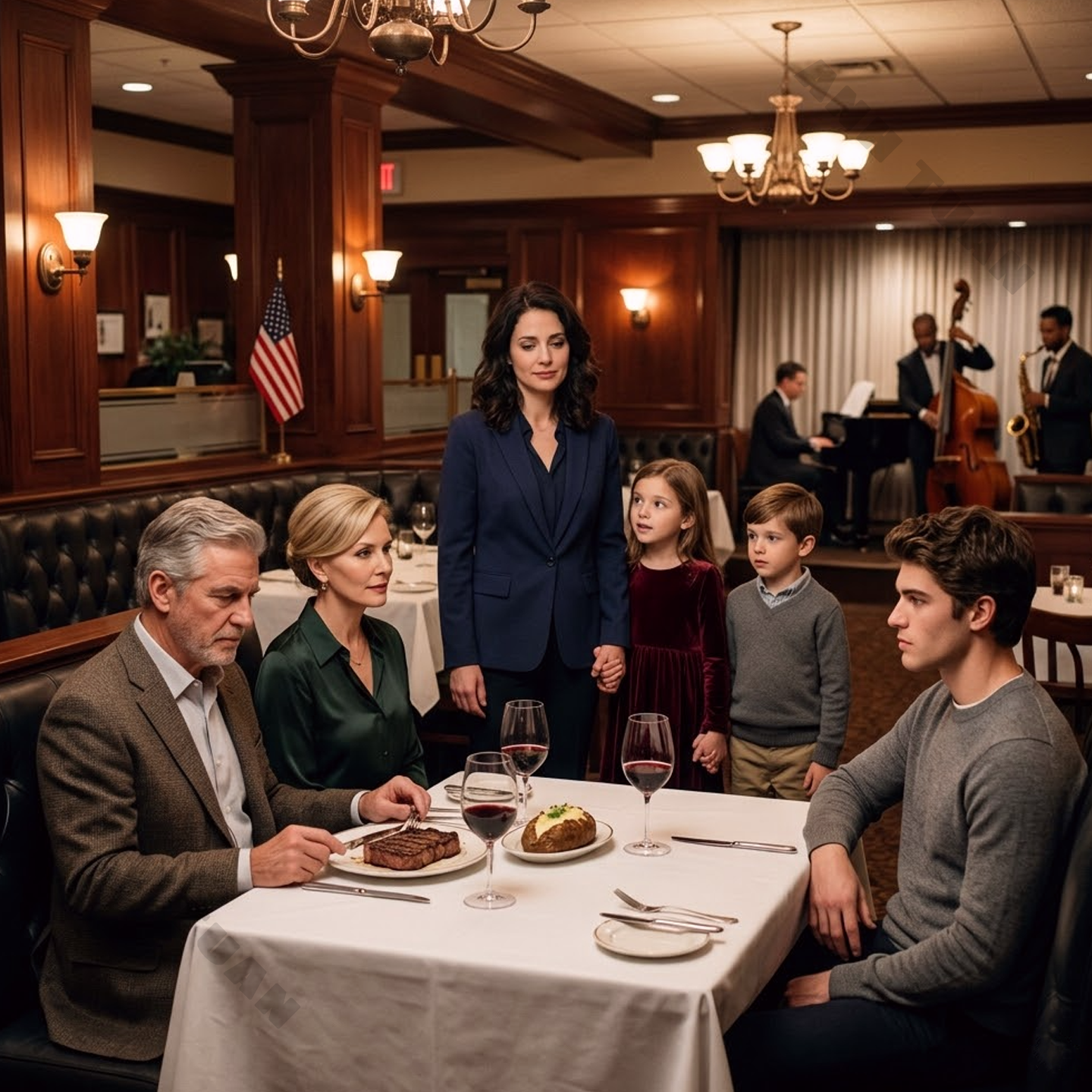
My father had turned seventy-two that night. Richard Bennett. He was the kind of man who had spent most of his life believing that if the table looked right, the wine was expensive enough, and everyone kept their voices low, then nothing ugly could really be happening. He liked polished silver, pressed napkins, old-school steakhouses with dark wood paneling and low music, places where the men still ordered bourbon as if it meant something and the servers moved with that soft, expensive efficiency meant to reassure people they were in the kind of room where embarrassment could be swallowed before anyone at the next table noticed it. In Naperville, Illinois, where my father had built a reputation through decades of commercial properties, quiet handshakes, and the performance of steadiness, those details mattered to him almost as much as the people gathered around the table.
Maybe more.
That was probably why he let Linda organize the dinner.
Linda, my stepmother, had a gift for making everything sound gracious while arranging it entirely around hierarchy. She had come into my father’s life when I was thirty-one, widowed only on paper because my marriage had not quite ended yet but had long since collapsed in every way that mattered. Linda knew how to walk into a room and make herself indispensable in under ten minutes. She brought flowers no one asked for, remembered birthdays she could use later, and spoke in the smooth, faintly patronizing tone of a woman who always wanted to be seen as the reasonable one. People who did not know her well called her charming. People who did knew better.
She did not invite people because she loved them. She invited them because she liked deciding who counted.
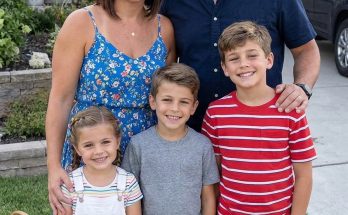
I should have recognized the shape of the evening before it ever fully formed. The warning signs were there. She had texted me only once, late and without warmth, confirming the restaurant and time. No table details. No mention of who else would be there. No “Dad can’t wait to see the kids.” Even that would have been a clue. Still, it was my father’s birthday, and he had always had a soft spot for my children at least when it cost him nothing. Ethan was thirteen then, all knees and elbows and earnestness, still at that age when he was trying to become a man while carrying too much tenderness in his face to hide that he was still a boy. Lily was nine, bright as a struck match, quick with questions, quick with laughter, and just as quick to go quiet when she sensed she was not welcome. They had spent the afternoon working on a framed photo collage for their grandfather at my dining room table while a late-March rain tapped against the windows in that thin, cold Illinois way that makes spring feel like a rumor instead of a season.
Ethan had chosen the photos. Fishing at Lake Geneva one summer when Grandpa still had patience. Christmas morning in Downers Grove with wrapping paper all over the floor. Lily on my father’s shoulders at the Morton Arboretum, both of them smiling into a bright autumn day. A school play. A backyard barbecue. A Thanksgiving where everyone still knew how to pretend less badly. Ethan had arranged the photos with careful, deliberate hands, lining up the edges and straightening every image twice. Lily had written a little note on thick cream-colored paper in her best cursive Happy Birthday, Grandpa. We love you so much. Love, Ethan and Lily. and asked me three times if “so much” sounded too babyish.
“No,” I told her. “It sounds true.”
That should have been enough to keep me away from a room like the one we walked into that night. But family teaches you dangerous things if you let it. It teaches you to confuse hope with obligation. It teaches you that because something has hurt you before, maybe this time it won’t. It teaches you to keep giving certain people one more chance because you remember who they were twenty years ago, or who they should have been, or who you still need them to become.
So I drove us there anyway.
The restaurant sat just off Route 59 in one of those polished suburban stretches where the storefront glass is always clean, the parking lots are full of good cars, and everybody likes to believe whatever happens inside those buildings is more refined than ordinary human pettiness. We were four minutes late. Not forty. Not fifteen. Four. Long enough, apparently, for Linda to decide the slight had been codified into family law.
The hostess looked down at the reservation tablet, then up at me with the quick flash of hesitation service workers get when they know there is some problem they did not create but will now have to stand near. She asked the name. I gave it. Her eyes shifted almost immediately toward the back dining room, where I could already see the glow of a long table and the outline of my father’s profile near the middle, silver hair combed back, broad shoulders still carrying traces of the man he had once been.
The first thing I noticed when we approached was that there were no place cards for us.
Linda loved place cards. She loved little visual proofs of order. Cream cardstock, gold script, everything assigned and decided before anyone arrived. That table had place cards for Richard, Linda, Grant, his wife Melissa, their two college-age sons, my father’s golf friend Hal and his wife, one of Linda’s sisters, even some neighbor of theirs from the subdivision who always laughed too loudly at my father’s stories. But there was no Claire. No Ethan. No Lily.
The second thing I noticed was Grant.
He saw us before anyone else did. My stepbrother had the kind of face that always looked a little too pleased with itself, even at rest. He was six years younger than me and had spent most of his adult life living inside the confidence that comes from being the person least often contradicted. Tall, expensive haircut, custom watch, half a tan in March from some golf trip he would call work if anyone asked. He leaned back in his chair when he saw us and smirked like a man spotting a punchline walking through the door.
“Oh,” he said loudly enough for half the table to hear. “You actually came.”
There was that small, embarrassed ripple of laughter people use when they know a comment was cruel but would rather reward the speaker than challenge him. It passed around the table and died in the low light.
I ignored him. I had spent years ignoring Grant in exactly that tone, because engaging with him directly was like giving matches to a child and then acting surprised when he lit the curtains. I guided Ethan and Lily to the table, set the wrapped frame near my father’s place, and forced warmth into my voice.
“Happy birthday, Dad.”
He gave me a distracted nod and glanced at his watch before he glanced at me. “You’re a little late.”
We were four minutes late.
Something in me registered that and filed it away for later.
Linda stood at once. She was wearing a dark green silk blouse and a smile so polished it practically gleamed. “Claire, sweetheart,” she said, in that tone she reserved for moments when she wanted the room to understand she was extending grace to someone beneath her, “this is really more of an adult evening.”
For a second I thought I had misheard her. Not because she was incapable of saying something like that, but because there are forms of rudeness so naked that your brain resists them on principle.
I looked at her. “You told me six-thirty. You said bring the kids because Dad would want to see them.”
Grant cut in before she could answer, as if he had been waiting for the cue. “Yeah, for five minutes maybe, not to sit through dinner. We already finalized the count. There’s no room.”
That was a lie so obvious I almost admired the laziness of it. Two chairs sat empty at the far end of the table, one with a folded napkin and no water glass, another angled slightly away as though someone had simply not shown. A third chair could have been brought over in under thirty seconds. Restaurants do this every day. Families do this every day. People with functioning souls do not treat children as logistical inconveniences because they were not printed on cardstock.
Lily tugged lightly at my hand. “Mom?”
Her voice was small enough that only I heard it, but I felt it all the way through me.
“We won’t take much space,” I said, keeping my tone even. I did that for the kids more than anyone else. Children hear their own humiliation differently when it is reflected back to them by the adult they trust most. I would not give mine the sound of me unraveling if I could help it.
Grant laughed outright then, not even pretending anymore. “That’s not the point. This dinner is expensive. We’re not covering extra meals because you don’t know when you’re not wanted.”
The whole table went still.
It was one of those silences that feels louder than speech because it contains so many separate acts of cowardice. Someone coughed. Someone looked down at a menu they were no longer reading. Melissa shifted uncomfortably and reached for her wine as if she could disappear behind the glass. Linda gave the faintest sigh, the kind meant to suggest she regretted the ugliness while benefiting from it completely.
Ethan’s face went red. My son had inherited my tendency to speak when his dignity was scraped hard enough, even if his voice shook while he did it.
“We brought Grandpa a gift,” he said.
That should have stopped everyone. It should have cracked something open. Any decent adult, hearing a thirteen-year-old say that in a room like that, would have found a way to make room. But Linda only closed her eyes for a beat and exhaled theatrically.
“This,” she said, “is exactly the kind of scene I was hoping to avoid.”
I looked at my father then.
I did not look at Linda. I did not look at Grant. I looked at the man who had once taught me to ride a bike in an empty church parking lot, who had stood in the bleachers at my college graduation, who had cried at my wedding and then later pretended not to notice when that marriage cracked down the middle. I looked at my father and waited for the one simple thing that would have changed the entire night.
All he had to do was say, Sit down. My grandchildren are staying.
That was all.
Instead he reached for his water glass, stared at the condensation sliding down the side, and said without meeting my eyes, “Maybe tonight just isn’t the right night.”
If grief could flash-freeze, that was the sound it would make.
Something inside me went cold and clean. Not explosive. Not dramatic. Colder than that. The kind of cold that clarifies. The kind that says, So this is what it is. So now I know.
I picked up the gift. My fingers were steady even though the blood in my ears had started roaring. “Come on, kids.”
Ethan stood rigid for a second, then moved. Lily came with me immediately, clutching the side of my coat. We turned toward the door. I could feel people watching us without wanting to be seen watching, the way people do when they know they are witnessing something they will describe later as unfortunate instead of shameful because unfortunate keeps their own reflection cleaner.
Then Grant called after me.
“And Claire?” he said. “Since you’re leaving, don’t worry about the bill. We’ve got it.”
He made sure everyone heard him. That was the point. The line was not for me. It was for the table, for the room, for the mythology of himself he carried around like a cologne too expensive for his character. See? the line said. See how generous I am? See how unnecessary she was?
I did not turn around. I think if I had, I might have said something that would have followed us all for years, and my children had already seen enough adults lose control in one evening.
We walked out into the damp, cold parking lot. The sky over Naperville had gone the color of dirty wool, and the blacktop still held thin reflective patches from an afternoon rain. A wind moved through the bare decorative trees near the curb, carrying the smell of wet pavement and grilled meat from the restaurant vent. The whole suburban world around us looked exactly as it always did orderly, trimmed, lit by the soft certainty of expensive businesses and that made it worse somehow. Humiliation is meanest in ordinary lighting.
Lily did not cry right away. She waited until we were in the car, buckled in, the doors shut. Then she asked, very quietly, “Did Grandpa not want us there?”
There are questions children ask that no adult should ever have to answer honestly.
I started the engine and stared through the windshield for a second before I trusted my voice. “This was not about you,” I said. “Not even a little.”
She looked down at her lap. “But he didn’t say anything.”
No. He hadn’t.
Ethan stared out the passenger-side window with his jaw set in a way that made him look older than thirteen and younger than ten at the same time. He did not say much when he was hurt deeply. He went still. That was how I knew the wound had landed somewhere that mattered.
I drove without deciding where I was going until muscle memory took me toward a frozen yogurt place in a shopping center a few miles away, one of those bright little suburban businesses with chrome stools, self-serve toppings, and a neon sign trying very hard to convince everyone that sugar could qualify as recovery. It was not really about dessert. It was about changing the scene. Changing the air. Giving the kids something small and sweet and completely unrelated to white tablecloths and family politics.
By the time we were sitting there, Lily carefully scooping rainbow sprinkles as though the concentration required might protect her from feeling too much, and Ethan pretending not to listen while hearing every word around him, the first call came through.
Grant.
I watched it ring out.
Then Linda.
Then my father.
Then the restaurant itself.
That was when I knew something had gone very wrong.
I let the phone buzz three more times before I answered. Not because I was trying to punish anyone, though maybe there was some of that too, but because I wanted one full breath in which they still had to sit with whatever had happened without assuming I would make it disappear on schedule.
I chose Grant first. Mostly because I wanted to hear what panic sounded like in his voice.
“Claire, where are you?” he snapped the second the call connected. He was breathing hard, as if urgency itself could cover incompetence.
I leaned against the side of my car in the frozen yogurt parking lot and looked through the windshield at my children under the fluorescent glow inside. Ethan was turned toward the window. Lily was eating the top layer of sprinkles one color at a time. “Why?” I asked.
“Because you need to get back here. Now.”
I actually laughed. It came out flatter than humor. “You threw us out.”
“This isn’t funny.”
“No,” I said. “It wasn’t.”
There was noise in the background muffled voices, a clink of glassware, a woman speaking in that professionally softened tone service staff use when a situation is already absurd and they need everyone else to help them keep it from becoming worse. Then, lower and close to the receiver, I heard Linda hiss, “Don’t tell her that.”
Grant ignored her or maybe simply failed to lower the phone fast enough. When he came back on, his voice was pitched downward, trying for control and missing. “The payment didn’t go through.”
I let a beat pass. “Use another card.”
“It’s not that simple.”
That answer told me nearly everything.
“Whose account?” I asked.
Silence.
Then: “Dad’s.”
I closed my eyes.
Three weeks earlier my father had asked me to help him untangle what he called “some confusion” with his business and personal accounts. That was his phrase for most crises: some confusion. He owned several small commercial properties around DuPage County and one office building near Aurora he still referred to as “the Elmhurst property” even though it was not in Elmhurst and had not been for thirty years. He liked telling people he was still overseeing the books himself. After his mild stroke the year before, that had become less true with every passing month. Nothing catastrophic at first. A late property tax payment here. A duplicate transfer there. A vendor who had not been paid because he had written the amount down on the wrong yellow pad. Passwords forgotten and then re-created in ways no sane person could track. Grant had started announcing to anyone who would listen that he was “taking over operations,” but what he meant by that, in practice, was showing up to meetings in a navy blazer, using phrases like cash-flow event, and then leaving the actual details to whichever woman in his orbit would quietly keep the lights on.
Usually that woman was me.
Not because I had ever wanted that role, and not because anyone had ever thanked me for it in a way that lasted longer than the emergency itself, but because I understand numbers and timelines and what happens when paperwork is ignored. My own career fifteen years in corporate compliance before I shifted to freelance financial consulting after my divorce had trained me to notice the exact kind of mess men like my father and Grant preferred to wave away until it acquired teeth. I knew which payments could slide for a week and which ones could not. I knew how quickly fraud alerts became account freezes and how little the bank cared whether the person inconvenienced by that had a dinner reservation at a steakhouse.
That afternoon, while Lily was choosing which photos to put beside the fishing picture and Ethan was carefully wiping fingerprints off the glass of the frame, I had found a serious fraud flag on my father’s primary operating account. Two wire attempts from Florida. Both large. Both unauthorized. The bank had automatically frozen the account pending in-person verification. That was not unusual. It was also not optional. Once triggered, it would stay frozen until my father showed up with identification or until a series of steps happened that no one at a birthday dinner was equipped to negotiate in real time.
I had called him immediately. No answer.
I had texted him. No response.
Then I texted Grant and Linda too, because experience had taught me that if my father was ignoring the phone, one of them was usually the reason.
No response from either.
So I did what I could. I moved enough money from a secondary personal account to cover immediate obligations for the next few days. I handled a payroll-related transfer that could not wait. I left a detailed voicemail for my father. Then another for Grant. Then a text, plain enough that a distracted teenager could have understood it: Main operating account frozen for fraud review. Do not use primary business card. I will go with Dad to the bank Monday morning.
Apparently none of them had read a word.
“You should have fixed that already,” Grant snapped, as though banking regulations had been invented specifically to insult him.
I laughed again, this time without warmth. “I tried. While you were busy rehearsing how to humiliate my children.”
His silence sharpened.
Then Linda took the phone from him. I could hear it happen, hear the little shuffle of possession disguised as urgency. When she spoke, her voice had that controlled, acid brightness she used whenever public embarrassment had landed too close to home.
“Claire, the restaurant manager is standing here, and this is becoming embarrassing.”
I looked back through the window again. Ethan had finally turned toward me. Lily was no longer eating. “Now it’s embarrassing?”
“Your father is upset.”
“Good.”
“Don’t be childish.”
That did it. There are phrases some people reach for because they assume shame will work faster than accountability. With Linda, childish had always meant: stop making my cruelty inconvenient.
I straightened and spoke slowly, so she would hear every word as clearly as I had heard every word she and Grant had said to my children.
“Childish? You publicly told my nine-year-old she didn’t belong at her grandfather’s birthday dinner. My thirteen-year-old stood there holding a gift while your son mocked him. And now you’re calling me because the account you ignored warnings about got frozen and none of you can pay an eighteen-hundred-and-forty-two-dollar restaurant bill.”
She went quiet.
There is a particular silence people fall into when they realize you know more than they expected.
Then my father came on the line.
For a moment he said nothing at all. I could hear his breathing. I could hear the low restaurant noise around him, the clatter of a room trying very hard to remain civilized while something humiliating unfolded at one table. When he finally spoke, his voice sounded smaller than it had earlier. Not weak exactly. Smaller. Like a man who had discovered too late that authority does not survive every test.
“Claire,” he said, “is there a way to fix this tonight?”
There it was.
Not I’m sorry.
Not I shouldn’t have let that happen.
Not How are the kids?
Just need.
Need is honest that way. It strips away everything decorative. Need shows you who people believe exists to serve them.
I leaned my head briefly against the cold metal of the car. If I had been alone, I might have let them sit there until the restaurant called the police or until Grant finally discovered what it feels like to explain yourself when your last name stops opening doors. But I was not alone. My children were ten feet away under fluorescent light, and whether they knew it or not, they were learning something from me right then. About family. About dignity. About whether grace means pretending cruelty never happened.
I went back to the restaurant.
Not because Grant deserved rescue. Not because Linda deserved protection. Certainly not because my father had earned an easy way out after what he had just allowed. I went because Ethan and Lily were watching. I went because children remember the moral geometry of a night long after they forget the details. They remember whether their parent became bitter or merely firm. They remember whether kindness looked like surrender or strength. And I knew, with a clarity that did not leave much room for self-pity, that if I let them sit with only the first half of the lesson that people can humiliate you and still need you they would learn the wrong thing. I needed them to see the second half too. That helping someone in a crisis is not the same as excusing what they did. That boundaries are not the opposite of compassion. That dignity does not require spectacle.