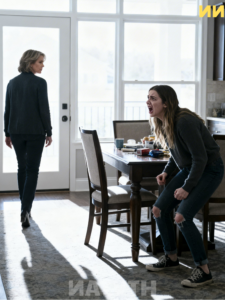
If I’d put that money into investments, I could have traveled. Bought a nicer place. Paid for comfort. Medical care. Peace. Instead, I invested in love. I invested in the idea that one day Rebecca would look at me and see what I’d done, and it would mean something. Now she’d looked me in the eye and said the greatest gift would be if I died. I called her. I needed to hear it again, not because I wanted pain, but because my brain still searched for a misunderstanding like a drowning person searching for air. She answered on the fifth ring. “What do you want now?” she said, annoyed. “Rebecca,” I whispered. “Did you mean what you said?” “Of course I meant it,” she replied. “Mom
, it’s time you understand. I need space. Your obsession with me isn’t healthy.” “Obsession,” I repeated, stunned. “Yes,” she said, sharp. “You call it love. I call it suffocating.” I hung up without saying goodbye. It was real. No misunderstanding. No apology. No softening. That night, I lay awake staring at the ceiling, and somewhere around three in the morning, the grief shifted. Sadness can make you heavy. It can make you curl inward and disappear slowly. But something else arrived—clear, cold determination. Rebecca wanted me to die. Fine. I couldn’t die on command. But I could become dead to her. I could disappear. And not as a victim. As a choice. The next day,
I dressed carefully. Not in mourning clothes. In my best outfit, the one I usually saved for special occasions. A pearl necklace. A coat that made me feel like myself, not like an old woman someone could push aside. First stop: the bank. Mr. Martinez, the manager, greeted me warmly. “Mrs. Johnson! Good to see you. How can we help today?” “I want to close the joint account,” I said, smiling politely. “Account number 45872891.”
He blinked. “Are you sure? There’s twenty thousand in there.” “Completely sure,” I said. “Transfer it to my personal account.” My signature was steady. Seeing the balance shift back into my name felt like reclaiming oxygen. Second stop: the mortgage office. When David lost his job last year, I’d co-signed their mortgage “temporarily” to help them qualify. They’d hugged me, thanked me, called me their savior.
Co-signing meant I was responsible if they couldn’t pay. It also meant I had rights. Ms. Williams pulled the thick folder and slid it to me. “As a co-signer, you’re responsible for payments if they default. But you also have the right to pursue remedies if you believe the debtors are unable to fulfill obligations.” I read every page carefully. “And you see,” Ms. Williams added,
“you covered eight months of payments last year. That’s significant evidence of instability.” Perfect. Third stop: my lawyer. Anel Adams was seventy, kind-eyed, and had known my late husband. He’d watched me pour my life into Rebecca. When I told him what she’d said, his face hardened with something like heartbreak on my behalf. “I want to change my will,” I said.
“Everything goes to charity. And I want a trust for my grandchildren—locked until they’re twenty-five. Rebecca gets nothing.” Anel nodded. “And your life insurance?” “Change it,” I said. “Everything.” He hesitated only once. “Julieta… are you sure?” “I’ve never been more sure,” I replied. Then I added, quietly: “I also want the documents prepared to reclaim the house.” Anel’s eyebrows lifted.
“I’m disappearing,” I said. “But first I’m making sure she understands what disappearing actually costs.”
Part 2
Anel leaned back in his chair and studied me over the rim of his glasses.
“Julieta,” he said carefully, “reclaiming the house won’t be simple. Rebecca and David are the primary owners. You’re the co-signer, not the owner.”
“I know,” I said. “But I paid the down payment.”
“You gifted it.”
“I also paid eight months of mortgage when David was unemployed.”
“That helps,” he admitted. “And you paid property taxes twice.”
“Yes.”
“And repairs?”
“The roof, the water heater, the kitchen floors.”
Anel’s eyes narrowed. “Do you have receipts?”
I opened my purse and pulled out a folder.
His expression changed.
For years, everyone had called me sentimental. Soft. Too forgiving. Too eager to help. But I had not been foolish. Every transfer, every check, every receipt, every promise Rebecca made in writing—I had kept them all.
Anel flipped through the papers slowly.
“Julieta,” he said at last, “this is more than enough to make them very uncomfortable.”
“I don’t want comfort,” I said. “I want freedom.”
He prepared the documents that afternoon.
A demand letter.
A notice of financial liability.
A petition to recover funds used under false promises.
And one more thing.
A legal letter informing Rebecca and David that if they failed to remove me from the mortgage within sixty days, I would pursue action to force sale or repayment.
For the first time in years, I slept through the night.
The next morning, I packed two suitcases.
Not everything. Just what mattered.
My husband’s watch. Our wedding photo. A few dresses. My medicine. Important papers. A small jewelry box. And the framed drawing Rebecca made me when she was eight.
It showed two stick figures holding hands under a yellow sun.
At the bottom she had written: “Me and Mommy forever.”
I stared at it for a long time.
Then I wrapped it in tissue and placed it gently in the suitcase.
Love does not vanish because someone becomes cruel.
It simply learns to stop kneeling.
By noon, I was gone.
I moved to a small coastal town three hours away, into a quiet apartment above a bakery owned by a woman named Nora. Every morning, the smell of bread floated through the floorboards. Every evening, the ocean wind rattled the windows.
No one there knew me as Rebecca’s mother.
No one knew me as the woman who sacrificed everything.
I was just Julieta.
For the first week, my phone rang constantly.
Rebecca.
David.
Rebecca again.
Then texts came.
Mom, call me.
What did you do to the account?
Why is the mortgage company calling us?
You can’t just disappear.
This is childish.
Answer me.
I read each message once.
Then I blocked her.
Not forever, I told myself.
Just until my hands stopped shaking whenever her name appeared.
Three days later, Anel called.
“They received the letters.”
“And?”
“They’re furious.”
I almost laughed. “Of course they are.”
“Rebecca says you’re being vindictive.”
“No,” I said quietly. “I’m being accurate.”
Anel was silent for a moment. Then he said, “She also asked if you really changed the will.”
I looked out the window at the sea.
“Yes,” I said. “Tell her yes.”
That was when Rebecca truly understood.
Not when she hurt me.
Not when I left.
Not when the joint account closed.
Only when she realized my death would no longer benefit her.
That was the moment my daughter wanted me alive.
A week later, she appeared at my apartment.
I had no idea how she found me. Maybe through an old friend. Maybe through David. Maybe through anger, which has its own strange sense of direction.
I opened the door and saw her standing there in expensive sunglasses, arms folded, face pale with rage.
“So this is what you’re doing?” she snapped. “Hiding?”
“No,” I said. “Living.”
She pushed past me without being invited.
The old me would have made tea.
The old me would have apologized for upsetting her.
The old me would have tried to make her comfortable in the middle of breaking my heart.
I remained by the door.
Rebecca looked around my small apartment with disgust.
“You left your home for this?”
“My home?” I asked.
She turned sharply. “Our home. My home. You know what I mean.”
“I know exactly what you mean.”
Her jaw tightened.
“You had no right to touch that money,” she said. “That was for emergencies.”
“It was my money.”
“You said it was for the family.”
“And then you told me your greatest gift would be my death.”
Her face changed for half a second.
Not guilt.
I knew guilt. I had waited for guilt.
This was annoyance at being reminded.
“You’re twisting my words,” she said.
I walked to my purse, took out my phone, and pressed play.
Her voice filled the room.
“Of course I meant it. Mom, it’s time you understand. I need space. Your obsession with me isn’t healthy.”
Rebecca froze.
I stopped the recording.
“You said more after that,” I said. “But this is enough.”
Her mouth opened, then closed.
For the first time, my daughter had no weapon ready.
Then tears came.
Fast. Dramatic. Familiar.
“Mom,” she whispered. “I was stressed. David and I have been under so much pressure. You don’t know what it’s like.”
“I know exactly what pressure feels like,” I said. “I raised you alone after your father died. I worked double shifts. I sold my wedding ring to pay your college deposit. I ate soup for dinner so you could have braces. Do not stand in my home and tell me I don’t understand pressure.”
Her tears stopped.
The mask slipped.
“You’re really going to punish your own daughter?”
“No,” I said. “I’m going to stop rewarding her cruelty.”
She stared at me like I had slapped her.
“What about the kids?” she demanded. “You’re hurting your grandchildren.”
“I protected them. Their trust is untouched. They will receive it when they’re twenty-five.”
Her eyes flashed.
“You locked us out?”
“I locked you out.”
“Unbelievable.”
“Yes,” I said softly. “It is.”
For a moment, I saw her as two people at once.
The little girl who used to crawl into my bed during storms.
And the woman who had calculated the value of my death.
I loved one.
I refused to fund the other.
Rebecca grabbed her purse.
“You’ll regret this,” she said.
I opened the door wider.
“I already regret many things,” I replied. “This is not one of them.”
She left.
Her footsteps pounded down the stairs.
I closed the door and leaned against it, waiting for the collapse.
But it did not come.
Instead, I felt something strange and light.
Space.
The legal storm lasted five months.
Rebecca and David tried everything.
First anger.
Then guilt.
Then relatives.
My sister called me and said, “She’s still your daughter.”
I answered, “And I am still her mother, not her bank.”
An old cousin said, “Family forgives.”
I said, “Forgiveness is not the same as access.”
A pastor Rebecca barely spoke to sent me a message about mercy.
I replied, “Mercy is why I’m not suing for more.”
After that, people stopped calling.
The truth has a way of making spectators uncomfortable.
David cracked first.
He called Anel directly and admitted they could not refinance the mortgage without me. Their finances were worse than anyone knew. Credit cards. Late payments. A business loan David had hidden from Rebecca. The perfect life Rebecca posted online was held together by my checks and her lies.
The house went up for sale.
Rebecca fought it bitterly, but she had no choice.
When it sold, the remaining debt was cleared. I recovered a portion of what I had paid, not all of it, but enough.
Enough to breathe.
Enough to buy myself a small cottage near the water.
Enough to stop counting every pill, every bill, every grocery item like survival was a math problem.
And then, one spring afternoon, my grandson Mateo came to find me.
He was seventeen.
Tall, nervous, holding a backpack in one hand.
When I opened the door, he looked so much like Rebecca at that age that my heart nearly broke open.
“Grandma,” he said, voice trembling. “Can I come in?”
I stepped aside.
Click Here to continuous Read Full Ending Story👉 PART2: A Week Before Her Birthday, My Daughter Told Me “THE GREATEST GIFT WOULD BE IF YOU JUST DIED.” So I Did Exactly That. After Canceling
A Week Before Her Birthday, My Daughter Told Me “THE GREATEST GIFT WOULD BE IF YOU JUST DIED.” So I Did Exactly That. After Canceling
Part 1 of 2