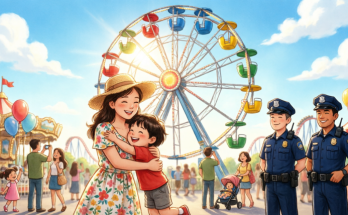
He stood awkwardly in my living room, looking at the books, the plants, the sunlight on the floor.
“Mom said you abandoned us,” he said.
“I know.”
“She said you took everything.”
“I took back what was mine.”
He swallowed.
“Did she really say she wished you were dead?”
I did not answer immediately.
Children should not have to carry the sins of their parents.
But Mateo was almost a man now, and lies had already been fed to him.
“Yes,” I said gently. “She did.”
His eyes filled.
“I heard her say something once,” he whispered. “To Dad. She said when you were gone, everything would be easier. I thought she meant when you moved.”
My chest tightened.
“I’m sorry you heard that.”
He wiped his face angrily.
“She tells everyone you’re cruel.”
“I expected that.”
“But you still made the trust for us?”
“Yes.”
“Why?”
I looked at him.
“Because love and trust are not the same thing. I love you. I no longer trust your mother with what belongs to you.”
That broke him.
He came into my arms like the little boy he used to be, and I held him while he cried against my shoulder.
After Mateo came Sofia.
Then little Elena.
One by one, my grandchildren found their way back to me—not because I bought them gifts, not because I took sides, but because peace feels different from manipulation. In my cottage, no one screamed. No one owed me affection. No one had to perform gratitude.
We cooked pasta.
We watched old movies.
I taught Sofia to sew.
Mateo fixed my garden gate.
Elena painted seashells and lined them along my windowsill.
My life became smaller.
Then fuller.
Rebecca did not come for two years.
I heard pieces of her life through the children. The marriage strained. The house gone. The image cracked. She had taken a job again. David left for six months, then returned, then left again.
I did not celebrate her suffering.
That surprised some people.
They thought freedom meant revenge.
It does not.
Freedom meant I no longer checked my phone hoping for love from someone who only called when she needed something.
Freedom meant I could pray for my daughter without handing her my wallet.
Freedom meant missing her and still not opening the door to abuse.
Then, on my seventy-sixth birthday, there was a knock.
I was in the kitchen, frosting a small cake with Elena. Mateo and Sofia were setting the table. Nora had brought flowers from the bakery.
When I opened the door, Rebecca stood there.
No sunglasses.
No expensive coat.
No performance.
Just my daughter, older somehow, with gray at her temples and fear in her eyes.
“Happy birthday, Mom,” she said.
The room went silent behind me.
I stepped outside and closed the door halfway.
“What are you doing here, Rebecca?”
Her mouth trembled.
“I wanted to see you.”
“Why?”
She looked down.
“Because I started therapy.”
I said nothing.
“And because Mateo told me if I came here asking for money, he’d never speak to me again.”
Despite myself, I almost smiled.
Rebecca saw it and began to cry.
Not the old tears.
These were quieter.
Ashamed.
“I was awful to you,” she said. “I don’t even know how to say it without making it smaller. I used you. I blamed you. I acted like your love was a burden because it was easier than admitting I depended on it.”
My hand tightened on the doorframe.
“And what you said?” I asked.
She covered her mouth.
“I have heard myself say it every day for two years.”
The wind moved between us.
“I don’t expect you to forgive me,” she whispered. “I don’t expect anything. I just wanted to say I’m sorry while you’re alive. Not at your funeral. Not when it’s too late. While you can hear me.”
For years, I had imagined that apology.
I thought it would heal everything instantly.
It did not.
Some words are knives. Even when removed, the wound remembers.
But something in me softened—not enough to forget, not enough to return to the old life, but enough to see the broken person standing before me.
“Thank you for saying it,” I said.
She nodded, crying harder.
“Can I hug you?”
I looked through the window.
My grandchildren were watching.
Waiting.
Learning.
I opened the door a little wider.
“One hug,” I said. “And then you may come inside for cake. But Rebecca?”
She froze.
“Yes?”
“My boundaries are not temporary.”
She nodded quickly. “I know.”
“I will not give you money.”
“I know.”
“I will not co-sign anything.”
“I know.”
“I will not allow you to insult me and call it honesty.”
Her face crumpled.
“I know, Mom.”
Only then did I step forward.
She hugged me like someone holding a thing she had once thrown away and never expected to touch again.
I did not say, “It’s okay.”
Because it was not okay.
I said, “We can begin here.”
And that was enough.
Years passed after that.
Rebecca and I did not become what we had been.
That version of us had been built on my silence and her entitlement.
Instead, slowly, carefully, we became something more honest.
She visited once a month.
Sometimes we walked by the water.
Sometimes we sat in uncomfortable silence.
Sometimes she apologized again, and sometimes I told her, gently, “You don’t need to repeat it. You need to live differently.”
And she did.
Not perfectly.
But truly.
She learned to ask without demanding.
To listen without defending.
To leave when I said I was tired.
To bring flowers without expecting forgiveness in return.
The grandchildren grew.
Mateo became an engineer. Sofia opened a small design studio. Elena became a teacher. When each turned twenty-five, the trust helped them begin their lives—not with luxury, but with stability.
At Mateo’s wedding, Rebecca sat beside me.
During the mother-son dance, she reached for my hand.
I let her hold it.
Not because all pain had vanished.
Because love, when it finally becomes humble, can sit beside pain without pretending it was never there.
I lived to be eighty-four.
My last years were peaceful.
There were no grand mansions. No luxury cruises. No dramatic wealth.
But there was morning light in my cottage.
There were grandchildren laughing in the kitchen.
There was fresh bread from Nora downstairs.
There was Rebecca, older and softer, reading to me when my eyes grew weak.
One evening, near the end, she sat beside my bed holding my hand.
“Mom,” she whispered, “I wasted so much time.”
I looked at her face.
My daughter.
My heartbreak.
My lesson.
My child.
“Yes,” I said softly. “But not all of it.”
She began to cry.
“I don’t deserve your forgiveness.”
“No one deserves forgiveness,” I said. “That’s why it’s forgiveness.”
“Do you forgive me?”
I closed my eyes.
I thought of the phone call.
The bank.
The lawyer.
The empty apartment above the bakery.
The first night I slept without fear.
The grandchildren returning.
The birthday apology.
The long, slow rebuilding.
Then I squeezed her hand.
“Yes,” I whispered. “But I am glad I left.”
Rebecca bowed her head over my hand and wept.
I died three nights later, in my own bed, with the window open and the sound of the ocean moving through the room.
At my funeral, Rebecca did not give a speech about what a wonderful daughter she had been.
She stood before everyone and told the truth.
“My mother loved me better than I loved her,” she said, voice breaking. “And when I mistook her love for weakness, she taught me the hardest lesson of my life. She showed me that love can forgive, but it must never be forced to beg.”
Then she looked at her children.
“She saved you from my worst self,” she said. “And she saved me too, by leaving.”
In my will, the charities received what I had promised.
A shelter for abandoned women.
A school fund for girls without parents.
A hospice by the sea.
My grandchildren received their trusts.
Rebecca received one thing.
A small framed drawing wrapped in tissue paper.
Two stick figures holding hands under a yellow sun.
On the back, in my handwriting, I had written:
“I kept this because I never stopped loving the little girl who made it. I hope the woman she became keeps learning how to love without taking.”
Rebecca kept it on her bedroom wall for the rest of her life.
And whenever someone asked about it, she told them the truth.
“That,” she would say, “is the picture my mother saved after I broke her heart. It reminds me that love is not something you inherit. It is something you must become worthy of every day.”
My name was Julieta Johnson.
For most of my life, I thought being a mother meant giving until nothing was left.
But at the end, I learned the truth.
A mother’s love can be endless.
Her permission to be mistreated should not be.
The Sh0cking Reason My Husband Wanted Me Out of the Hospital
Part 2 of 2