The inheritance question arrived earlier than I expected.
Not from Rebecca.
From my lawyer.
I had postponed estate planning after Carol’s death because every decision felt contaminated by revelation.
Eventually, avoidance became irresponsible.
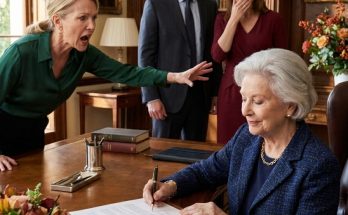
I met with my attorney, James Holloway.
He had handled our wills for years.
Carol and I had left nearly everything to each other, then to Daniel and Evan equally.
Now Carol was gone.
I had a biological daughter.
James asked:
“Do you want Rebecca included?”
The question sounded simple.
It was not.
If I added her equally, would it look like thirty-nine years reimbursed by money?
If I excluded her, would that repeat another form of erasure?
If I gave her more, would my sons feel punished for Carol’s choice?
Money loves turning grief into arithmetic.
I hated it.
I told Rebecca before making changes.
That was the first important decision.
“I’m reviewing my will.”
Her face closed slightly.
“I don’t want your money.”
“I’m not offering a check today.”
“I mean it.”
“I believe you.”
She had feared this.
Of course.
A late biological parent can use money to accelerate intimacy.
Gifts become claims.
Rebecca said:
“I don’t want Daniel and Evan thinking I appeared and took something.”
“They won’t decide my estate.”
“No, but relationships matter.”
True.
I asked:
“What would feel respectful?”
She looked annoyed.
“Why do I have to design your will?”
Fair.
“That’s my job.”
“Yes.”
Good correction.
I spoke with Daniel and Evan separately.
Not asking permission.
Giving transparency.
Daniel’s first reaction:
“Of course include her.”
Evan said:
“Equal.”
Too fast.
I slowed them.
“You do not have to perform generosity because you feel guilty.”
Daniel frowned.
“What else would we do?”
“Have feelings.”
He laughed.
Therapy had infected us all.
Daniel admitted part of him worried about Carol’s grandchildren.
His daughters.
Would equal division reduce what eventually reached them?
Yes.
Mathematically.
That was a real feeling.
Not shameful.
Evan admitted he hoped including Rebecca would prove we accepted her.
Money as proof again.
Dangerous.
I met James a second time.
We discussed assets.
House.
Retirement.
Investments.
Life insurance no longer relevant after policy term.
I was comfortable.
Not wealthy beyond imagination.
Enough to matter.
I decided on a structure that treated all three adult children as children in the estate, with equal broad shares after certain charitable gifts and specific bequests.
Not because equality erased history.
Because, after reflection, it matched how I wanted to recognize them going forward.
I included a letter.
Not legal.
It said:
This division is not compensation for years lost and not a statement that every relationship was identical. It reflects that Daniel, Evan, and Rebecca are all my children. Please do not use percentages to measure love or injury.
I showed the letter to all three.
Rebecca cried.
Then said:
“I still don’t want money.”
“You are allowed to disclaim later if you want.”
She laughed.
“Very lawyerly.”
James had taught me.
More importantly, I added no conditions requiring relationship.
No:
Rebecca gets this only if she visits.
No emotional leverage from the grave.
A gift should not purchase closeness.
I also began giving ordinary gifts more carefully.
At Rebecca’s fortieth birthday, I wanted to buy something huge.
A car.
Trip.
Jewelry.
Lost-time panic.
Instead I asked Mark what she actually liked.
He said:
“Old botanical prints.”
Of course.
Anna’s biology background.
I found an antique print from the region where she grew up.
Meaningful.
Reasonable.
Rebecca loved it.
No financial spectacle.
Daniel later told me:
“I was worried you’d start trying to make up thirty-nine birthdays.”
“I considered it.”
He laughed.
“Mom would have.”
I froze.
Would Carol have tried to compensate materially if she confessed?
Maybe.
We did not need to know.
Another money issue came from Anna.
Rebecca’s biological paternity had potential implications for family medical history, not inheritance from Anna.
We shared health information.
My father’s heart disease.
Mother’s dementia.
Cancer histories.
That practical exchange felt more important than money.
Rebecca said:
“This is the first thing biology actually changes for me day to day.”
Exactly.
She updated her records.
No drama.
Real consequence.
Estate planning finished months later.
I felt relief.
Not because death was imminent.
Because ambiguity had once damaged our family badly.
I refused to leave another secret structure.
All three knew where documents were.
All three knew James’s contact.
No surprise.
Paper could not solve emotional life.
But it could avoid manufacturing new confusion after I was gone.
Carol had left me a mystery.
I chose clarity.
Not as moral superiority.
As a lesson learned the expensive way.
Estate planning also made me confront Carol’s share of our wealth.
Much of what I owned had been built during our marriage.
Retirement savings.
House equity.
Investments.
Carol contributed through paid work, caregiving and household management.
If I now divided everything among three children, part of what Rebecca received would economically derive from a woman who had hidden her.
Was that strange?
Yes.
Rebecca noticed too.
“This money was partly hers.”
“Yes.”
“Does that bother you?”
“It complicates it.”
James, the lawyer, reminded me that once Carol’s estate passed to me under our valid plan, the assets were legally mine to distribute.
Emotional meaning remained mine to decide.
I did not pretend the history vanished.
But I also refused to treat every dollar as permanently stamped CAROL.
Marriage had combined lives.
After death, ownership changed.
I chose what happened next.
Rebecca said:
“I don’t want accepting later to feel like taking from her sons.”
Daniel answered before I could.
“We’re all his children.”
That mattered.
Not:
Mom would want this.
We did not know.
Daniel spoke for himself.
Evan agreed.
The future beneficiaries made their own relationship.
That was healthier than using Carol’s imagined wishes as authority again.
After the will discussion, I made one more choice to reduce future conflict.
I named an independent executor.
Not Daniel.
Not Evan.
Not Rebecca.
A trusted professional through James’s firm.
The children initially protested.
Daniel said:
“We can handle paperwork.”
“I know.”
“Then why pay someone?”
“Because I want you to be siblings, not administrators arguing while grieving.”
That landed.
The professional would handle legal and financial administration.
The children could still receive information and personal property.
This was not distrust.
Role design.
I had learned from the secret how easily family relationships become distorted when one person controls information.
No need to recreate that after death.
Rebecca especially appreciated it.
“I don’t want anyone thinking I influenced distributions.”
Exactly.
Transparency is easier when the process does not depend on one beneficiary.
We also documented digital accounts.
Photographs.
Passwords through secure storage.
No mystery drives.
No hidden letters designed to detonate later.
If I had something important to say, I wanted to say it alive.
That became almost a moral obsession.
Maybe overcorrection.
Still, better than the alternative.
Click here to continue reading: PART 12: When Anna became ill, Rebecca’s divided loyalties tested whether I could support the family I had found without acting as though biology gave me a place ahead of the people who had always been there
Carol’s final request sent me to Anna’s doorstep nearly forty years after we said goodbye, where one sentence changed everything I thought I knew about my marriage
Part 11 of 16