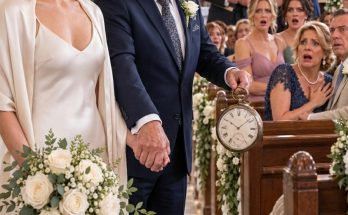
Three years after Dad died, Vanessa called.
“I have something for the estate.”
“The estate is closed.”
“I know.”
She asked to meet.
At Samuel’s office, she placed a jewelry box on the table.
The funeral diamonds.
Necklace.
Earrings.
Bracelet.
Marcus had bought them during the period when disputed money flowed through MVS Consulting.
No one could prove the exact dollars used for the purchase.
The jewelry was hers legally under the circumstances her attorney had reviewed.
She still did not want it.
“I can’t wear them.”
Samuel said, “You are not required to return these.”
“I know.”
She wanted them sold and the proceeds donated to the elder-advocacy organization Dad had supported late in life.
That surprised me.
Samuel made sure the transfer was documented properly.
No informal donation through a closed estate.
Vanessa sold through a reputable jeweler and donated directly.
She sent receipts to her lawyer.
Clean.
Independent.
When she left, I asked Samuel what he thought.
“She needed to assign new meaning to something.”
That sounded right.
Marcus knew.
He did not object.
Their marriage had survived, but differently.
Separate business accounts.
Joint household budget.
Full disclosure for major purchases.
Counseling continued on and off.
I admired Vanessa for staying only because it was her choice.
I would also have admired her for leaving.
The point was not preserving marriage at any cost.
It was refusing another person’s secrecy as the price of love.
Vanessa’s decision about the diamonds was hers from beginning to end.
That mattered to me.
No family pressure campaign.
No social-media apology.
No public donation ceremony.
She selected the nonprofit after meeting with its director.
The organization helped older adults detect fraud and navigate financial abuse.
She told me, “I don’t want my name on anything.”
Good.
The donation receipt stayed private except for necessary tax records.
The jewelry sold for less than Marcus had paid.
Luxury purchases often do.
Another reminder that spending is not storing value.
Vanessa laughed bitterly when she learned that.
“At least the donation does something.”
It did.
Marcus never bought her expensive jewelry again.
Not because jewelry was bad.
Because that particular category had become too loaded.
Years later, he gave her a simple silver bracelet.
She wore it.
Meaning changes with context.
Vanessa’s donation was acknowledged by the nonprofit with a generic letter.
No gala.
No article.
She showed it to me once.
Then put it away.
The diamonds stopped being a family topic.
That was healthy.
Objects can become too powerful when everyone keeps narrating them.
She had changed their meaning privately.
Then moved on.
Vanessa’s donation inspired no family tradition.
That was good.
Not every corrective act needs to become annual ritual.
She did it once.
Then moved on.
Years later, she told me she bought herself earrings again.
Small gold ones.
With money from her own salary.
“I felt ridiculous being nervous.”
“Did you wear them?”
“Yes.”
“Good.”
She smiled.
Objects should not stay contaminated forever.
Vanessa later joined the board of the elder-advocacy nonprofit she supported.
Not immediately.
Years later.
After learning the work.
That seemed fitting.
She never told the public why the cause mattered personally.
Privacy remained part of her repair.
Vanessa’s later work with elder advocacy made her careful around language.
She never called every bad family financial decision abuse.
She had learned nuance firsthand.
That made her a better volunteer.
Vanessa eventually wore the silver bracelet Marcus gave her to one family dinner.
No one mentioned the old diamonds.
Silence can be respectful too.
Vanessa’s donation meant more because nobody used it to demand forgiveness.
Vanessa’s advocacy work eventually became part-time paid employment.
She laughed that the worst financial chapter of her marriage had led to useful expertise.
Life reuses pain unpredictably.
Vanessa wore ordinary jewelry again years before she could speak lightly about the funeral.
Vanessa later told me the silver bracelet cost less than one dinner they used to spend on impressing clients. She preferred it. So did Marcus. Their life became smaller in some ways and steadier in others.
Vanessa’s work at the nonprofit later brought her into contact with families far more severe than ours. She became careful not to compare suffering. She told me once, 'I thought our story was enormous until I saw what some people survive.' Perspective did not erase her pain. It gave it context.
Vanessa’s later choices showed that accountability can continue privately after public attention disappears.
Vanessa's later confidence came from understanding her own finances, not from being reassured that someone else had handled them.
Click here to continue reading: PART 16: Years after the funeral, the safe became ordinary again because Dad’s real legacy was never inside it
The empty safe revealed that Dad had been protecting evidence, not hiding a fortune
Part 15 of 16