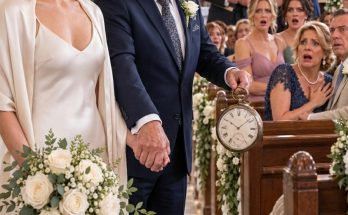
For several seconds, nobody moved.
The grandfather clock near the study window kept ticking.
Tick.
Tick.
Tick.
After the shouting at the funeral, the sound felt almost insulting.
Marcus stared at Samuel Price.
Then at the two men behind him.
Then back at me.
His confidence had vanished.
“Why are bank investigators here?”
Samuel closed the study door.
“Because your father asked them to be present when these materials were opened.”
Marcus laughed once.
Nervously.
“This is ridiculous.”
Samuel did not answer.
He stepped beside the desk.
The two investigators introduced themselves.
Daniel Cho from the bank’s internal investigations unit.
Miriam Cole from its fraud and elder-financial-abuse team.
Neither wore a badge.
Neither claimed to be law enforcement.
That mattered.
Dad had wanted witnesses and a clean chain of custody.
Not theater.
Marcus looked around the room.
Aunt Louise stood near the bookshelves.
Uncle Raymond folded his arms.
Vanessa stayed by the fireplace.
My cousins had followed us from the church and now looked as though they regretted it.
Samuel turned to me.
“Elena, you may open the folders.”
I lifted the first one.
Dad had written on the front in black ink.
ACCOUNT REVIEW — DO NOT REMOVE.
Marcus scoffed.
“What account review?”
I opened it.
Bank statements.
Copies of canceled checks.
Printouts of electronic transfers.
Several pages were highlighted.
Miriam placed a gloved finger beside one entry.
“Mr. Hale reported this transfer five months ago.”
My father was Robert Hale.
Seventy-eight years old.
Retired contractor.
Careful with money.
Not rich in the way Marcus liked to imply.
Comfortable.
A house paid off years earlier.
Retirement accounts.
Savings.
A small commercial property he co-owned with an old business partner.
Marcus had told half the family Dad was sitting on millions in cash.
Dad had let him talk.
That was the part I had never understood until now.
Marcus stepped toward the desk.
“Reported what?”
Samuel held up one hand.
“Please stay where you are.”
Marcus laughed again.
“You think I stole from my own father?”
No one had said that.
Not yet.
Miriam turned another page.
Three transfers.
Forty-eight thousand.
Seventy-two thousand.
Ninety-one thousand.
All sent within six weeks to an account belonging to MVS Consulting.
Vanessa’s initials.
Marcus and Vanessa Sinclair.
Vanessa went pale.
“That’s not my company.”
Marcus turned.
“Don’t.”
She stared at him.
“I said that’s not my company.”
Daniel Cho spoke calmly.
“The business account is registered to Marcus Hale, doing business as MVS Consulting.”
Marcus’s face hardened.
“That was Dad’s investment.”
I looked at him.
“What investment?”
He ignored me.
Samuel opened the second folder.
POWER OF ATTORNEY — REVOKED.
Marcus stopped moving.
The room changed.
Dad had given Marcus a limited financial power of attorney the previous year while recovering from surgery.
It allowed him to pay certain bills and manage designated accounts if Dad needed help.
It did not authorize gifts to himself.
It did not authorize business investments.
It did not authorize new debt secured by Dad’s property.
Samuel placed the revocation document on the desk.
Signed.
Notarized.
Dated six months earlier.
The third folder contained a letter from Dad to the bank.
I knew this one.
I had driven him to Samuel’s office the day he signed it.
At the time, Dad told me only that he was “cleaning up paperwork.”
The letter disputed a series of transfers and instructed the bank to block Marcus from account access.
The fourth folder contained a preliminary forensic accounting report.
I had never seen it.
My hands began to shake.
Samuel noticed.
“You can sit.”
“I’m fine.”
I was not.
The report traced more than four hundred thousand dollars in transfers, checks, and credit-card payments over approximately fourteen months.
Not all of it was proven unauthorized.
Some had been legitimate help.
Dad had paid one of Marcus’s business debts.
Covered medical insurance during a bad year.
Helped with a truck purchase.
But several transactions had no matching note, gift letter, or business agreement.
Others occurred after Dad said he had stopped giving Marcus money.
The fifth folder contained documents involving a proposed home-equity line.
The application bore Dad’s signature.
Dad had disputed it.
The loan had not funded.
The bank had frozen the application during review.
Marcus’s face was no longer angry.
It was frightened.
Uncle Raymond looked at him.
“What is this?”
Marcus snapped.
“Dad knew about everything.”
Samuel said, “That question will be addressed through records and, if necessary, the probate court.”
“Probate court?”
Marcus turned toward me.
“You’re doing this.”
“No.”
“You’ve been planning this.”
“Dad was.”
That was the truth.
The sixth folder was marked ESTATE.
Samuel opened it himself.
Inside were copies of Dad’s will, a later codicil, trust papers for the grandchildren, and an executor memorandum.
The will still named both Marcus and me as beneficiaries.
That surprised everyone.
Especially Marcus.
Dad had not cut him out.
The codicil did something more careful.
Any legally established debt Marcus owed Dad or the estate could be set off against Marcus’s distributive share to the extent permitted by law.
Marcus’s remaining share, if any, would be held in trust for a period rather than delivered in one lump sum.
The house was to be sold unless both beneficiaries agreed to another arrangement approved by the estate.
No secret transfer to me.
No revenge clause.
No magical punishment.
Just structure.
Marcus looked at Samuel.
“You’re saying I still inherit?”
Samuel chose his words carefully.
“I’m saying the will controls, subject to valid estate claims, debts, probate orders, and the codicil. No one in this room is calculating your final distribution today.”
Marcus sat down.
For the first time all afternoon.
Vanessa remained standing.
Then Samuel pointed to the flash drive.
“This contains copies of supporting records your father asked me to preserve.”
Marcus looked up sharply.
“What records?”
Samuel met his eyes.
“Emails. Voicemails. Scanned checks. Account logs. Notes from meetings. Nothing will be played here unless necessary.”
Dad’s handwritten note remained unopened.
Samuel handed it to me.
“Elena.”
I broke the seal.
The first line stopped me.
Do not let grief make you cruel.
I swallowed.
Then continued.
If this room is full when you read this, I was probably right that Marcus would make a scene.
Several relatives shifted uncomfortably.
Dad knew us well.
The note explained that he had spent months reviewing his finances.
He wrote that he loved both of us.
He believed Marcus had become desperate, not evil.
But desperation did not create permission.
He had chosen me as executor because I followed instructions even when angry.
Then came the line that broke me.
Elena, do not use what I left you to punish your brother.
Use the records.
Use Samuel.
Use the court.
Do not use shame.
I sat down.
All the anger I had carried from the funeral suddenly had nowhere to perform.
Marcus had accused me publicly.
Uncle Raymond had dismissed me.
Vanessa had smiled beside the fireplace.
I wanted, for one hot second, to read every ugly transaction aloud.
Dad had anticipated that too.
Patience was his last lesson.
Samuel took the note when my hands began to tremble.
“We’re done for today.”
Marcus stood.
“No, we’re not.”
Samuel looked at him.
“Yes. We are.”
Marcus pointed at the folders.
“I want copies.”
“You can request appropriate estate records through counsel.”
“I don’t have counsel.”
“Then I strongly suggest you get some.”
Marcus looked at me.
For once, I did not feel quiet because I was afraid of him.
I felt quiet because I finally understood Dad’s plan.
The safe did not contain an inheritance.
It contained a process.
Before Samuel ended the gathering, Daniel Cho asked whether anyone had touched the folders before he arrived.
“No,” I said.
Marcus laughed.
“Of course she says no.”
Daniel did not react.
He photographed the safe interior.
Then each folder.
Then the flash drive in place.
The process was methodical.
Almost boring.
That was why Dad wanted professionals there.
Boring procedures survive dramatic accusations better than family memory.
Samuel asked every relative who had remained in the study to write down their name and contact information.
Uncle Raymond objected.
“We’re not witnesses in a crime.”
“No,” Samuel said. “You are witnesses to what was present when the safe was opened.”
Different.
Important.
Dad had anticipated not only Marcus’s anger, but the family habit of rewriting events later.
By Christmas, someone would otherwise say there had been cash.
Someone else would remember jewelry.
Someone would claim I carried away a seventh folder.
Dad knew us.
That realization made me sad.
He had spent his final months planning against our worst instincts.
When the investigators left, Samuel sealed the flash drive in an evidence envelope.
The original folders went into locked document cases.
I kept nothing except a copy of Dad’s note.
Marcus watched every movement.
“Where are you taking those?”
“Samuel’s office.”
“Why does he get everything?”
“Because your father instructed counsel to preserve the originals.”
Marcus looked at me.
“You’re hiding behind him.”
I almost answered sharply.
Then Dad’s line returned.
Do not use shame.
“I’m following instructions.”
That sentence became my anchor.
Not I’m right.
Not you’re guilty.
Not Dad trusted me more.
I’m following instructions.
At home that night, I could not sleep.
The funeral dress hung over a chair.
My black shoes were by the door.
I had not eaten since morning.
Grief arrived late after administration.
I heated soup.
Sat at the kitchen table.
Then cried so hard I could barely breathe.
Not over money.
Over the fact that Dad had known Marcus would make a scene.
Over the fact that he had prepared for his own funeral as though it were another jobsite needing safety barriers.
Over the note.
Over the empty chair beside me.
Executor sounded powerful at the church.
At midnight, it felt like paperwork handed to the child who remained functional longest.
I called Sofia.
My daughter answered sleepy.
“Mom?”
“I’m sorry.”
“For what?”
“For waking you.”
“You can wake me.”
I cried again.
She came over.
No advice.
No questions about the safe.
She made tea.
Sat with me.
That was the first moment all day when no one wanted anything from Dad’s estate.
It was also the moment I understood why I needed people outside the dispute.
Grief should not have to compete with administration every hour.
The day after the funeral, I returned to Dad’s house alone.
Not to search the safe.
Not to inventory anything.
To find his medication organizer because the pharmacy had called about a refill that no longer mattered.
I stood in the kitchen with the plastic box in my hand.
Monday.
Tuesday.
Wednesday.
Empty compartments.
The practical evidence of death can be more brutal than a coffin.
I sat at the table.
Dad’s mug was still in the drying rack.
One coffee stain marked the counter.
I could have wiped it.
I did not.
For twenty minutes, I let the house remain exactly as he left it.
Then the executor part of me returned.
Refrigerator emptied.
Mail gathered.
Thermostat adjusted.
Doors checked.
Grief and administration took turns.
That rhythm lasted months.
It also changed how I remembered the funeral confrontation.
At church, Marcus’s shouting had felt like the biggest thing in the world.
At Dad’s kitchen table, it became smaller than absence.
That helped.
I stopped treating the safe scene as the center of Dad’s death.
It was only one ugly afternoon.
Dad had eighty years of life around it.
Sofia stayed with me until almost dawn after the funeral.
At some point, she asked what Dad had been like during his last week.
That question pulled me out of the safe entirely.
He complained about the hospital coffee.
He refused the television remote because sports commentary irritated him.
He made me promise to water his tomatoes.
He asked whether Marcus had called.
That last part stayed with me.
Even after everything.
Even with the account review.
Dad still wanted his son to call.
Marcus did.
Twice.
The first conversation was short.
The second lasted twenty minutes.
I never knew what they said.
For months, I wondered whether Dad forgave him in that call.
Then I realized forgiveness is not a bank transaction.
No receipt.
No final balance.
Maybe they talked about baseball.
Maybe Dad asked about the grandchildren.
Maybe Marcus apologized.
Maybe not.
I stopped needing to know.
Their relationship belonged partly to them.
That was difficult for me because I had become keeper of so many records.
Records create an illusion that everything important can be documented.
It cannot.
Some truths die with people.
That is not always a failure.
The next morning, Sofia asked whether I intended to tell the whole extended family what the folders contained.
“No.”
“Why not?”
“Because they witnessed the safe opening. They do not need the whole investigation.”
She nodded.
That was another line Dad had understood.
Transparency does not mean broadcasting every private record.
Relatives had seen enough to know there was no hidden fortune and that Dad had preserved financial concerns.
The rest belonged to those legally involved.
I called Aunt Louise and said exactly that.
She sounded almost disappointed.
People confuse access with closeness.
But Dad’s bank statements were not family entertainment.
That boundary helped reduce gossip before it became permanent.
A week after the funeral, I found Dad’s contractor pencil behind the study desk.
Flat yellow pencil.
Chewed edge.
His initials carved into one side.
I carried it home.
Not because it had value.
Because it felt like Dad in a way the estate files did not.
For months, I kept the pencil beside the executor binder.
That pairing became important.
Paperwork and person.
Claim and memory.
If I spent too long with statements, I picked up the pencil.
Dad was not the disputed transfer schedule.
He was the man who used that pencil to mark cuts on lumber.
Grief needed reminders outside the case.
Sofia eventually asked whether I had been frightened of Marcus at the funeral.
I said no too quickly.
Then corrected myself.
“Not physically.”
“What then?”
“Afraid he would make me doubt myself.”
That was more accurate.
Marcus had always been fast with words.
Certain.
Loud.
I processed slowly.
At family arguments, speed often looked like confidence and confidence looked like truth.
Dad knew that.
The safe-opening plan slowed everything down.
Documents.
Witnesses.
Attorney present.
One statement at a time.
For once, Marcus’s volume could not decide reality.
That was why I wore the key under my collar.
Not as power.
As a reminder to wait.
Waiting did not make me passive. It made my next step deliberate. That difference became one of the most useful things Dad left me.
The funeral itself returned to me in fragments for months.
Not Marcus shouting.
Dad’s casket flowers.
The hymn Mom used to hum.
The way Sofia squeezed my hand during the final prayer.
Grief reclaimed the day slowly.
That mattered.
I did not want Marcus’s outburst to become the only memory attached to Dad’s funeral.
So I wrote down three things from the service that had nothing to do with inheritance.
Then three more.
Memory can be trained toward proportion.
I left Dad’s house that week with the pencil in my pocket and the safe key under my shirt, carrying one object for memory and one for duty.
That night, I also removed the safe key from my neck before bed and placed it on the nightstand. For weeks Dad had told me to keep it close. Without him, the chain felt heavier. I put it back on the next morning because the estate still needed me. Duty can outlast the person who assigned it, but it should not be mistaken for identity.
In the days after the funeral, several relatives called to ask what had really been in the safe. I gave the same answer every time: documents under review. Some sounded disappointed. That reaction taught me how quickly grief can become curiosity about money. I stopped explaining. Dad’s privacy still mattered after death. The people legally entitled to records would receive them. Everyone else could live with uncertainty.
Dad had trusted process more than performance. I understood that only after watching the family calm down once documents replaced shouting.
That restraint became one of the few things from the funeral day I could later feel proud of.
Click here to continue reading: PART 2: Marcus denied the transfers until Vanessa recognized a company name she had never agreed to use
The empty safe revealed that Dad had been protecting evidence, not hiding a fortune
Part 1 of 16