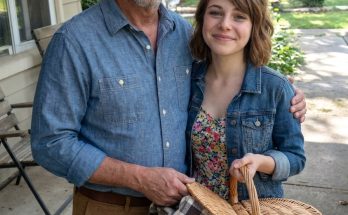
Emma’s eighteenth birthday was in April.
I had imagined the day for years.
Eleanor had imagined it too.
Before she died, she once held the necklace against Emma’s chest while Emma was twelve and said, “Not yet. You’ll grow into it.”
Emma rolled her eyes.
“Grandma, jewelry doesn’t grow.”
“You do.”
That memory returned while I stood at the bank.
The velvet box sat on the desk between me and the branch employee.
The jewelry had spent months in a safe deposit box after the police returned it.
I could have left it there.
I nearly did.
The pieces had become tangled with too many things.
Preston’s theft.
The pawn shop.
Police reports.
Christmas.
Debt.
Shame.
Then I remembered why I had saved them.
Not as evidence.
For Emma.
I brought the box home.
Her birthday dinner was small.
Me.
Preston.
Marissa.
Emma.
A friend from school named Tessa.
No extended family production.
No photographer.
No rented room.
Emma requested meatloaf because she claimed restaurants made birthdays “too loud.”
That sounded like Eleanor.
Preston arrived carrying flowers.
Not for Emma.
For me.
I looked at him.
“What are these?”
“Mom’s favorite.”
Yellow tulips.
I put them in water without making the gesture bigger than it was.
During dinner, Preston asked about Emma’s college decision.
She had been accepted to three schools and was choosing between Ohio State and a smaller university in Pennsylvania.
Preston wanted Ohio State.
I knew before he opened his mouth.
Cheaper.
Closer.
Familiar.
Emma wanted Pennsylvania.
Marissa looked nervous when the conversation started.
Six months earlier, this family would have turned the choice into a financial crisis and then looked toward me.
This time, Preston said, “We can afford Ohio State without taking much debt.”
Emma put down her fork.
“I know.”
“The Pennsylvania school gave you aid, but it still costs more.”
“I know.”
Marissa added, “We’re not saying no.”
Preston looked at her.
She held his gaze.
“We’re saying we need to understand the numbers.”
I waited.
Nobody looked at me.
I cannot explain why that made me proud.
After dessert, I brought out the velvet box.
Emma froze.
“Is that—”
“Yes.”
Preston went pale.
Marissa lowered her eyes.
I placed the box in front of Emma.
“This was your grandmother’s. I always intended it for you when you turned eighteen.”
She did not touch it.
“Grandpa, I can’t.”
“Yes, you can.”
“After everything that happened?”
“That is exactly why you can.”
She looked at her father.
Preston’s face tightened.
Then he said, “Open it, Em.”
She did.
The necklace caught the light.
For a few seconds, nobody spoke.
Then Emma began crying.
Not because of its value.
Because it had survived.
Because Eleanor had worn it.
Because something taken had come back.
She lifted the necklace.
“Can you put it on me?”
My hands were not as steady as they used to be.
I fastened it behind her neck.
She touched the pendant.
“It feels weird.”
“Too heavy?”
“No. Like Grandma is here.”
Preston pushed his chair back.
“I need some air.”
Emma watched him leave.
I started to stand.
She shook her head.
“Let him go.”
So I did.
He returned ten minutes later.
His eyes were red.
He sat beside Emma.
“I’m sorry,” he said.
She looked at him.
“I know.”
“No. For that specifically. I knew Grandpa was saving it for you.”
I had not known that.
“You knew?”
Preston nodded.
“Mom told me.”
That hurt more than I expected.
He had not taken an anonymous asset.
He had taken something he knew belonged emotionally to his daughter’s future.
Emma closed the box.
“Why?”
Preston stared at his plate.
“Because I thought I could fix it before anyone knew.”
“That’s not why.”
He looked up.
Emma’s voice was calm.
“Why did you think you were allowed to risk it?”
The question silenced the room.
Preston had spent months answering adults.
Police.
Lawyers.
Probation officers.
Counselors.
Me.
Now his daughter was asking.
He took a long breath.
“Because I was scared and selfish.”
Emma waited.
“And because Grandpa had always fixed things for me.”
She looked at me.
“That’s not Grandpa’s fault.”
“No,” Preston said. “But it made it easier for me to lie to myself.”
I appreciated that distinction.
He did not blame me.
He acknowledged the pattern.
Emma removed the necklace.
She placed it back in the box.
“I love it.”
“You don’t have to wear it today,” I said.
“I know.”
She smiled.
“I’m going to wear it at graduation.”
She did.
Six weeks later, I sat between Preston and Marissa in a high-school gymnasium.
Emma crossed the stage wearing a blue gown.
The pendant rested against the fabric.
When her name was called, Preston stood too quickly and almost knocked his chair backward.
I laughed.
He looked at me.
Then he laughed too.
For one minute, we were simply two men proud of the same girl.
After graduation, Emma chose Pennsylvania.
Preston did not ask me to pay the difference.
That was important.
He and Marissa adjusted their budget.
Emma accepted federal student loans within a manageable amount.
She took a campus job.
I offered one specific gift.
“I’ll cover your books.”
She frowned.
“All four years?”
“If I’m alive and able.”
“Grandpa.”
“That was a joke.”
“It wasn’t funny.”
“It was a little funny.”
She hugged me.
I paid the bookstore directly each semester.
Not because anyone demanded it.
Because I chose to.
That difference changed how giving felt.
Preston and Marissa sold their second car that summer.
They canceled a planned beach trip.
They listed several luxury items online.
Marissa closed the rented studio space she had maintained for her struggling business and moved the work into a smaller room at home.
Preston picked up consulting projects on weekends.
Debt came down slowly.
There was no miracle.
No secret investor.
No huge inheritance.
Month by month.
Statement by statement.
Their marriage remained strained.
Sometimes Emma called me from college and said they were fighting.
I never told her what they should do.
“They have a counselor,” I reminded her. “They have to decide their own marriage.”
“What if they divorce?”
“Then they divorce.”
She was quiet.
“Would that be terrible?”
“It would be painful. That is not always the same thing.”
In November, nearly a year after the Telluride disaster, Preston asked if I wanted to come to their house for Thanksgiving.
I said yes.
Then he added, “You don’t need to bring anything.”
I laughed.
“I am bringing pie.”
“Fine.”
“And I’m wearing flannel.”
A pause.
Then he said, “Wear the red one. Mom liked that one.”
I stood in my kitchen holding the phone.
“Okay.”
Thanksgiving was awkward.
Good awkward.
Marissa’s parents were there.
Her father shook my hand and apologized again for not realizing how the trip had been funded.
I told him he had nothing to apologize for.
Marissa cooked.
Preston did dishes.
Nobody asked me to pay for anything.
Nobody made a speech.
At one point, I went to the bathroom and passed the small office where Preston kept his bills.
The door was open.
A spreadsheet filled the computer screen.
Debt balance.
Monthly payment.
Projected payoff date.
He had become a man who looked at the number instead of hiding from it.
I did not mention that I saw it.
Some progress deserves privacy.
Click here to continue reading: PART 7: A Year After Telluride, Preston Asked for Help and I Finally Learned How to Say Yes Differently
The Christmas Trip I Paid For Put Me in a Motel and My Family in a Lodge
Part 6 of 16