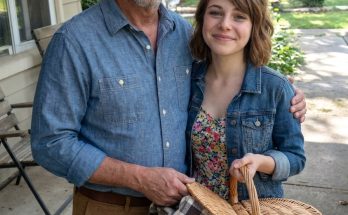
We sat in the airport parking garage with the heater running.
Emma kept her hands tucked beneath her thighs.
I unfolded the receipt.
The pawn shop was in Parma.
The date was six weeks earlier.
The description was vague but recognizable.
Gold necklace.
Diamond pendant.
Matching earrings.
My stomach tightened.
“Where did you get this?”
“I found it in Dad’s desk.”
“When?”
“Last week.”
“Why were you in his desk?”
“I was looking for stamps for college applications.”
That sounded like Emma.
She had inherited Eleanor’s habit of putting postage on everything immediately.
“There was an envelope from the pawn shop. I opened it because Grandma’s name was written on one of the old appraisal copies.”
I looked at her.
“You saw an appraisal?”
She nodded.
“I took a picture. I didn’t know what it meant.”
“Why didn’t you tell me?”
Her eyes filled.
“Because Dad said you were getting forgetful.”
My grip tightened around the paper.
“What?”
“He said you lose things now. He said sometimes you think people took them.”
I stared through the windshield.
Cars moved slowly between concrete pillars.
“He said that?”
“He and Mom talk about your house all the time.”
“Emma.”
She looked at me.
“Has your father ever told you I agreed to sell it?”
“No.”
“Has he ever told you I asked him to manage my finances?”
“No.”
“Has he ever told you I was diagnosed with anything that affects my memory?”
“No.”
“Good. Because none of those things happened.”
She began crying.
Quietly.
“I didn’t know what to believe.”
“You were not supposed to have to decide.”
I called Julian from the car.
He told me not to confront Preston about the pawn receipt.
“Preserve it. Photograph it. Send me a copy. Then contact police.”
I did exactly that.
The responding officer met us at my house.
His name was Officer Bell.
He listened carefully.
He did not say, “Your son stole it, case closed.”
He asked practical questions.
Who owned the jewelry?
When had I last seen it?
Who had access to the home?
Where had the spare safe key been?
Could anyone else have removed the pieces?
Did I have photographs or appraisals?
I brought out Eleanor’s insurance file.
There were photographs.
Receipts.
An appraisal from years earlier.
Emma provided the picture from Preston’s desk.
The officer explained that a pawn receipt connected to Preston would be important, but the police would still have to verify the transaction and establish how the jewelry came into his possession.
I appreciated that.
I wanted the truth.
Not theater.
The pawn shop was closed for Christmas Eve.
Officer Bell documented everything and gave me a report number.
Then he left.
Emma stood near the Christmas tree staring at the little village Eleanor had collected.
“Dad told me Grandma wanted him to have everything.”
“That is not true.”
“How do you know?”
“Because I was married to her for forty-one years.”
Emma wiped her face.
“Did she leave a will?”
“Yes.”
“Can I see it?”
I hesitated.
Not because there was anything to hide.
Because I did not want a seventeen-year-old reading estate documents on Christmas Eve to settle an argument between adults.
But she had already been dragged into it.
So I showed her the relevant page.
Eleanor had left her personal property to me.
There was no special gift of the jewelry to Preston.
Emma read it twice.
Then she sat down.
“He lied.”
“Yes.”
“Why?”
“I don’t know.”
That was the honest answer.
At eleven that morning, Preston called.
I let it ring.
Then again.
Then a message.
Emma’s flight was not your decision to make.
I replied:
She asked to come home. She is safe with me.
He called immediately.
“Put her on.”
“She can decide whether she wants to speak.”
“I’m her father.”
“Yes.”
“You are undermining me.”
“I am not discussing this while you’re angry.”
“Dad, I swear to God—”
I ended the call.
My hands shook afterward.
Not from fear.
From habit.
For decades, my body had learned to treat Preston’s anger as something that needed fixing.
Emma came into the kitchen.
“You hung up on him.”
“I did.”
“He hates that.”
“I noticed.”
A small smile appeared.
Then disappeared just as quickly.
“Grandpa, are you going to have him arrested?”
“No.”
She looked surprised.
“I filed a police report. The police will investigate. I do not control what happens next.”
“But if he took it?”
“Then he will have to answer for it.”
“Will you forgive him?”
“I don’t know yet.”
That was another answer she deserved.
Christmas Eve became quieter after that.
Emma helped me make Eleanor’s stuffing.
She corrected the amount of sage twice.
At four, a delivery arrived.
A bouquet from Marissa’s parents.
The card read:
We did not know Raymond. We are sorry.
I believed them.
Not because I wanted to.
Because their actions matched the limited facts I had.
They had paid for their own return flights and left Colorado that morning.
Marissa’s sisters had done the same.
The trip had fallen apart.
But nobody was stranded.
Nobody was homeless.
Nobody was in danger.
The adults simply had to pay their own way.
That evening, Emma and I ate at the kitchen table.
No lodge.
No photographer.
No matching sweaters.
Just ham, potatoes, stuffing, green beans, and two kinds of pie because Eleanor had always considered one pie insufficient.
At seven, Preston called again.
This time Emma answered.
She put him on speaker only after asking me.
“Emma, you need to come back.”
“I’m staying with Grandpa.”
“You don’t understand what he’s doing.”
“I understand enough.”
“Your grandfather is punishing this family because he has control issues.”
I watched Emma’s jaw tighten.
“Did you pawn Grandma’s jewelry?”
Silence.
Long enough.
Then Preston said, “Who told you that?”
I closed my eyes.
Emma looked at me.
“Dad.”
“That jewelry was family property.”
“No,” I said.
He heard me.
His voice changed.
“So this is what you’re doing? Turning my daughter against me?”
“Nobody forced you to say what you just said.”
“I didn’t steal anything.”
“Then explain how it reached the pawn shop.”
“I borrowed against it.”
“You had no permission.”
“It was going to come back.”
“When?”
“After Christmas.”
“With whose money?”
He stopped.
Emma turned away.
The truth was no longer dramatic.
It was small and ugly.
Preston had debts.
He needed cash.
He knew where the jewelry was.
He told himself he would replace it before anyone noticed.
That was how people crossed lines.
Not always with a grand plan.
Sometimes one excuse at a time.
“I’m ending this call,” I said.
“Dad, wait.”
“No.”
“The pawn shop only gave me twelve thousand. I can get it back.”
I froze.
Twelve thousand.
That was the first number we had.
“Do not contact the pawn shop,” I said.
“Why?”
“Because there is now a police report.”
He went silent.
“You called the police on me?”
“I reported missing property.”
“I’m your son.”
“And it was Eleanor’s.”
He hung up.
Emma cried after that.
Not loudly.
I sat beside her until she stopped.
I did not tell her everything would be fine.
Sometimes that phrase is a lie adults use because uncertainty scares them.
Instead, I told her what I knew.
She could stay with me.
Her college applications would still go out.
Christmas dinner would still happen.
Her father loved her, even if he was behaving badly.
And none of this was her fault to repair.
The next morning, Christmas Day, the phone remained quiet until almost noon.
Then Julian called.
Not to talk about the house.
Not about the resort.
About the bank.
The card issuer had received documentation from the resort.
The initial thirty-thousand-dollar charge was not as simple as Preston had described.
Only twelve thousand had actually posted as a nonrefundable holiday deposit.
The remaining balance had been scheduled for capture at check-in.
Because I had canceled access and contacted the resort before that occurred, the larger second payment had failed.
The dispute over the twelve-thousand-dollar deposit would continue.
I might recover some.
I might not.
For the first time, the number felt almost secondary.
I had stopped the next charge.
Stopped the next withdrawal.
Stopped the next assumption.
That afternoon, Emma and I walked through the snow to the cemetery.
She placed a small evergreen branch beside Eleanor’s stone.
“Grandma would be mad at Dad,” she said.
“Yes.”
“Would she stop loving him?”
I looked at my wife’s name carved into granite.
“No.”
Emma nodded.
Then she asked the harder question.
“Can both be true?”
“Yes.”
That answer I knew.
Click here to continue reading: PART 4: When Preston Came Home, He Had Debts, Excuses, and One Truth He Couldn’t Avoid
The Christmas Trip I Paid For Put Me in a Motel and My Family in a Lodge
Part 3 of 16