The nurse kept one hand on the door handle.
For a second, I thought she was about to tell me Rachel had died.
My knees actually weakened.
“She didn’t want you to know how sick she was,” she repeated.
“I understand.”
“No, sir.”
She shook her head gently.
“I mean she built her life around making sure you wouldn’t find out.”
My mouth went dry.
Her badge said MARIA SANTOS, RN.
I noticed because my mind had become desperate for ordinary facts.
Name.
Badge.
Blue scrubs.
White shoes.
Anything except the sentence hanging between us.
“What does that mean?”
Maria looked at the sealed envelope in my hand.
“It means you should read that before you go in.”
I stared at the date in Rachel’s handwriting.
Three years earlier.
The same week she sat across from me at our kitchen table and said, You deserve a full life, Danny.
I broke the seal.
The first page was yellow legal paper.
Of course it was.
Rachel had used yellow pads for everything.
Grocery lists.
Insurance calls.
Christmas planning.
Even arguments.
Danny,
If you are reading this in a hospital, then the one thing I hoped would never happen has happened. You found out because my body made the decision for me.
I stopped.
The hallway blurred.
Maria waited.
No pressure.
I kept reading.
Rachel wrote that four years earlier she had been diagnosed with a rare soft-tissue cancer near her pancreas.
Not pancreatic cancer.
A sarcoma.
Operable at first.
Then uncertain.
The first surgery had been the year before our divorce.
She had told me it was a gallbladder procedure.
I remembered.
I took three days off from the shop.
Made soup.
Changed her bandage.
Slept in a chair beside her.
I had cared for her through cancer surgery while believing it was something routine.
My anger arrived before grief.
I pressed the page flat with my thumb.
She wrote that the doctors could not promise what came next.
There might be years.
There might be months.
There might be more surgery.
Radiation.
Chemotherapy.
Long stretches when she looked healthy.
Periods when she would not.
Her first instinct was to tell me.
Then she watched me close Whitmore Auto early every day for two weeks.
Watched me sleep beside her.
Watched me cancel a fishing trip with my brother.
Watched me become terrified over what I thought was a simple operation.
And she made a decision.
A bad one.
She called it that herself.
I decided I could not make your whole life become my illness.
The words shook in my hands.
She wrote that she had spent twenty-two years watching me stay.
Through her mother’s stroke.
Through my father’s death.
Through lean years at the shop.
Through two miscarriages we almost never talked about afterward.
She believed if she told me the truth, I would never leave.
She was right.
That was exactly why she left first.
I lowered the page.
“She divorced me because she was sick.”
Maria said nothing.
For one angry second, I hated her for not answering.
Then I realized she was a nurse, not the interpreter of my marriage.
I looked at the next page.
Rachel wrote that she moved to Tulsa because her sister Linda lived ten minutes from Saint Anne’s.
She wanted treatment nearby without me driving six hours every time a scan changed.
She kept my number as emergency contact.
Kept me listed as husband because every time a form asked for next of kin, she could not bring herself to write anyone else first.
I laughed once.
A terrible sound.
“Of course.”
Maria looked at me.
“She updated that herself?”
“Yes.”
“When?”
“Several times.”
That hurt differently.
Rachel had divorced me legally.
Administratively, in the places where fear makes people honest, she had never quite replaced me.
The last page was worse.
I know this was not fair to you.
I know deciding what you could handle was another kind of control.
If you hate me when you read this, I understand.
If you have built another life, do not destroy it out of guilt.
If you are alone, that is not proof I was right.
Please do not turn my illness into a duty.
Then one line was underlined.
If you come through that door, come because you still want me there.
Not because I am sick.
I folded the pages.
Maria waited.
“Is she conscious?”
“Yes.”
“Can she talk?”
“Some.”
“Is she dying?”
Maria’s face changed.
Professional.
Careful.
“She had a complication from treatment and an infection. She is very sick, but her doctors need to explain prognosis. I can’t give you that in the hallway.”
I nodded.
Facts.
That was fair.
“Does she know I’m here?”
“No.”
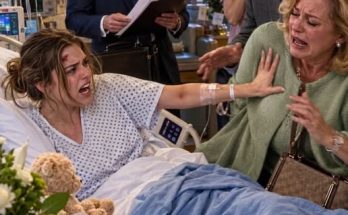
I looked through the little window.
Rachel lay under a white blanket.
Thinner than at the wedding.
Oxygen beneath her nose.
An IV.
Monitors.
The woman who had walked out of my house two weeks earlier before sunrise was sleeping fifteen feet away.
My ex-wife.
My wife on a hospital chart.
My Rachel.
I put my hand on the door.
Then stopped.
The letter had given me a choice.
That mattered.
She had taken choices away from me three years earlier.
Now she had left one.
I opened the door.
I did not go straight to the bed.
That surprised me.
I stood just inside the room until the door clicked shut behind me.
Rachel’s face looked smaller against the pillow.
Her hair was shorter than at the wedding.
At the wedding she wore it pinned up.
I had thought the style made her look younger.
Now I wondered whether it had been hiding thinning hair.
A chair sat beside the bed.
I took it.
For almost ten minutes, she slept.
The monitor beeped.
A pump clicked.
Someone laughed in the hallway.
Hospitals are cruel that way.
The world continues at full volume.
Rachel opened her eyes.
She looked toward me.
Then closed them.
I thought she had not recognized me.
A second later, they opened again.
“Danny?”
Her voice barely carried.
“Yeah.”
She stared.
“How?”
I held up the envelope.
Her eyes filled.
“Oh.”
That one word contained three years.
I wanted to shout.
Instead I asked, “Why?”
She looked at the ceiling.
“Which part?”
I almost laughed.
“The divorce.”
“I wrote it.”
“I read it.”
“Then you know.”
“No.”
I leaned forward.
“I know what you told yourself.”
Her face tightened.
“You don’t get to decide that loving you would have ruined my life.”
“I know.”
“Do you?”
“Yes.”
“You didn’t three years ago.”
“No.”
The anger was easier than fear.
So I stayed angry.
“You lied about surgery.”
“Yes.”
“You lied about Tulsa.”
“I said I wanted to be near Linda.”
“You did.”
“That part was true.”
“You let me think I failed you.”
Rachel closed her eyes.
“I know.”
That stopped me harder than defense would have.
No argument.
No speech about sacrifice.
Just I know.
My anger had nowhere to climb.
She whispered, “I thought if I made you hate me a little, you’d heal faster.”
“That worked great.”
A tear slid toward her ear.
“I noticed.”
For the first time, I understood her text after the wedding.
Please don’t make this harder.
She had been trying to rebuild the wall.
Then the infection knocked it down.
A doctor came in before I could say more.
Dr. Patel.
Oncology.
He asked Rachel whether she wanted me present.
She looked at me.
Then said, “Yes.”
Consent.
Such a small question.
Such a contrast to the last three years.
He explained the infection was responding to antibiotics.
Her blood pressure had improved.
The cancer itself was not the immediate crisis.
The latest procedure had addressed one visible recurrence, though long-term risk remained.
No one said terminal.
No one said cured.
They talked about surveillance.
Pathology.
Treatment options if disease returned.
Rachel watched my face.
I could feel it.
After the doctor left, I stood.
Rachel flinched.
I saw it.
Not fear I would hurt her.
Fear I would leave.
I hated that she expected her plan to finally work.
“I need coffee.”
“Oh.”
“I’m coming back.”
Her face changed.
I put both hands on the rail of the bed.
“Listen to me. I am angry enough that I may need to walk around this entire hospital twice. But I am coming back.”
She nodded.
“Okay.”
I went downstairs.
Bought coffee I did not drink.
Then went back upstairs.
Rachel was asleep again.
This time I took her hand.
Not because she was sick.
Because I wanted to.
Before I fully trusted the first hospital morning, I wrote down what the nurse had actually said.
Rachel was very sick.
The infection was responding.
The cancer was not the immediate crisis.
The letter predated the divorce.
Those were facts.
Everything else was interpretation.
I needed that distinction because my mind kept racing toward betrayal and death at the same time.
Later, Maria explained that emergency-contact information and marital status on a chart can remain imperfect if patients update some fields and not others.
That mattered too.
The chart calling me husband did not magically undo the divorce.
Rachel had repeatedly kept me as contact because she wanted me reachable if she could not speak.
That was emotionally significant.
Legally, it was not remarriage.
I appreciated the correction.
I had spent enough of the morning turning paperwork into prophecy.
After visiting hours ended, I stayed in the parking lot for twenty minutes.
Then I drove to the hotel.
Not the house.
Not Linda’s.
A neutral room.
I showered.
Sat on the bed.
Read the letter once more.
Then put it in the nightstand.
For the first time that day, I did nothing.
No calls.
No research.
No planning.
I let the facts remain facts until morning.
One detail from the first hospital day kept returning.
Rachel had updated my emergency-contact number after I changed cell providers.
That meant she had actively checked the information during our divorce.
Not once, then forgotten it.
Actively.
I asked her later why.
She said, “Because if something happened and I couldn’t speak, I wanted someone to call you.”
“Even though you were determined I should move on?”
“Yes.”
“That makes no sense.”
“I know.”
Contradiction did not make the feeling less real.
People can want distance and still want the person at the edge of fear.
Understanding that helped me stop trying to make her past choices form one elegant theory.
They did not.
She had been scared.
Scared people are inconsistent.
That did not erase responsibility.
It made the inconsistency human.
By the time I left Saint Anne’s that first week, the hallway no longer felt like the place my life ended. It had become the place the hidden part of my marriage finally became visible. That did not make me grateful for the crisis. It made me grateful truth had somewhere to enter.
Click here to continue reading: PART 2: Rachel’s sealed letter explained why she chose separation instead of asking me to stay
The nurse finally told me what Rachel had hidden since the year before our divorce
Part 1 of 16