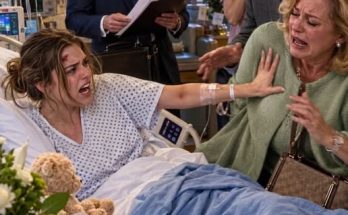
Rosalind fell in her kitchen on a Thursday.
Not a dramatic fall.
She caught her hip on a chair, lost balance, and landed hard enough to bruise her shoulder.
Her granddaughter found her.
At the hospital, nothing was broken.
The doctor recommended home physical therapy and someone checking in for a few days.
Rosalind hated all of it.
“I have been standing independently since 1948.”
“You were a baby in 1948.”
“Strong baby.”
I stayed with her that first night.
The next morning, I caught myself making a list.
Grab bars.
Meal delivery.
Medication organizer.
Maybe someone should stay longer.
Then I stopped.
The irony was almost embarrassing.
I had spent years insisting that help begins with asking.
Now Rosalind was vulnerable, and my brain immediately started designing her life.
“What do you want?” I asked.
She narrowed her eyes.
“That sounds like your lawyer.”
“Answer.”
“I want you to stop hovering.”
“Done.”
“I want physical therapy because I hate falling.”
“Reasonable.”
“I want Anne to check on me every evening for a week.”
“Good.”
“And I do not want anyone moving my coffee cups.”
I looked at the mug she kept on the highest shelf.
“Rosalind.”
“Do not begin.”
We compromised.
That word matters too.
She moved two everyday mugs lower.
Not all.
I learned something uncomfortable.
Control rarely arrives wearing a villain’s coat.
Sometimes it arrives with a casserole.
Sometimes it says, I’m only trying to help.
That does not make all help dangerous.
It makes consent necessary.
Curtis came by Rosalind’s house that weekend and fixed a loose stair rail.
She watched him closely.
“You’re improved.”
“Thank you?”
“That wasn’t praise. It was an observation.”
He laughed.
She pointed at the rail.
“Two more screws.”
“Yes, ma’am.”
Watching them, I saw how much my son had changed in small ways.
He no longer needed to be seen as good.
He simply did useful things.
That spring, he paid off the last credit card.
He sent me a photograph of the zero balance.
I called.
“What are you going to do now?”
“Try not to celebrate by spending money.”
“Excellent.”
“I’m serious.”
“So am I.”
He started saving.
First an emergency fund.
Then retirement.
He told me he had never understood how exposed he was until the debt crisis.
“You had me.”
“That was the problem.”
I was quiet.
He continued.
“I treated you like a backup plan without saying it.”
“Yes.”
“I don’t want to do that anymore.”
“Good.”
He did not move into a bigger apartment.
He did not replace the truck.
He learned to live without proving anything.
Meanwhile, my vision deteriorated further.
I could still see shapes, faces at close range, and large print.
Reading normal paper became almost impossible.
That frightened me less than before.
I had systems.
Audio bills.
Large-print bank statements.
A screen reader.
Rosalind still read sentimental mail with me when she could.
The irony of her doing that after her own fall made us laugh.
One Wednesday, she held up an envelope.
“From Bridget.”
“Read it.”
It was not to me.
It was a copy of a letter Bridget had sent to Curtis.
She had found several old financial records while cleaning out storage.
Among them were notes about the proposed house sale.
She wanted Curtis to have copies.
No excuse.
No revision.
At the end she wrote:
I used your mother’s age and eyesight as reasons to do things I wanted for myself. I know that now. Keep this in case she ever needs proof of what happened.
Rosalind lowered the page.
“Well.”
“Put it in the legal folder.”
“You sure you don’t want to frame it?”
“No.”
“Shame.”
The records did not create a new case.
Nothing had been signed or recorded.
But they closed one remaining question.
Bridget had not merely misunderstood.
She had knowingly tried to create a path toward control.
Her admission made that plain.
Oddly, knowing for certain made me less angry.
Doubt is noisy.
Facts can be quiet.
Later that year, Denise called me.
I had not spoken to her since the lock-change day.
She sounded uncomfortable.
“I owe you an apology.”
“For the phone call?”
“For believing Bridget’s version.”
“What did she tell you?”
“That you couldn’t manage money. That you were forgetting bills. That Curtis was overwhelmed. That Fairview was basically decided.”
“Did you ever ask me?”
“No.”
There it was again.
The family disease.
Talking around the person most affected.
“I’m sorry,” Denise said.
“I accept the apology.”
“Does that mean we’re okay?”
“No.”
She exhaled.
“Fair.”
That answer told me Bridget was not the only one learning.
We spoke occasionally after that.
Never close.
Civil.
Limited.
Sometimes that is enough.
Rosalind recovered from her fall.
Then, six months later, she had a stroke.
This time recovery was harder.
Her speech slowed.
Her right hand weakened.
Anne asked if I would visit during rehabilitation.
Of course I went.
Rosalind looked furious in the hospital bed.
“Don’t,” she said slowly.
“Don’t what?”
“Make… decisions.”
I laughed so suddenly I cried.
“I learned from the best.”
She pointed at me.
“Good.”
I sat beside her.
For the first time in our friendship, I read her mail aloud.
Twice.
Reading Rosalind’s mail after her stroke changed our friendship.
For decades, she had been the competent one.
The one with opinions.
The one who drove.
Now she sometimes lost a word halfway through a sentence and slapped the armrest in frustration.
I learned not to finish every word for her.
At first, I did.
Then she glared.
“Wait.”
So I waited.
Sometimes thirty seconds.
Sometimes longer.
The word usually came.
Watching her struggle taught me another form of respect.
Efficiency is not always kindness.
People who move slowly still deserve time to finish.
I thought about all the forms Bridget had rushed past me.
All the yellow arrows.
All the “just sign here.”
Speed had been part of the control.
So with Rosalind, I practiced slowness.
We played bridge again eventually.
Badly.
She held cards in one hand.
I used a magnifier.
We took forever.
It was one of the best games of my life.
Click here to continue reading: PART 11: Curtis Was Tested Again When I Was Hospitalized and Could No Longer Speak for Myself
The Locked Door, the Silver Chest, and the Folder Marked SALE in Bridget’s Car
Part 10 of 16