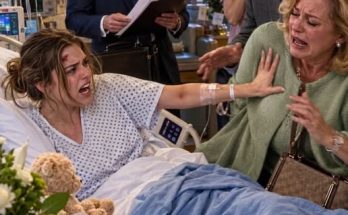
I had a small stroke at eighty-three.
Not the kind that changes a life in one instant.
The kind that changes it in increments.
I woke one morning with my right hand feeling strange.
Then my speech became thick.
I pressed the emergency button.
After that, memory comes in pieces.
Paramedics.
Bright lights.
A nurse asking my name.
Me knowing the answer and struggling to make my mouth cooperate.
At the hospital, Anne was called first because she remained my health-care proxy.
Curtis arrived twenty minutes later.
That sequence mattered.
Years earlier, it would have wounded him.
This time, he thanked Anne for coming.
I learned that later.
For the first several hours, I could understand much more than I could say.
That was terrifying.
People talked around me.
Not cruelly.
Efficiently.
A resident said, “She lives in senior housing.”
A nurse corrected him.
“Independent living.”
I wanted to hug her.
Curtis stood beside my bed.
A doctor asked, “Does she have cognitive impairment?”
Curtis answered immediately.
“No.”
Then he stopped.
He leaned toward me.
“Mom, do you want me to tell them about your baseline?”
I nodded.
He explained my vision loss.
My hearing.
My walker.
My normal memory.
He did not call me confused because I could not speak clearly.
That single choice repaired something I had not known was still broken.
The stroke was mild.
I received treatment quickly.
Speech improved over two days.
My hand remained weak for several weeks.
The discharge planner recommended temporary rehabilitation.
The word made my body go cold.
Rehabilitation.
Facility.
Bed.
Forms.
Old fear is fast.
I said no before she finished.
Anne sat beside me.
“No one is making you do anything.”
The therapist explained.
The recommended unit was short-term rehabilitation, not permanent placement.
I could choose home-based therapy instead, but the apartment staff could not provide the intensity of support I needed for the first week.
I looked at Curtis.
He said nothing.
“What do you think?”
He looked startled.
“You’re asking?”
“Yes.”
“I think rehab for a week might get you home faster.”
“Not Fairview.”
“No.”
“Not permanent.”
“No.”
“And if I hate it?”
“We talk to the team.”
Not we pull you out no matter what.
Not we leave you there.
We talk.
I agreed.
The rehab center was ordinary.
Good nurses.
Bad coffee.
A roommate who watched game shows too loudly.
I worked with physical therapy every morning.
Speech therapy in the afternoon.
Curtis visited but did not camp at my bedside.
Anne handled medical questions.
The staff spoke to me directly.
Once, a nurse turned to Curtis and asked what I wanted for dinner.
He pointed at me.
“Ask her.”
I could have kissed him.
After nine days, I went home.
My apartment needed a few changes.
A different shower chair.
A rail near the bed.
Voice controls for lights.
Curtis installed what he could.
Professionals handled the rest.
I approved every item.
That was the quiet victory.
Not that I never needed care.
That needing care did not erase me.
During recovery, Bridget sent flowers.
No card beyond her name.
I kept them.
That surprised me.
A week later, she called.
“I heard about the stroke.”
“I’m alive.”
“I heard that too.”
We spoke for ten minutes.
Then she said, “I thought about Fairview when I heard.”
“So did I.”
“I’m ashamed of that.”
“I’m not.”
She went quiet.
“Why?”
“Because I finally understand what I was afraid of.”
Not the building.
The loss of voice.
The possibility that weakness would become permission for other people.
Bridget said softly, “I’m sorry.”
This apology landed differently.
Not because it was better worded.
Because years had passed.
She had lived with the consequence.
So had I.
“I believe you,” I said.
She started crying.
I did not.
That was fine.
Forgiveness, when it came, was not a door opening.
It was a weight becoming lighter.
I did not invite her into my apartment.
I did not give her a key.
I did not put her back inside my intimate life.
But I no longer needed to imagine her as a danger every time her name appeared.
That was enough.
Curtis drove me to follow-up therapy for six weeks.
At the last appointment, my therapist asked what goal mattered most.
“Writing my name.”
She smiled.
“Your handwriting is functional.”
“I know.”
“Then why?”
I thought about yellow arrows.
Draft deeds.
Practice signatures.
The way Bridget had once assumed small print made my name available.
“Because it’s mine.”
So we practiced.
Slow loops.
E.
L.
E.
A.
N.
O.
R.
Doyle.
My hand shook.
The letters leaned.
They were mine.
At home, I signed a birthday card for Curtis.
Not electronically.
Not with a stamp.
My own hand.
He opened it at dinner.
His eyes stopped on the signature.
He understood.
He did not say anything.
He just touched the ink with one finger.
Then he folded the card carefully and put it in his pocket.
After my stroke, the facility staff asked whether I wanted Curtis added to their routine contact list.
I said yes.
Then I corrected myself.
“Secondary.”
The staff member nodded and wrote it that way.
Curtis was sitting beside me.
He did not react.
Later, I asked if it bothered him.
“A little.”
I appreciated the honesty.
“But Anne is first because you chose her.”
“Yes.”
“And she has been good at it.”
“Yes.”
“So I can be bothered and still respect it.”
That sentence would have been impossible for the old Curtis.
He used to believe discomfort meant something needed fixing.
Now he could carry it.
So could I.
Our relationship improved partly because neither of us demanded that the other make every feeling disappear.
That left room for truth.
Click here to continue reading: PART 12: Bridget’s Final Apology Did Not Restore the Old Relationship, but It Ended the Fight Over My Life
The Locked Door, the Silver Chest, and the Folder Marked SALE in Bridget’s Car
Part 11 of 16