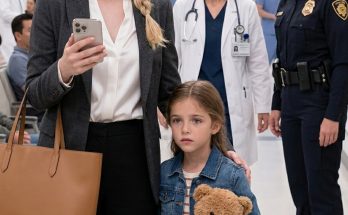
The next afternoon, Lily chose her purple sweatshirt.
She refused the pink one because it had a scratchy tag.
I cut the tag out and packed both sweatshirts anyway.
We drove to the pediatric specialty clinic in light rain.
Mom came with us.
She sat in the waiting room with a book while Lily and I met the nurse.
The clinic had a mural of sea creatures along one wall.
Lily counted the orange fish.
“Seven,” she said.
The nurse told her she was right.
Then she explained the appointment.
Lily could ask questions.
She could ask for breaks.
The team would explain what they were doing before any examination.
“We're here to help you feel better,” the nurse said.
Lily held Bunny closer.
“Will it hurt?”
“We'll do everything we can to keep you comfortable.”
The pediatric specialist, Dr. Anita Rao, began with ordinary questions about school, food, and sleep.
She spoke to Lily directly.
I was relieved to hear my daughter answer without looking at me for permission.
When the conversation turned to symptoms, Dr. Rao remained gentle and specific.
She asked about pain and bathroom habits.
She did not ask Lily to name a person responsible.
I knew by then that a separate trained interviewer might speak with her if investigators believed that was appropriate.
Medical care was not an interrogation.
Some test results were still pending.
Dr. Rao explained possible medical causes that needed attention, including irritation and infection.
She also discussed why the hospital had made a safety report.
“The concern comes from the whole picture,” she said afterward when Lily was drawing with a nurse.
“The symptoms, her distress, and what she has said. A physical finding alone cannot tell us who did what.”
I asked whether she thought Lily was lying.
Dr. Rao looked almost surprised.
“Your daughter is telling us that she hurts and that she's afraid.”
She paused.
“We take both seriously.”
I hadn't realized how much I needed to hear that.
The team reviewed a plan for managing Lily's symptoms and follow-up testing.
They gave me instructions about hygiene and medication, along with warning signs that would require urgent care.
Everything was written in plain language.
I folded the papers into my bag.
Then Dr. Rao asked to speak about safety.
I told her Lily was staying with my mother.
I told her Daniel had threatened legal consequences.
I told her that the detective and my attorney were aware.
“Good,” she said.
“Keep communicating through those channels.”
Lily returned with a drawing of a jellyfish.
She insisted the jellyfish was wearing shoes.
Dr. Rao admired the shoes.
We left without a shocking medical revelation.
I had expected certainty.
The clinic sent a follow-up message that evening.
It contained instructions about symptoms, medications, and how to reach the on-call team.
I read the instructions twice.
Then I moved them into a folder labeled Lily's Care.
There was a line for questions at the next appointment.
I wrote three.
What symptoms should prompt urgent evaluation?
What can we do to make bathing comfortable?
How should I respond if Lily is frightened by an ordinary routine?
I did not add a question demanding that the doctor name a perpetrator.
I knew by then that medical professionals could not answer that from a guess.
The following day, I took Lily to a small bookstore near Mom's apartment.
We needed notebooks and colored pencils.
Lily chose a notebook with silver stars.
I chose a plain blue one.
At the checkout counter, Lily asked the cashier whether the stars were real silver.
The cashier said probably not.
Lily considered that an outrageous marketing decision.
On the walk home, she stopped beside a puddle.
She examined her reflection for a long time.
“Do I look sick?” she asked.
“No.”
“Then why do I need doctors?”
“Because doctors can help when something hurts, even if other people can't see it.”
She nodded.
“That makes sense.”
She jumped over the puddle.
I followed more carefully because I was wearing shoes that leaked.
At home, Mom offered us warm socks.
Lily chose a mismatched pair.
One was green.
One was yellow.
She said they were a team.
I watched her run to the living room.
It was hard to reconcile that lively child with the frightened girl from the bath.
Dr. Rao had warned me not to expect emotions to move in a straight line.
A child might seem cheerful and still need support.
I wrote that in the silver-star notebook because Lily had insisted I borrow it.
Then I closed the cover.
I didn't need to study her every smile.
I needed to let her enjoy one.
Instead, we received a careful treatment plan and a reminder that uncertainty did not mean we should ignore danger.
Mom bought Lily a sandwich at the café downstairs.
We sat near a window overlooking the parking lot.
Lily peeled the crust from her bread.
“Do I have to see the doctor again?” she asked.
“Yes, probably.”
“Because I'm bad?”
I put down my coffee.
“No, sweetheart.”
She pushed a crumb around her plate.
“Did I make you cry?”
“No.”
I waited until she looked at me.
“Nothing about being sick or scared makes you bad.”
She considered that.
“Can I have a cookie?”
“Yes.”
Mom returned from the counter with one already wrapped in paper.
She knew Lily well.
That evening, detective Chen called with an update.
The hospital's report had been received.
A child advocacy center had been contacted about a possible forensic interview.
It would be scheduled when appropriate, not rushed into the middle of Lily's medical distress.
Mara asked whether Lily had volunteered any new information.
“Nothing about what happened,” I said.
“She's been asking about her toothbrush.”
Mara was quiet for a moment.
“Routine can matter a great deal.”
She said any interview would be handled by a trained specialist and generally recorded according to local protocol.
She asked me not to prepare Lily with suggested answers.
I agreed.
Afterward, I called Priya.
She had begun preparing a request for temporary parenting protections based on the available records and immediate concerns.
She explained the court would consider what could be supported at that stage.
A temporary order would not be a criminal verdict.
Daniel would have opportunities to respond.
“I don't want to lie to get what I need,” I said.
“You shouldn't,” Priya answered.
“The truthful facts are enough to explain why you are asking the court to look carefully.”
I opened my notebook and drew a line beneath the last entry.
The following morning, a message came from Daniel's sister, Megan.
Daniel says you've kidnapped Lily. Is she okay?
I knew Megan loved our daughter.
I also knew anything I wrote might be forwarded.
I typed a simple response.
Lily has received medical care and is safe with me. Please do not discuss this with her. Our attorneys are addressing next steps.
Megan read it immediately.
She didn't respond for several minutes.
Then she wrote only two words.
Thank you.
I stared at the screen.
It was the first response from Daniel's side of the family that hadn't asked me to make his life easier.
Click here to continue reading: PART 5: Daniel Appeared at My Mother’s Apartment Before the Court Had Spoken
The Night Lily Asked Me Not to Take Her Home with Her Father
Part 4 of 16