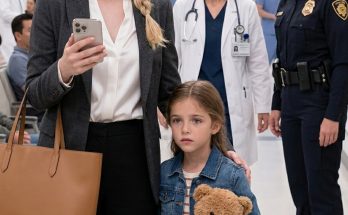
The child advocacy center looked more like a library than a government office.
There were stuffed animals in a basket.
A small table held crayons and puzzles.
The receptionist wore sneakers with bright green laces.
Lily noticed them immediately.
“Those are funny,” she said.
The receptionist smiled.
“I like funny shoes.”
I had spent the drive worrying that Lily would be frightened by the building.
Instead, she wanted to know whether the fish tank was real.
A family advocate named Jonah met me in a private room.
He explained the purpose of a child forensic interview and the limits of what he could tell me afterward.
The interviewer's job was to ask developmentally appropriate, non-leading questions.
The goal was to obtain Lily's account, if she had one, without coaching her.
I was not allowed to sit inside the interview room.
At first, that felt unbearable.
“She's only six,” I said.
“I know,” Jonah replied.
“We will explain the process to her and make sure she understands she can say she doesn't know.”
He didn't tell me what she would say.
He didn't tell me what he hoped she would say.
I realized that was the point.
Lily needed a chance to use her own words.
Before she went in, she climbed onto my lap.
“Are you leaving?”
“No. I'll be right here.”
“Can Bunny go?”
The interviewer checked and said Bunny could wait nearby.
Lily kissed the rabbit's nose.
Then she walked away holding the interviewer's hand.
The door closed.
I stared at the carpet.
Jonah offered water.
I took a cup and never drank it.
The minutes moved slowly.
I wanted to know everything.
I wanted to know nothing.
I wanted someone to tell me that Lily's pain came from a harmless cause and that her fear would pass by morning.
But I could not make those wishes into evidence.
After the interview, Lily came back carrying a sticker sheet.
She had chosen a blue whale.
“Can we get noodles?” she asked.
“Yes.”
She leaned against me.
“I told the lady I didn't know some things.”
“That's okay,” I said.
She seemed relieved.
I did not ask what else she had said.
Jonah later explained that the interview had produced information investigators needed to evaluate.
He could not provide me with a full account at that moment.
He emphasized ongoing support and said a prosecutor would decide whether available evidence met the threshold for charges.
Some investigations do not lead to prosecution.
The advocacy center gave me a packet about supporting children after distressing experiences.
It wasn't a script for uncovering secrets.
It was about ordinary care.
Predictable meals.
Adequate sleep.
Listening without leading.
Asking permission before unnecessary touch.
Knowing when to seek professional help.
I read it while Lily worked on a jigsaw puzzle.
Every few minutes, she called me over to inspect a piece.
She kept insisting that a blue piece belonged in the corner.
I suspected it belonged to the sky.
She refused my suggestion.
I let her try.
Eventually, she moved it herself.
“Don't say anything,” she warned.
I closed my mouth.
She grinned.
In a caregiver meeting, Jonah explained how stressful it can be when relatives demand details.
I thought of the messages gathering on my phone.
An aunt wanted to know whether Lily had been hurt.
A cousin wanted to know whether Daniel had been arrested.
The next Sunday, my mother discovered that Lily had rearranged every book on the living room shelf by color.
Cookbooks were mixed with gardening guides.
The dictionary sat beside a children's story about a rainbow.
Mom asked how she would find anything.
Lily said she should remember the color of the cover.
I promised to help put the reference books back later.
Mom shrugged and left the rainbow in place for a day.
I watched Lily explain her system with great seriousness.
She had spent weeks feeling that adults controlled every change in her life.
Here was a small decision she could make herself.
We let the shelf stay colorful until Monday.
Then we sorted it together so Mom could find her recipes again.
Someone I barely knew sent a long message about false accusations.
I stopped reading that one halfway through.
With Priya's help, I prepared a short response for people who needed one.
Lily is safe and receiving appropriate care. We are not discussing private details.
I didn't send it to everyone.
I used it when necessary.
Mom began screening calls during dinner.
Megan respected the boundary immediately.
A few relatives complained.
I let them complain without turning Lily into an explanation.
One afternoon, Lily asked why I kept my notebook in a drawer.
“It's for grown-up appointments,” I said.
“Like the dentist?”
“Something like that.”
She nodded and returned to coloring.
I felt grateful that she didn't have to understand every paper on the table.
The next morning, she completed the puzzle without my help.
She held the final blue piece above the board and studied it.
Then she pushed it into place.
“I knew it,” she said.
I smiled and let her have that victory.
There would be enough difficult truths ahead without arguing over a piece of cardboard sky.
That does not remove the need to address a child's medical and emotional safety.
I nodded, although I wanted him to say more.
The center connected us with a therapist trained to work with young children following frightening experiences.
Her name was Dr. Emily Sato.
She offered an intake appointment for the following week.
On the way home, Lily sang to herself while looking out the window.
She sang the same three lines of a song from school.
I let her repeat them.
That evening, I found her trying to brush Bunny's fur with my hairbrush.
She looked up guiltily.
“Am I in trouble?”
“No.”
She held up the rabbit.
“He has tangles.”
We worked on the imaginary tangles together.
When bedtime came, Lily asked for the hallway light to remain on.
I said yes.
She also asked whether I would be angry if she didn't want to call Daniel.
My chest tightened.
“Your feelings aren't something you get in trouble for,” I said.
“Will Daddy be mad?”
“I'll handle the adult decisions.”
She put her cheek against Bunny's head.
“Okay.”
The next day, Mara called.
She said the interview and other information were being reviewed.
There was no immediate charge decision.
She asked whether Daniel had contacted us directly again.
I gave her the messages and the account of his visit.
Mara said the family court process would continue independently.
She did not ask me to wait for a criminal result before protecting Lily.
Priya filed our motion with the supporting declaration.
The court would determine how to proceed and provide notice as required.
I signed the papers with shaking hands.
The declaration contained ordinary words.
Dates.
Phone calls.
Doctor's appointments.
Temporary residence.
It also contained the sentence I had struggled hardest to write.
I cannot presently ensure my daughter's safety if she is returned to unsupervised care with her father.
I read that sentence several times.
Then I signed below it.
Mom was making soup when I came out of the bedroom.
She handed me a spoon.
“Taste this.”
I tasted it.
“Needs salt.”
She nodded and reached for the jar.
Neither of us mentioned the papers.
For ten minutes, we were simply a mother and daughter cooking dinner.
That was a kind of mercy I hadn't expected.
Click here to continue reading: PART 7: The First Hearing Did Not Answer What Happened, but It Changed Our Days
The Night Lily Asked Me Not to Take Her Home with Her Father
Part 6 of 16