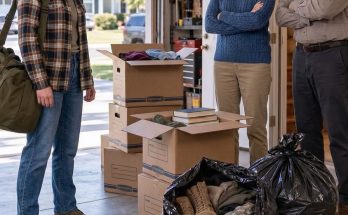
Walt sold his transport business two years before he got sick.
We told almost nobody.
The money from the sale was invested carefully, and we kept our little house.
We kept the same dependable sedan, too.
Every Wednesday, Walt still clipped coupons at the kitchen table.
“Why should we buy expensive coffee just because we can?” he would ask.
We had been married forty-six years.
I knew when he was teasing and when he was worried.
What worried him was our children.
Not because they were bad people.
Because money had started to mean different things to each of them.
Michael, our oldest, had built a comfortable life as an executive.
He had a five-bedroom house, a polished driveway, and an appointment for everything.
Stephanie married a man who managed commercial properties.
They had two children, expensive hobbies, and constant conversations about what things cost.
Danny, our youngest, struggled through high school.
He became a mechanic and worked sixty hours most weeks.
He and his wife, Kayla, lived above a laundromat with their two little boys.
They were tired almost all the time.
But whenever Walt needed help changing a tire or lifting a box, Danny showed up.
Walt noticed.
I noticed, too.
Still, I loved all three of them.
I had carried each child through a fever.
I had saved their drawings in the same kitchen drawer.
A mother doesn't stop remembering those things because her children become difficult adults.
One evening, Walt set down the newspaper and said something I never forgot.
“Money shows you exactly who people are, Dolores. Let's not find out until we have to.”
I laughed then.
“I already know who they are.”
He reached across the table and covered my hand.
“I hope you're right.”
When his illness came, it came slowly.
There were specialist visits, scans, medications, and stretches when he seemed better.
Then there were days he could barely eat.
Our savings and insurance made the expenses manageable.
But we didn't tell the children about the sale of the business.
Walt wanted to be visited because he was their father.
Not because he had an estate worth asking about.
Michael visited when his calendar allowed.
Stephanie visited when she could arrange childcare.
Danny came after work with grease under his nails and food wrapped in foil.
Sometimes he sat quietly while Walt slept.
He didn't need an audience for being there.
After Walt died, the house felt too large for one person, even though it had never been large at all.
His reading glasses stayed beside his chair.
His slippers waited under the bed.
I left both where they were.
At the funeral reception, Michael stood near the window answering messages.
Stephanie asked twice whether her father had left important paperwork.
Danny washed every plate in the hall kitchen.
A week later, I sat at our table with Walt's glasses in my palm.
I had an idea that now embarrasses me.
I wanted to learn which child would take me in if I truly needed help.
I convinced myself it was a necessary test.
I called each child separately.
I said the medical bills had taken everything.
I said the bank was taking the house.
I said I had nowhere to sleep.
It wasn't true.
I knew it wasn't true when I said it.
But grief had made me stubborn, and I kept going.
Michael answered on the fourth ring.
When I finished, he was silent.
“Mom, that's awful.”
I heard papers shifting on his desk.
“But this really isn't a good time. Jenna's mother comes in the spring, and the guest room is basically Jenna's home office now.”
“Michael, you have five bedrooms.”
“It's more complicated than it sounds.”
He offered to email senior apartment listings.
Three links arrived that afternoon.
There was no message asking whether I had eaten.
Stephanie cried when I explained the situation.
Then she asked how much money was left.
“Nothing,” I said.
The crying stopped.
“Have you looked into charity housing?”
“Not yet.”
“Some shelters are surprisingly nice now. The community-run ones.”
I waited for her to offer to visit.
Instead, she remembered the children's tennis practice.
“I'll call you back, Mom.”
She didn't.
Danny was last.
I barely reached the part about losing the house.
“Come tonight, Mom.”
“Danny, there isn't space.”
“You'll take our bed. Kayla and I'll take the couch. The boys will love having you.”
“I can't pay you a dime.”
He laughed.
“Mom. You raised me. I'm coming to get you.”
Forty minutes later, his old pickup pulled into my driveway.
He had come straight from the shop.
His work shirt smelled of motor oil and soap.
He lifted my suitcase without asking how heavy it was.
“Are you sure Kayla agrees?”
“She told me to bring the good pillows.”
I almost confessed the truth right there.
Instead, I locked my front door and climbed into the truck.
My lie felt heavier than the suitcase.
The apartment stairs were narrow.
Somebody downstairs was running a washer that shook the railing.
Kayla opened the door before we reached the landing.
She took my coat and kissed my cheek.
“We cleared the dresser's top drawer for you.”
The boys came racing from their room.
One was carrying a plastic dinosaur.
The other was wearing mismatched socks.
“Grandma! Are you staying forever?”
“No,” I said, crouching carefully. “Just for a while.”
Kayla's smile was gentle.
“You can stay as long as you need.”
They had changed the sheets on their bed.
A glass of water stood on the nightstand.
Danny had moved a lamp so I could read at night.
That first evening, I heard him arguing quietly with the couch springs.
There was a sharp metallic pop.
Then he whispered a word his boys were not supposed to know.
I covered my mouth to keep from laughing.
And then I cried.
Not because the room was uncomfortable.
Because it was the first place since Walt's death where I felt wanted.
The next morning, Kayla had coffee ready before leaving for her shift at the pharmacy.
Danny packed two lunches and hunted for a missing school shoe.
I found it behind the couch.
“Look at that,” he said. “You've already earned your keep.”
I told him I could watch the boys after school.
“Only if you want to,” he said.
I did.
Within a week, I knew which stair creaked and which washing machine downstairs shook our cups.
I made soup when the boys caught colds.
I folded tiny shirts while Kayla paid bills at the kitchen table.
One night, she closed her laptop and rubbed her eyes.
“Danny's hours were cut last winter. We're still catching up.”
I watched her put three envelopes into a neat stack.
“Does having me here make it harder?”
She looked genuinely surprised.
“You're family.”
“That doesn't pay the electricity.”
“No,” she said. “But we didn't invite you because you were an expense we could afford.”
I carried those words around for days.
During the first month, I nearly told them about the money at least six times.
Whenever I tried, Walt's voice came back to me.
Then a different thought followed.
Walt was gone.
I was the one choosing to keep lying.
I called our estate attorney, Margaret Ellis.
She had helped Walt organize his affairs long before he became ill.
The sale proceeds were in accounts held for my benefit, and the estate plan named me as the principal beneficiary of his remaining property.
The financial statements showed approximately $3.8 million available to me after the arrangements already in place.
The house was paid off.
There was no foreclosure.
Margaret listened as I described my calls.
“You can decide what to give your children,” she said.
“But don't confuse a painful experiment with complete knowledge of somebody's life.”
“I didn't ask them for money,” I said.
“You asked whether they could make room for you. That's a very large request, even when someone loves you.”
“Danny made room.”
“Yes. And now you owe him the truth.”
I left her office with those words sitting beside me like another passenger.
For three months, I lived in Danny and Kayla's apartment.
Danny slept on the broken couch.
Kayla sometimes woke with a stiff neck.
Neither complained.
Every Saturday morning, the boys crawled under my blanket with their cartoons.
One would take my left arm.
The other insisted on holding my right hand.
I had not expected to feel so happy in a room that wasn't mine.
Michael called twice.
Both calls were brief.
Stephanie called once to ask whether I still had Walt's vintage watch.
I told her it was safe.
She said it might be valuable.
I didn't argue.
As Thanksgiving approached, Kayla began planning a modest meal.
She measured cabinet space and counted chairs.
I asked whether she would mind inviting Michael and Stephanie and their families.
Her expression changed only a little.
“Of course. But we'll need another folding table.”
Danny carried one upstairs from a neighbor.
I called the others and said I had something of their father's to hand out.
Both accepted.
On Thanksgiving morning, I took Walt's old leather briefcase from my closet at home.
Inside were letters he had written while he was still well enough to hold a pen steadily.
There were also documents I had prepared with Margaret.
The envelope for Danny was thicker than the others.
That difference was deliberate.
By the time the turkey came out of the oven, I knew our family was about to have a very different conversation.
Click here to continue reading: PART 2: At Danny’s Thanksgiving Table, Three Letters Exposed Both My Children’s Choices and My Own Lie
The Three Calls I Made After Walt’s Funeral Led Me to My Youngest Son’s Door
Part 1 of 3