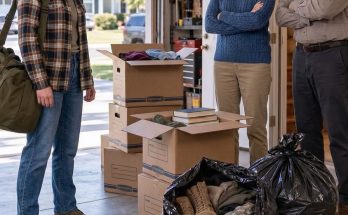
I moved back into my house the day after Thanksgiving.
Danny carried the suitcase upstairs for me one last time.
Kayla had packed my toiletries in a grocery bag.
The boys hugged me so tightly I had trouble standing.
“Are you coming Saturday?” the older one asked.
“If your mom and dad say yes.”
Danny nodded.
“Call first.”
It was a small boundary.
I understood why he needed it.
At home, I opened every curtain.
I changed the sheets and put fresh food in the refrigerator.
Then I sat at the kitchen table and wrote Kayla a letter.
Not a check.
A letter.
I described what I had done without excuses.
I thanked her for the room, the meals, and the ordinary kindness she had offered.
I wrote that I had no right to turn her generosity into evidence for a family contest.
I asked whether she would let me reimburse the household expenses from the three months.
I made it clear that repayment was not a condition for forgiveness.
When I delivered the letter, Danny read it with her.
They came to see me two evenings later.
Kayla wore her pharmacy uniform.
Danny still had a grease mark on his wrist.
“We talked,” Kayla said.
“We'll accept the extra groceries and utilities. But not some huge amount for putting you up.”
“Of course.”
I asked them to estimate the costs.
We reviewed receipts and agreed on a reasonable contribution.
I wrote the check and left it on the table.
Kayla didn't immediately take it.
“I want you to understand something,” she said.
“We were happy to help you. That's what made the lie hurt.”
“I understand better now.”
She nodded.
“Then don't do it again.”
“I won't.”
We ate soup in the same kitchen where Walt had once clipped coupons.
It was an awkward evening.
Still, nobody left early.
A week later, Danny called to ask whether I wanted him to repair the loose back step.
“Only if I pay you your shop rate,” I said.
He laughed.
“You'd have to book three weeks out.”
“Then put me on your schedule.”
He did.
Michael took longer to contact me.
He sent an email saying the Thanksgiving conversation had hurt him.
He also acknowledged that he had abandoned the discussion about my supposed housing problem too quickly.
He suggested lunch in a public place.
We met at a quiet diner halfway between our houses.
He arrived before me.
His phone remained face down on the table.
“I was angry because you lied,” he began.
“You had every reason.”
“I'm also ashamed of what I said to you.”
He stared into his coffee.
“I kept picturing you standing outside your house with a suitcase.”
I said nothing.
“I should have at least offered to drive over and help make a plan.”
“Yes,” I said.
He looked relieved that I hadn't softened the answer.
“But I should not have invented an emergency to force you to prove yourself,” I added.
We talked about his marriage.
He and Jenna had begun counseling.
They weren't sure where it would lead.
I didn't offer advice.
I asked whether the children were all right.
“They know we're working on things,” he said.
“That's all they need from me,” I answered.
Before we left, he asked if he could visit the house the following Sunday.
I said yes.
He arrived with groceries and helped clean out Walt's crowded garage.
We found a box of Michael's old school trophies.
He laughed when he saw his crooked spelling-bee certificate.
Then he sat on a paint can and cried.
I sat on another one.
We didn't try to turn that moment into a speech.
Stephanie called in December.
At first, she wanted to talk about the financial plans.
I told her I would discuss them after our relationship had room for something else.
She went quiet.
Then she asked whether she could come by with the children.
We made cookies that Sunday.
Her daughter spilled flour across the counter.
Stephanie started to scold her and stopped herself.
“It's all right,” she said, reaching for a cloth.
After the children went outside, Stephanie placed Walt's letter on the table.
“I was angry at him,” she said.
“Because he wrote about possessions?”
“Because he saw something in me I didn't want to admit.”
She touched the envelope.
“I really did think about your money first when you called.”
I didn't rescue her from the admission.
She continued.
“But I also felt that you were asking me to take on another responsibility when I was barely managing my own.”
“You could have told me that.”
“I know.”
“And I could have told you the truth.”
She nodded.
We spoke about the debt only as much as she wished.
She and her husband were making a budget and reducing their spending.
I offered to pay for a meeting with a qualified financial counselor.
She accepted that limited help.
I made it clear I wouldn't become an endless source of bailouts.
“I don't want that,” she said.
“I hope you mean it.”
“So do I.”
The conversation wasn't perfect.
But it was a start.
In January, I met Margaret Ellis to review my estate plan.
I brought detailed notes.
She listened while I described what had happened since Thanksgiving.
“Have you decided what you want your money to accomplish?” she asked.
“I want each child to have security,” I said.
“Not a prize for making the right choice in my little test.”
We discussed reasonable gifts, my own retirement needs, future medical costs, and money I wanted reserved for the grandchildren's education.
Margaret recommended reviewing the tax and estate implications with the appropriate advisers before making major transfers.
Nothing happened instantly.
There were documents to prepare and decisions to reconsider.
I took my time.
I eventually decided on substantial but manageable gifts for all three children.
I chose equal initial amounts.
Each adult child would be free to use the gift responsibly, but I would not police their affection in exchange for it.
I also made plans for educational savings for all my grandchildren under appropriate account arrangements.
The rest remained under my control, with long-term provisions to be reviewed as my circumstances changed.
Danny's cream-colored envelope still needed its own ending.
He had waited several days before opening Walt's letter in private.
When he finally told me about it, he asked whether I knew what it said.
“Only parts,” I admitted.
He brought the letter over and read one paragraph aloud.
Walt described the first day Danny came home after being told he might not graduate.
Danny had expected a lecture.
Instead, his father had asked whether fixing things made him happy.
Danny said yes.
Walt told him that useful work done carefully was nothing to be ashamed of.
In the envelope was also a small photograph.
It showed Danny at sixteen, leaning over a truck engine with Walt beside him.
On the back, Walt had written: “You always knew how to stay when something needed fixing.”
Danny pressed the photograph flat against the table.
“Dad thought I was doing all right,” he said.
“He knew you were.”
The thicker envelope also held a copy of a handwritten note Walt had made about a set of tools he wanted Danny to have.
They were still stored in our garage.
I had already confirmed that the tools could be passed on under the estate arrangements.
Danny came the following weekend with his pickup.
He unlatched each dusty case slowly.
He recognized the wrench with the taped handle.
“Dad taught me to adjust brakes with this.”
I remembered.
They had spent three hours on an old truck and come inside laughing.
Danny took the tools home.
He did not ask whether his envelope entitled him to more money.
By early spring, the family was changing in small ways.
Michael began calling on Sunday evenings.
Sometimes he missed a week.
When he did, he called the next.
Stephanie came by without asking about property or watches.
She even asked whether I wanted help sorting Walt's clothes.
I said not yet.
She accepted that answer.
Danny and Kayla moved to a slightly larger rental that summer.
They chose it because the boys needed more space and the stairs at the old building were becoming difficult.
They used part of their gift for the deposit and kept savings for emergencies.
Danny continued working at the repair shop.
He liked his job and had no interest in becoming a different man just because his mother had money.
Kayla remained at the pharmacy.
They bought a comfortable couch first.
Danny sent me a picture of it.
“Finally, no broken spring,” his message said.
I laughed until I cried.
That autumn, we gathered for dinner in my small house.
Nobody dressed for an occasion.
Michael brought salad.
Stephanie carried a pan of potatoes.
Danny arrived with Kayla and the boys, who ran straight toward the backyard.
We ate at the table Walt and I had used for decades.
His old watch lay beside my plate.
Stephanie noticed it.
“Still keeping Dad on time?” she asked.
“Trying to.”
She smiled and passed me the potatoes.
There was no grand apology that fixed everything.
Michael and Jenna were still working through their marriage.
Stephanie was still learning to make room for other people's needs when her own life felt crowded.
Danny sometimes reminded me that he wanted invitations, not surprise appearances.
Kayla was warm with me again, but she didn't pretend the deception had never happened.
I respected that.
I visited the boys regularly.
I brought books and baked treats instead of extravagant presents.
Sometimes I watched them so Danny and Kayla could have an evening alone.
I always asked first.
One afternoon, I found Walt's old reading glasses in the kitchen drawer.
For months, I had treated his warning about money as an instruction to test the people we loved.
Now I heard his words differently.
Money could expose fear, selfishness, and generosity.
It could also tempt someone who possessed it to believe they had the right to judge everyone else.
I had nearly made that mistake permanent.
I put the glasses beside his photograph.
Then my phone rang.
It was Danny.
“Mom, the boys want to know if you're coming for pancakes Saturday.”
“Would you like me there?”
“Of course.”
“Then I'll bring the syrup.”
“Don't buy the expensive kind,” he said.
“Your father would never forgive me.”
Danny laughed.
I stood looking out the window for a moment after we hung up.
The house was still mine.
The money was still there.
But I had stopped using either one to measure the love around me.
I picked up my keys and went shopping for Saturday breakfast.
THE END
The End
Read more original stories on Feel Every Story.
The Three Calls I Made After Walt’s Funeral Led Me to My Youngest Son’s Door
Part 3 of 3