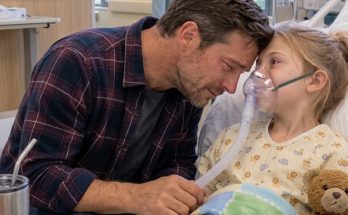
Grandpa Harold sat beside Emma's hospital bed for a long time.
She was sleeping under a light blanket.
Her breathing had become more comfortable, though she still needed careful monitoring.
He watched the equipment and then looked at me.
“Monroe, your mother told me she was home.”
“I know.”
“She said you were upset over a little wheezing.”
I didn't answer immediately.
I was too tired to summarize another argument.
Instead, I showed him the hospital admission paperwork and the message history on my phone.
He read the texts slowly.
He stopped at my mother's ultimatum.
Show up or stay out of our lives forever.
He read it again.
Then he placed the phone on the table.
“I am sorry,” he said.
“You didn't send it.”
“I believed what she told me.”
He looked toward Emma.
“Next time I'll ask you directly.”
Those words were enough.
I didn't need him to promise to fix everything.
I needed him to understand why I had stayed.
Dr. Williams entered to review Emma's progress.
Harold asked whether the doctor could explain her condition in plain language.
She described a severe asthma exacerbation that had required intensive treatment and respiratory support.
She explained that Emma was improving but still needed monitoring and a safe discharge plan.
The doctor did not speculate about family conflicts.
She did not offer opinions about who should attend a party.
She answered medical questions.
When she left, Harold's eyes were wet.
“Your mother said it was nothing.”
“I know.”
He asked whether he could bring food the following day.
I told him I'd appreciate that.
Then I asked him not to confront the family while Emma was still critically ill.
“I can't handle a war right now.”
He nodded.
“I'll speak with them when you're ready.”
That night, Emma opened her eyes and asked why Grandpa was there.
“He wanted to see you,” I said.
She smiled weakly.
“Did he bring the peppermints?”
Harold laughed through his tears.
“Not into intensive care, sweetheart.”
He promised to bring a small drawing pad when the nurses said it was appropriate.
The next morning, Mom tried calling from an unfamiliar number.
I let it go to voicemail.
Her message accused Harold of taking sides.
She said Stephanie had cried all night because family members were questioning the party.
Nothing in the message asked how Emma was breathing.
I saved it with the earlier messages.
Not because I planned revenge.
Because the accusations had already reached my custody situation.
Jessica had said she might ask a court to change our parenting arrangement.
I needed an accurate record of what had happened.
I spoke with a social worker at the hospital.
She helped me understand which records I could request and how to coordinate Emma's discharge care with both parents.
I also contacted my family-law attorney.
She advised me not to discuss the custody dispute through angry text messages.
She said decisions about custody would depend on evidence and the child's best interests, not on accusations made during an emergency.
That afternoon, Jessica returned.
She stood beside Emma's bed and watched her sleep.
For several minutes, she was quiet.
Then she asked Dr. Williams about the medications and follow-up plan.
The doctor explained what had been given and why.
Jessica listened.
When we were alone, she said she still worried that our custody schedule made asthma management harder.
“I want Emma safe,” she said.
“So do I.”
She looked at me.
“I shouldn't have started talking about court while she was struggling to breathe.”
“No, you shouldn't have.”
“I was scared.”
“I was scared too.”
We did not suddenly become friends.
We still disagreed about other parts of parenting.
But we agreed to share medication schedules, specialist notes, and emergency contacts.
We asked the hospital team to review a written asthma action plan with both of us.
Jessica promised to keep a copy at her home.
I did the same.
The following day, Harold called my mother.
He told me afterward that he had kept the conversation brief.
He had asked her why she'd described the hospital admission inaccurately.
She said she thought I was exaggerating.
Harold asked whether she had spoken to Emma's doctors.
She had not.
He asked whether she'd visited.
She had not.
Then he said he would not participate in excluding me for staying with my child.
Mom hung up.
Harold didn't call back.
On Thursday, Emma moved out of intensive care to a regular pediatric room.
I felt relief so sharply that I had to sit down.
It wasn't a promise that everything would be easy.
She was still tired.
She still needed treatment.
But she was making progress.
She asked if she could eat a sandwich.
I almost cried at the ordinary request.
I brought her a sandwich after checking with the nurse.
Harold arrived with a coloring book.
He sat beside her while she chose a purple marker.
She drew a small dog with enormous ears.
For the first time since the ambulance ride, the room felt less frightening.
Then Grandpa quietly asked me whether I wanted the family to know she had improved.
“Yes,” I said.
“But I want them to hear it from me when I'm ready.”
He understood.
Click here to continue reading: PART 3: Emma Came Home With an Asthma Plan, While I Rebuilt My Family Around the People Who Showed Up
My Daughter Was Fighting to Breathe While My Family Demanded a Celebration
Part 2 of 3