By the following autumn, the flowers had grown beside the porch.
They were small and stubborn.
Some bloomed later than the others.
I liked them for that.
Every morning I carried my coffee outside and looked at the garden Robert had started.
I added a little water when the soil was dry.
Sometimes I spoke to him as I worked.
Sometimes I didn't.
Silence had become comfortable again.
It no longer sounded like somebody waiting for the next argument.
The practical matters took longer than the emotional scenes in a story might suggest.
The cleaning bill was paid.
The damaged stool was replaced.
The front locks stayed changed.
Emily did not get another key.
At first, that had hurt her.
Later, she said it helped her recognize that our relationship could be close without requiring unlimited access.
David's agreement with Linda was finalized through their attorneys.
It included documented repayment terms and regular reporting.
He received the first payments after the investment property sale closed.
The lawyers had made clear that the civil agreement did not resolve every question about the older paperwork.
No one claimed the family had obtained a complete answer about every signature.
The unresolved issues remained matters for the appropriate professionals, not whispered accusations at gatherings.
David stopped chasing a perfect explanation for every decision Linda had made.
He wanted to understand what had happened and recover what could lawfully be recovered.
He also wanted to live his own life.
For several months, his contact with Linda was limited to scheduled calls and written messages.
She initially tried to use Emily as a messenger.
Emily declined.
Then Linda began respecting the arrangement.
She attended counseling on her own.
David did not ask me to judge whether she was sincere.
He watched what she did over time.
I admired him for that.
Peter and Caroline supplied the records they still had.
Caroline received a photograph from Rose's memorial.
Helen told me she cried when she saw it.
“She said she can finally stop worrying that Rose was forgotten,” Helen said over the telephone.
I placed the photograph beside one of Robert in his workshop.
Two people who had tried to keep a promise, each in a different way.
The biggest change in my own life was less dramatic.
I used to think of the house as something Robert and I had built together and would never change.
After he died, I kept the furniture in nearly the same arrangement.
I even left a stack of his gardening magazines beneath the armchair, though the dates on their covers grew older every year.
The reunion had disturbed those things without permission.
At first, I wanted every object returned to its original place.
I wanted the whole house to look exactly as it had before I went to Florida.
Then, slowly, I began to ask whether that was truly what I wanted.
Some of the changes were painful because strangers had made them.
Other changes might be good if I chose them myself.
I had always disliked the heavy curtains in the guest room.
Robert loved them because they blocked out the morning sun.
After he died, I never replaced them.
One afternoon, I took them down.
The room filled with light.
I stood by the window, surprised by how much brighter the garden looked.
I bought lighter curtains in a small shop across town.
The woman at the counter asked whether I was redecorating.
“A little,” I said.
It felt strange and pleasing to say it.
At home, I moved a bookshelf to the opposite wall and made space for my sketching table.
I had never given myself a room for art.
Now I did.
The first painting I finished was of Robert's crooked blue mug on the kitchen table.
It wasn't technically impressive.
The handle looked slightly too large.
The shadows were uneven.
But I liked it.
I framed it and hung it near the kitchen window.
When Emily saw it, she laughed.
“Dad would have teased you about that mug.”
“He would have said the original was more beautiful.”
“He would have been wrong.”
We smiled at each other.
I thought about giving her the painting.
Then I decided to keep it a little longer.
She didn't seem offended.
“Paint me one of the garden someday,” she said.
“I'd like that.”
Around the same time, I began volunteering twice a week at the library.
I helped sort donated books and organized a small shelf of large-print novels.
The librarian asked whether I'd consider reading aloud at the community center.
I said I would try.
My first session was awkward.
I read too quickly and lost my place twice.
One woman in the front row smiled and told me she enjoyed the story anyway.
I returned the next week.
It was good to be useful in a place where nobody expected me to abandon my own plans to prove I cared.
One afternoon, a woman asked what had brought me to volunteering.
I told her I was retired and wanted to spend more time with people.
That was true.
I didn't mention the reunion or Rose's urn.
My life had room for conversations that did not begin with a family problem.
I began making friends who knew me as Margaret from the book table, not as Emily's mother or David's mother-in-law.
We went for coffee after our shifts.
We discussed novels, recipes, and travel.
I felt a little foolish for enjoying it so much.
Then I remembered Helen's words.
The house didn't need me to wait beside it every day.
Neither did my family.
Emily and David were learning to manage their own responsibilities.
They planned their schedules without asking me to fix every problem.
If they needed help, they asked.
Sometimes I said yes.
Sometimes I said I already had plans.
They accepted both answers.
That was a new kind of comfort.
It made giving feel generous again, rather than compulsory.
In early winter, David brought a small box of photographs from Rose's family.
He had sorted them with Peter and made copies for relatives who wanted them.
Inside were pictures of Rose at different ages.
There was a young woman standing beside a bicycle.
There was a mother holding a baby in a garden.
There was an older woman at a dining table with flour on her hands.
I chose one to display beside Robert's photograph.
David said Rose would have liked that.
He told me he'd begun writing down stories about her so they wouldn't disappear.
I offered to help if he wanted to include memories from her visit with us.
He said he'd appreciate it.
It struck me that something good had come from the effort to understand her life.
Not the conflict.
Not the money.
But the decision to remember her as more than a name on legal papers.
I looked at the photographs long after David left.
Then I placed them back in their box and put the lid on gently.
I no longer felt responsible for keeping every object and every memory in exactly the right place.
I could preserve what mattered and still allow life to move forward.
Before turning off the living room lights that Christmas, I walked past the shelf where Rose's urn had once rested.
I did not feel the urge to fill the empty space with another object.
Some places could remain empty without feeling abandoned.
I straightened the small photograph of her beside the garden.
Then I looked across the room at Robert's chair.
The house held both memories now.
And, at last, it held room for my own future too.
I took one last look at the mantelpiece.
Everything was where I had chosen to put it.
I stopped waiting for other people's approval before making decisions about my home.
I painted the guest room a pale green.
I donated a broken lamp I'd kept because Robert once promised to repair it.
I kept his chair.
I kept the quilt.
I moved the photographs back where I liked them.
For the first time in years, I changed something without wondering whether Emily would think it was selfish.
She never did.
One Sunday, she brought a plant for the windowsill and asked where I wanted it.
That question warmed me more than an expensive gift would have.
“By the kitchen window,” I said.
She put it there.
No argument.
No joke about how she'd arrange the room differently.
Then we made lunch together.
We chopped vegetables and talked about her work.
She told me counseling had helped her understand why she became so anxious around Linda.
“I kept hoping that if I did one more thing, she'd finally say I was good enough,” she said.
“And now?”
“Now I think I'd rather be honest than approved of.”
I smiled.
“That's a difficult lesson.”
She looked at me.
“I learned part of it from you.”
I shook my head.
“I spent too many years avoiding uncomfortable conversations.”
“You still had the conversation when it mattered.”
We went back to chopping carrots.
The house smelled of onions and fresh bread.
That winter, I invited Emily and David for Christmas dinner.
It was an invitation, not an expectation.
They said yes.
David asked whether he could bring a pie.
I told him he could bring whatever he liked, as long as he didn't bring fifteen people without calling first.
He laughed.
We had a quiet evening.
Three people around a table set for three.
Robert's old stockings hung by the fireplace.
David asked about the family photographs and listened while I told stories about the man who had built the shelves.
Emily brought out a box of decorations she'd used as a child.
We found the little wooden star Robert had carved for her first Christmas.
One edge was chipped.
She held it as though it were made of glass.
“Can I hang this?” she asked.
“Of course.”
She placed it near the top of the tree.
Before leaving, David told me Linda had asked whether they could have coffee together in the new year.
He hadn't decided.
“I think I might say yes,” he admitted. “In a public place. For half an hour.”
“That sounds like a decision you've thought through.”
“I have.”
He looked toward Emily.
“And if I change my mind, that's okay too.”
She nodded.
I stood in the doorway as they walked to their car.
The porch light shone on the flowers, now resting beneath the winter soil.
I thought about the morning I'd returned from Florida.
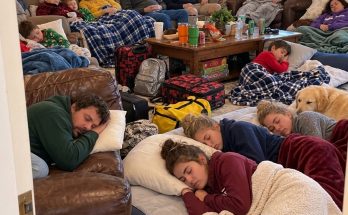
The mattresses.
The suitcases.
The empty refrigerator.
The photographs hidden in a drawer.
I remembered how small I had felt standing in my own hallway while other people told me not to make a fuss.
I had not fixed everything with a dramatic speech.
I had asked people to leave.
I had protected the documents.
I had sought help where I needed it.
I had told my daughter the truth even when it hurt both of us.
And I had allowed other adults to carry responsibility for their own choices.
Inside, the house was warm.
The quilt lay neatly over the sofa.
Robert's photograph stood on the mantelpiece, exactly where I wanted it.
I turned off the porch light and locked the door.
Not because I was afraid someone would come in.
Because the choice was mine.
THE END
The End
Read more original stories on Feel Every Story.
The Ashes on My Kitchen Table Made My Son-in-Law Forget His Carefully Prepared Story
Part 12 of 12