“Tell me what really happened to whom,” I said again.
David did not answer immediately.
Instead, he reached for the little urn.
Linda caught his wrist.
“Don't,” she whispered.
That single movement told me more than the entire conversation had.
I had imagined my homecoming in a hundred different ways during the flight from Florida.
I pictured making tea, opening the windows, and setting my sister's little gifts on the kitchen counter.
I thought I'd spend the afternoon watering the plants myself, even though Emily was supposed to have done it.
I certainly hadn't expected to meet a stranger wearing Robert's old slippers.
The man noticed me looking at his feet.
“Oh, I hope you don't mind,” he said. “They were by the back door.”
I did mind.
Those slippers had been a Christmas gift from Emily the year Robert started having trouble with his knees.
He'd worn them every morning to fetch the newspaper.
They were threadbare now, and I had never decided whether to keep them or let them go.
“Please take them off,” I said.
The man looked embarrassed and complied at once.
I wasn't angry at him for failing to know their history.
I was angry that someone who did know had made my belongings available without asking.
At the dining table, I found a little bowl of artificial flowers from the closet upstairs.
I remembered buying them after Robert's funeral because I couldn't bear keeping real flowers alive.
Someone had arranged them beside a stack of disposable plates.
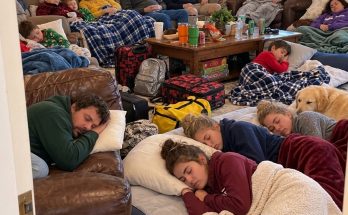
Around the table, the guests discussed breakfast plans.
One asked whether there was a waffle iron.
Another wanted to know if the television could be connected to a video game console.
I stood in my kitchen listening to people plan another day inside a house I hadn't agreed to share.
The absurdity nearly made me laugh.
Instead, I counted slowly to five and asked them to stop using the appliances until the situation was settled.
A young man muttered something about being treated like criminals.
Peter immediately told him to be quiet.
“Margaret has every right to be upset,” he said.
It was the first fair sentence I'd heard since walking through the front door.
I thanked him.
He introduced me to his wife, who apologized so sincerely that I believed her.
She said Linda had assured them I had offered my place for the reunion because I was away.
“That's what we were told,” she explained. “We brought our own towels because we didn't want to be a burden.”
I glanced at the towels draped over Robert's chair.
“Thank you,” I said. “But I was never asked.”
Her expression changed.
She turned toward Linda and asked why they hadn't simply rented a hall.
Linda looked offended.
“Because this is family,” she replied.
I had heard those words so often that they had begun to sound like a password.
Family meant helping when someone was ill.
Family meant visiting without needing an elaborate invitation.
In Linda's vocabulary, family seemed to mean taking whatever space was available and expecting the owner to smile.
The nine-year-old son of one visitor came down the stairs clutching a stuffed dinosaur.
His mother told him to pack his things.
He looked at me nervously.
“Are we in trouble?”
“No, sweetheart,” I said. “The grown-ups made a mistake about where everyone could stay.”
He nodded with the solemn expression children get when adults are arguing about something they don't understand.
I made sure nobody blamed him.
The last thing I wanted was to turn children into casualties of an argument they hadn't caused.
While people gathered their belongings, I checked the downstairs bathroom.
Wet towels were piled in the tub.
My toothbrush had been pushed behind a bottle of shampoo that wasn't mine.
The little ceramic dish Robert made at a pottery class had vanished from the sink.
I found it later under the bathroom cabinet.
One corner had chipped.
I sat on the closed toilet lid and held it for a moment.
After Robert died, objects had become unpredictable sources of grief.
I could walk past his favorite coat for months without feeling anything unusual.
Then a chipped dish could bring back the way he'd grinned when he gave it to me.
“Looks like a potato,” he'd said. “But it's a very romantic potato.”
I wrapped it in a clean towel and placed it where no one could touch it again.
When I returned to the hallway, the house smelled of burnt toast.
Someone had tried to use the old oven while searching for pans.
I turned it off.
I opened a window.
A woman began telling me that everybody was tired and it would be kinder to let them stay until morning.
“I understand you're tired,” I answered. “I just got off an early flight myself.”
She looked down at my suitcase, still standing beside the door.
For a moment, she seemed to see me as a person rather than an inconvenience.
“I didn't realize you'd only just arrived,” she said.
“That is part of the problem. Nobody checked.”
I moved my suitcase to the bedroom and locked the door behind me before returning downstairs.
I wasn't afraid any one of the guests would deliberately steal from me.
I simply had no idea what people had touched or taken.
Trust is hard to extend when nobody has bothered to ask whether they may enter.
In the kitchen, David finally looked at me without glancing toward his mother for approval.
“Margaret, I'm sorry about this,” he said.
“I'm listening.”
“I should have called you.”
“Yes.”
He nodded.
“Mom said Emily had cleared it with you.”
“Did you speak with Emily about that?”
“No.”
“Why not?”
He hesitated.
“Because it was easier to believe it was arranged.”
I looked at him for a long moment.
That answer was closer to the truth than anything Linda had offered.
It didn't make the decision harmless.
But it gave us somewhere to begin.
I asked him to help people carry their bags and leave the house tidy enough that I could examine what needed attention.
He started at once.
Linda watched with the outraged expression of someone who had expected loyalty to mean disobedience to everyone else.
I knew then that I would not get through this afternoon by persuading her.
I would get through it by making one clear decision after another.
I stayed calm.
I took the urn away from both of them and set it on a folded kitchen towel.
“It's mine to look after,” I said. “My sister entrusted it to me.”
David looked toward the living room, where a man in a football sweatshirt was folding an air mattress.
“Can we speak privately?”
“First, everyone needs to leave my house.”
Linda drew herself up.
“Margaret, you're making a scene over a few guests.”
“No. I'm asking fifteen people who never received my permission to gather their belongings and go.”
A younger woman near the doorway put down her coffee.
“I thought Emily invited us.”
“She did,” I said. “She didn't have the authority to.”
The woman looked genuinely embarrassed.
That made me feel better than Linda's performance of outrage.
At least one person understood the difference.
I asked everyone to bring their bags to the entryway and said I would give them time to arrange transportation.
Nobody needed to be thrown into the street.
But this was not becoming another day of brunch and board games.
Linda protested that people had traveled from three states.
I told her the hotel near the highway had vacancies when I drove past it an hour earlier.
If that had changed, she could call other hotels.
David made several calls.
A cousin volunteered to take two families to her place.
Someone else searched for rooms on a phone.
Within ten minutes, the air mattresses were losing air.
I walked into the living room and found Robert's old quilt bunched beneath a stranger's shoes.
I lifted it carefully and carried it upstairs.
On the landing, I stopped.
Someone had opened the door to Robert's study.
The room had been closed when I left for Florida.
Inside, two empty pizza boxes sat on his desk.
His reading lamp was unplugged.
The drawer where he kept our family albums had been pulled half open.
I stood in the doorway, trying not to let my imagination supply explanations.
Then I took photographs.
Not because I planned to make a lawsuit out of dirty dishes.
Because I was beginning to understand how many decisions had been made in my absence.
My sister, Helen, had warned me about the urn before my flight.
She had received it from a retired nurse named Caroline Price, who had recently moved into assisted living.
Caroline had once been a close friend of David's grandmother, Rose Mercer.
Rose had died seven years earlier.
According to Linda, her ashes had been scattered at the coast.
Yet here was a sealed urn bearing Rose's full name and the funeral home's identification number.
Helen had no reason to invent that.
She had also given me an envelope marked for David, but I'd packed it separately so it wouldn't be damaged.
I hadn't mentioned the envelope when I first confronted Linda.
I was starting to be grateful for that decision.
Downstairs, David asked whether I was okay.
“Your grandmother's name is on the bottom of the urn,” I told him.
He swallowed.
“That's why I recognized it.”
“Your mother said Rose's ashes were scattered.”
“They were supposed to be.”
Linda appeared behind him.
“Rose wanted privacy,” she said. “This is nothing to do with you.”
“Then why did you ask who else knew I had it?”
She crossed her arms.
“Because families deserve privacy about death.”
I had known Linda for nine years.
She could make a request sound like a rule and a lie sound like a favor.
But grief was not her property.
“David,” I asked, “did you ever see proof that your grandmother's wishes were carried out?”
He stared at his shoes.
“No.”
Linda's expression hardened.
“That's enough.”
“Actually,” he said, “it isn't.”
He looked up at me with the exhausted expression of someone who had been afraid to ask the same question for a long time.
“Grandma wrote to me before she died. Mom told me the letter was lost. She said the nurse who cared for her had confused things.”
“Caroline Price?” I asked.
He nodded.
I heard the front door open.
Emily had finally arrived.
She marched into the hallway with her coat still on and stopped when she saw the suitcases.
“Mom. What are you doing?”
“Taking my home back.”
Her face flushed.
“Everybody came for Linda's birthday. You're humiliating them.”
“Then they can celebrate her birthday somewhere she has permission to host.”
Emily looked past me toward the kitchen.
When she saw the urn, she went absolutely still.
“Where did you get that?”
I watched David turn toward her.
He looked just as surprised as I was.
“You know it too?” he asked.
Emily pressed her lips together.
The room filled with the soft hiss of someone deflating another mattress.
I had never felt more alone in my own house.
Then my daughter said, “Mom, we should have told you before you went away.”
“About the reunion?”
She shook her head.
“About what Linda asked us to find in Dad's study.”
Click here to continue reading: PART 2: My Daughter Admitted Why Fifteen Guests Had Been Allowed Near Her Father’s Locked Study
The Ashes on My Kitchen Table Made My Son-in-Law Forget His Carefully Prepared Story
Part 1 of 12