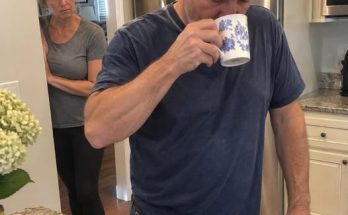
“What did you do?” Margaret repeated.
I looked past her at the empty street.
“I made his coffee.”
“That isn't what I asked.”
Her voice had become very controlled.
For the first time since I had known her, she looked frightened rather than angry.
“I put something in it,” I said.
“What something?”
“A laxative.”
Margaret stepped backward.
“You gave him medicine without telling him?”
I nodded.
She lowered her handbag onto the porch bench.
“Oh, Elaine.”
There was no triumph in her voice.
That made it worse.
“I thought he was meeting Chloe,” I said.
“Who is Chloe?”
“His secretary.”
Margaret closed her eyes for a moment.
“Come inside.”
“You just said he's in the hospital.”
“And neither of us should drive until we know where we're going.”
She took a folded paper from her bag.
It held the address of an emergency department across town.
I recognized the hospital.
Our neighbor had spent a week there the previous spring.
Margaret explained what she knew.
Brad had stopped at the pharmacy after leaving our house.
The clerk saw him gripping the counter and struggling to remain upright.
He complained of severe stomach cramps and dizziness.
An employee called emergency services.
Brad was alert when the ambulance arrived.
He told the paramedics he'd been unwell since breakfast.
Then he asked someone to call Margaret.
“Why didn't he call me?” I asked.
“Maybe because his phone was at home.”
I looked down at it.
Its screen was still showing Chloe's text.
Margaret reached for the pharmacy bag.
“May I?”
I handed it to her.
Inside was a sealed prescription package with my name and address.
It was a refill for the migraine medication I'd been using for years.
There was also a paper receipt and a small carton of crackers.
I remembered asking Brad to collect the prescription the previous week.
He'd said he would.
When he forgot, I ordered another pickup reminder and stopped bringing it up.
It was an ordinary errand.
Somehow, seeing it completed made me feel worse.
Margaret set the bag down.
“You can care about a person and still lie to them,” she said.
I wasn't sure whether she meant Brad or me.
At the hospital, the waiting room television was showing a cooking program.
A man in work boots slept across two chairs.
A little girl was asking her father for vending-machine pretzels.
The normality felt insulting.
At the reception desk, I identified myself as Brad's wife.
The nurse asked us to wait while she checked whether Brad could receive visitors.
I couldn't stop staring at the door beyond her station.
Margaret sat beside me but kept her coat on.
“I need to know exactly what you gave him,” she said.
I told her the name of the product and that I hadn't measured carefully.
She took a breath.
“You need to tell the medical staff.”
“I know.”
“Today, Elaine. Not when you feel ready.”
“I said I know.”
I went back to the desk and asked to speak privately with a nurse.
My voice trembled as I explained.
I gave the product name and the approximate amount.
I admitted that Brad hadn't known it was in his drink.
The nurse listened without making a face.
She asked when he'd consumed it and whether I had the bottle.
I told her it was at home.
She said she'd pass the information to his treating clinician and asked me to remain available for further questions.
No one congratulated me for confessing.
No one made me feel better.
They simply returned to helping him.
An hour passed.
Then a clinician met us in a small consultation room.
Brad had experienced significant gastrointestinal symptoms and dehydration.
They were giving him fluids and monitoring his condition.
Other factors could have contributed, so the team was evaluating him rather than attributing everything to one cause.
He was stable and awake.
I asked whether I could see him.
While Margaret was with Brad, I sat opposite a vending machine that accepted coins but refused paper bills.
A young man tried the same dollar three times, then gave up.
I watched him walk away with nothing.
A nurse passed and asked whether I needed water.
I told her no.
A minute later, I asked if she knew whether Brad was in pain.
She checked what information she was permitted to share.
“He's being assessed and monitored,” she said. “His team can answer more when they're available.”
I thanked her.
I thought of all the ways I'd assumed I understood people's intentions by watching from a distance.
The nurse wasn't hiding things to punish me.
She had boundaries around what she could tell me.
My husband wasn't withholding every explanation because he had no feelings for me.
Some of his secrecy had come from shame.
None of that excused the lies.
But I was beginning to understand how fear had shaped both of us into people who would rather guess than ask.
I found a notebook in my handbag.
It was the one I used to organize the children's reading program.
On a clean page, I wrote the facts in order.
Monday, shortly after eight: coffee.
Shortly afterward: Brad returned from the garage and used the bathroom.
By nine: I was at the library.
At approximately eleven: I found the house open.
The phone, the pharmacy bag, the message.
I wrote down the product name as accurately as I could remember it.
Then I stopped.
This was no longer a marital argument I could reshape by telling a more sympathetic version.
A medical team was treating him.
Other people needed accurate information.
I turned the notebook over so nobody walking past would read it.
When Margaret returned, she asked whether I'd eaten.
“No.”
“There's a sandwich counter.”
“I'm not hungry.”
“You still need food.”
The sentence sounded like the kind of thing I'd wanted her to say when I was sick two winters earlier.
Instead, that winter, she'd complained that Brad was missing work to take care of me.
I looked at her now.
“Why did you come to our house?”
“Brad asked me to find his phone and bring it.”
“Before you knew he was going to the hospital?”
“After the pharmacy called. I got confused about where he was taken.”
She glanced at the notebook.
“I wanted to be useful.”
“So did I,” I said.
It sounded absurd as soon as I heard it.
Margaret didn't ask what I meant.
We sat together in an uncomfortable silence.
For once, neither of us tried to make it easier by changing the subject.
The clinician said Brad had requested to speak to his mother first.
That hurt, though I had no right to complain.
Margaret stood and followed the nurse.
I remained with my hands folded so tightly my fingers ached.
I thought about the coffee mug.
I thought about Brad's forehead kiss.
Most of all, I thought about how easy it had been to turn someone else's body into a place where I planned to stage my anger.
My phone vibrated.
Ruth was asking whether I had made it home safely.
I typed a short reply.
“Family emergency. I will explain when I can.”
Then I stared at the message without sending it.
I had spent months hiding my suspicion from everyone.
Now I was preparing to hide the worst thing I had done.
I sent the message anyway.
Margaret returned twenty minutes later.
Her eyes were red.
“He's asking for you.”
Brad looked pale against the hospital pillow.
A clear tube ran from his arm to an IV bag.
His blue shirt was folded inside a plastic patient-belongings sack.
The tie Chloe had chosen lay on top.
For a moment I remembered him laughing in that same shirt at my sister's graduation.
It was a painful, useless memory.
“You came,” he said.
“Of course.”
He watched my face.
“Mom says you spoke to the nurse.”
“Yes.”
His gaze sharpened.
“About the coffee?”
I didn't move.
“You knew?”
“Not until they asked me what I ate and drank.”
He swallowed.
“Elaine, why?”
I wanted to tell him about Chloe.
I wanted to throw his messages onto the hospital bed.
On the way home, I stopped at a traffic light beside a flower shop.
A couple was choosing a potted plant together.
They disagreed about the color, laughed, and finally bought both.
I wanted to turn away.
I had been treating ordinary tenderness as something other people received without effort.
Now I understood how much work my own marriage would require, if it survived at all.
I drove carefully and kept both hands on the wheel.
There were phone calls to make, records to preserve, and difficult answers ahead.
No amount of panic would let me skip them.
Instead I said the thing he deserved to hear before anything else.
“I put medicine in your coffee without telling you. I wanted to hurt and embarrass you. I'm sorry.”
He looked away.
The silence lasted so long that I could hear someone wheeling a cart outside.
“You could have told me you hated me,” he said.
“I don't hate you.”
“That doesn't make this safe.”
“I know.”
He rubbed his forehead.
“I don't want you here right now.”
My throat tightened.
“All right.”
As I turned to leave, he spoke again.
“Chloe called my mother. She knows about the hospital.”
I stopped.
“I saw her message.”
He shut his eyes.
“Then you know I have something to tell you.”
“I know you have a lot to tell me.”
He nodded once.
“Not here.”
I went into the corridor.
Margaret waited beside the vending machines.
“He needs rest,” she said.
“So do I.”
She watched me put on my coat.
“I've never liked the way you confront him,” she said.
I laughed once, without humor.
“You've never liked the way I do anything.”
Margaret looked down.
“Maybe that's true.”
I wasn't prepared for the admission.
Then she said something that stopped me again.
“Brad isn't going to that hotel to spend a romantic morning with Chloe.”
“How would you know?”
“Because I was supposed to meet him there.”
I stared at her.
“Why?”
Margaret clasped the handles of her handbag.
“Because he's been trying to solve a problem I created.”
Click here to continue reading: PART 3: The Hotel Meeting Was Real, but Its Purpose Was Not What I Had Imagined
The Morning I Tried to Punish My Husband Ended With His Phone on Our Floor
Part 2 of 12